
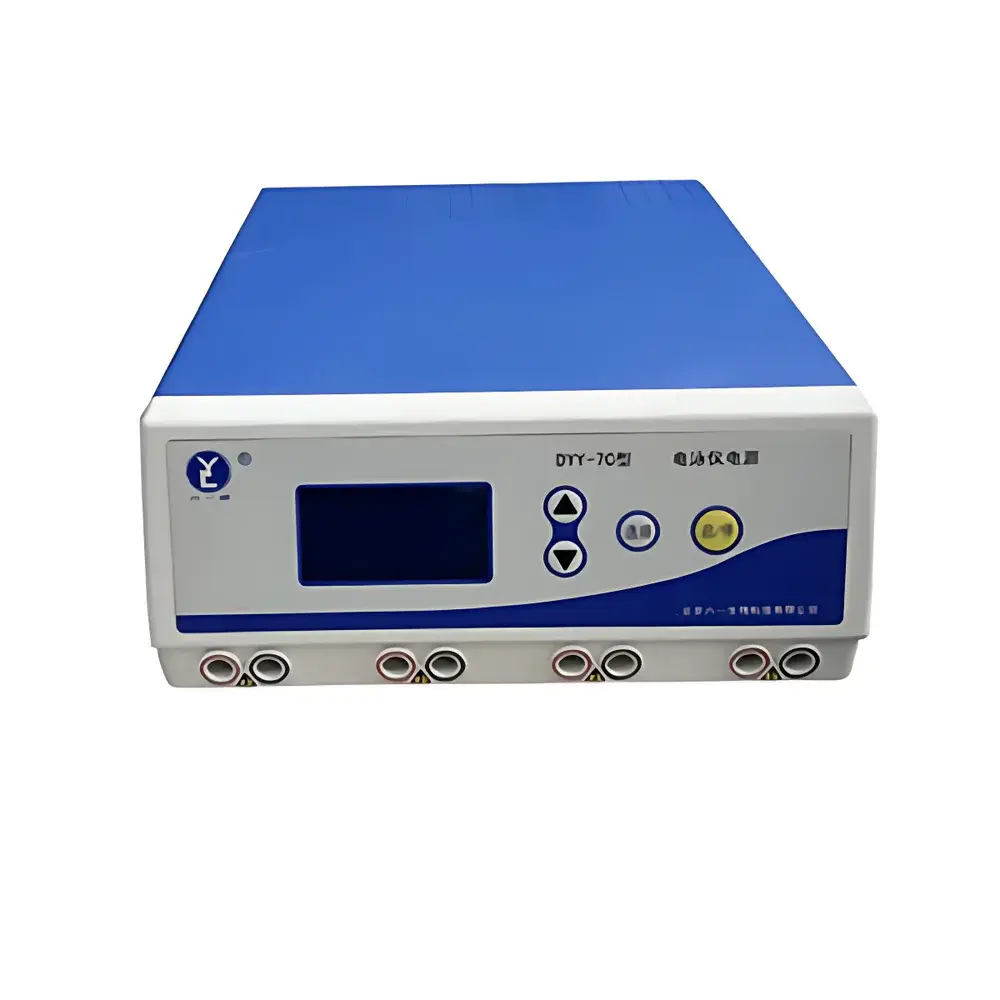
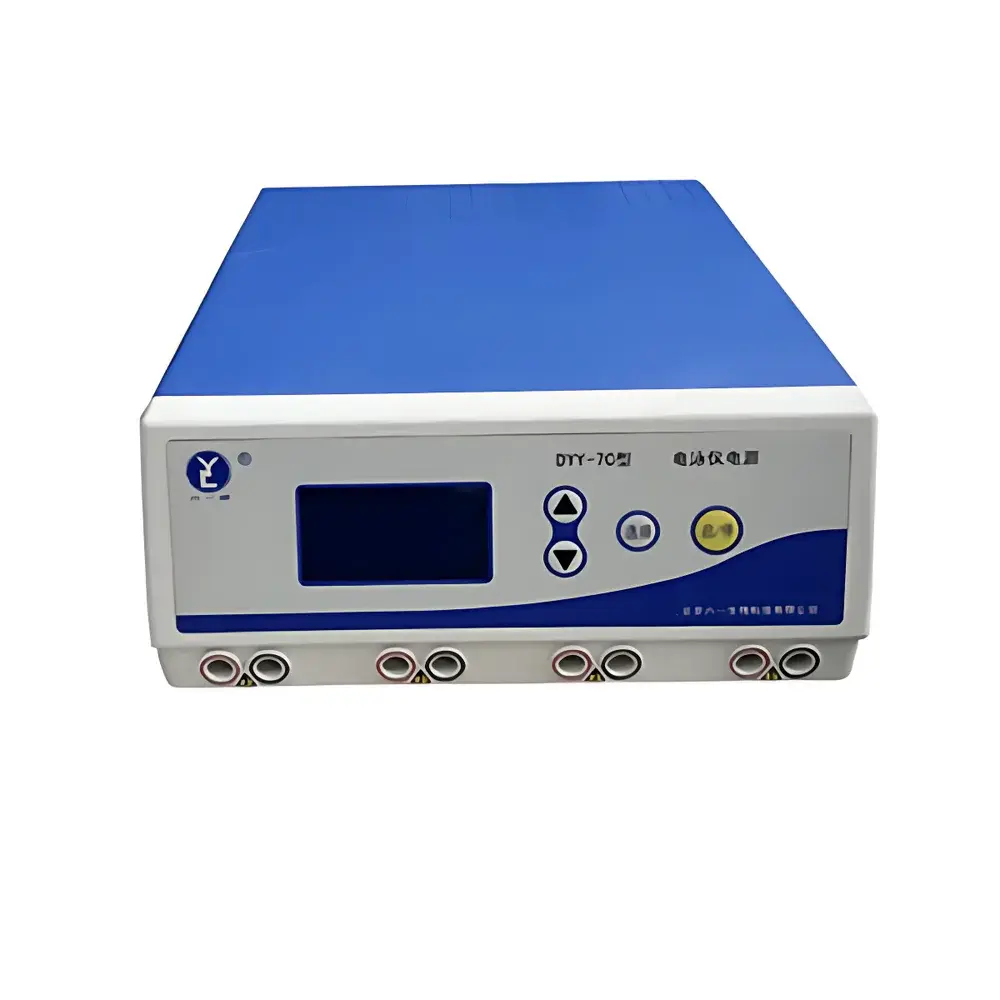
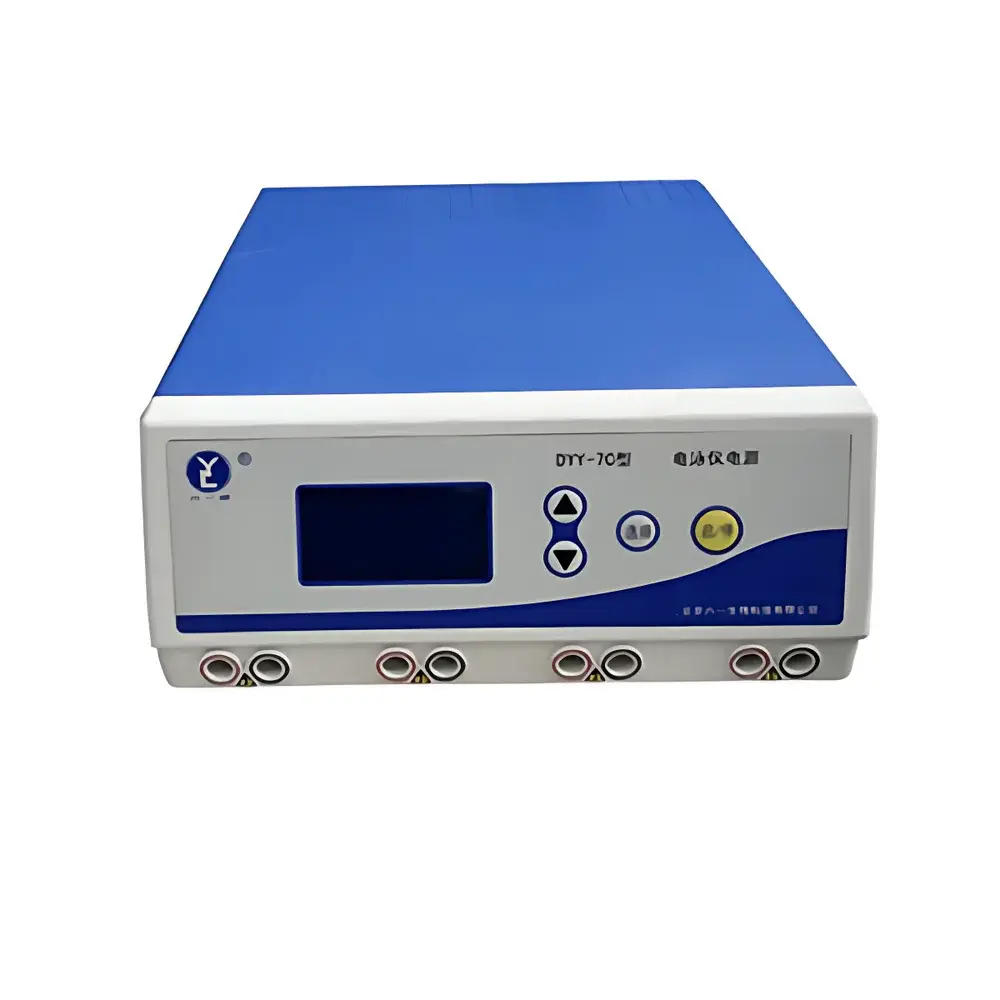
LY DYY-7C Transfer Electrophoresis Power Supply Model 112-0730
| Brand | LY (Beijing Liuyi) |
|---|---|
| Origin | Beijing, China |
| Model No. | 112-0730 |
| Output Voltage Range | 2–300 V (1 V resolution) |
| Output Current Range | 5–2000 mA (2 mA resolution) |
| Max. Power Output | 300 W |
| Dimensions (W × D × H) | 315 × 290 × 128 mm |
| Weight | 5 kg |
| Output Channels | 4 independent parallel outputs |
| Protection Features | Over-voltage, over-current, over-load, and load-mismatch detection |
| Control System | Microprocessor-based with real-time parameter adjustment |
| Display | LCD showing simultaneous voltage, current, and timer values |
| Memory Function | Parameter storage for repeat protocols |
| Power Architecture | High-efficiency switching-mode power supply |
Overview
The LY DYY-7C Transfer Electrophoresis Power Supply (Model 112-0730) is a precision-engineered DC power source specifically designed for semi-dry and wet electroblotting applications in molecular biology laboratories. It operates on the principle of controlled electrophoretic migration—applying a stable, adjustable electric field across a gel-membrane sandwich to drive negatively charged proteins or nucleic acids from polyacrylamide or agarose gels onto solid-phase supports such as nitrocellulose (NC) or polyvinylidene difluoride (PVDF) membranes. This instrument meets the fundamental electrical requirements of standardized transfer protocols including those defined in Western blotting (for immunodetection of proteins), Southern blotting (for DNA hybridization), and Northern blotting (for RNA analysis). Its robust switching-mode power architecture ensures low ripple, high line regulation (<0.1%), and thermal stability under extended operation—critical for reproducible transfer efficiency across replicate experiments.
Key Features
- Four independently configurable output channels enable concurrent operation of multiple transfer units or multi-gel setups—supporting high-throughput laboratory workflows without cross-channel interference.
- Microprocessor-controlled regulation allows real-time fine-tuning of voltage (2–300 V, 1 V step) and current (5–2000 mA, 2 mA step) during active transfer, facilitating optimization for diverse gel thicknesses, membrane types, and buffer systems.
- LCD interface displays voltage, current, and countdown timer simultaneously—enabling continuous monitoring without interrupting the run; user-defined time ranges extend from 1 minute to 99 hours 59 minutes.
- Integrated memory function retains up to 10 pre-programmed protocols—including voltage/current/time combinations—reducing setup time and minimizing operator-induced variability between runs.
- Comprehensive protection circuitry includes automatic shutdown upon detection of over-voltage, over-current, over-load, or abrupt load impedance change—preserving both sample integrity and internal component longevity.
- Switching-mode power design delivers high energy conversion efficiency (>85%) and minimal heat generation, eliminating need for forced-air cooling while maintaining stable output under ambient temperatures up to 40 °C.
Sample Compatibility & Compliance
The DYY-7C is compatible with standard electrophoretic transfer configurations: mini and midi slab gels (up to 20 × 20 cm), capillary transfer systems, and commercially available semi-dry blotting modules. It supports common transfer buffers—including Tris-Glycine-Methanol, CAPS, and Bicine-based formulations—and accommodates both constant-voltage and constant-current transfer modes per experimental requirement. While not certified to IEC 61010-1 or UL 61010B as a standalone medical device, its electrical safety architecture complies with general-purpose laboratory equipment guidelines under GB 4793.1–2007 (Chinese national standard equivalent to IEC 61010-1). For GLP/GMP-regulated environments, the unit supports audit-ready documentation via manual log recording of parameters; optional external data logging interfaces may be integrated using RS-232 or TTL-level serial output (available upon request).
Software & Data Management
The DYY-7C operates as a stand-alone hardware platform with no proprietary software dependency. All operational parameters are set and monitored locally via front-panel controls and LCD display. For laboratories requiring electronic recordkeeping, the device’s real-time parameter visibility enables synchronized manual entry into ELN systems (e.g., LabArchives, Benchling) or LIMS platforms. The memory protocol function supports consistent method execution across shifts and users—reducing deviation risk in routine QC/QA transfer procedures. Though lacking native FDA 21 CFR Part 11-compliant electronic signatures, its deterministic behavior, non-volatile protocol storage, and absence of network connectivity render it suitable for environments where procedural traceability is maintained through SOP-driven operator logs.
Applications
- Western blotting: Optimized transfer of SDS-PAGE-resolved proteins (10–250 kDa) onto NC or PVDF membranes for subsequent antibody probing and chemiluminescent detection.
- Southern/Northern blotting: Efficient DNA/RNA transfer from agarose gels under high-salt or alkaline conditions, preserving nucleic acid integrity for hybridization assays.
- Quantitative transfer validation: Paired use with prestained molecular weight markers enables visual assessment of transfer completeness and edge-to-edge uniformity—critical for densitometric analysis.
- Method development labs: Flexible voltage/current/timing control supports empirical optimization of transfer kinetics for novel membrane chemistries or low-abundance targets.
- Educational settings: Intuitive interface and built-in safety features make it appropriate for undergraduate and graduate teaching laboratories conducting foundational molecular techniques.
FAQ
What is the maximum simultaneous load capacity across all four outputs?
The unit delivers up to 300 W total output power; individual channel loading must be coordinated to remain within this aggregate limit—e.g., two channels at 150 mA/200 V (30 W each) and two at 500 mA/100 V (50 W each) sum to 260 W.
Does the DYY-7C support gradient or ramped voltage protocols?
No—it maintains fixed voltage or current setpoints throughout the programmed duration; dynamic ramping requires external programmable controllers or manual intervention.
Can it be used for native PAGE transfer?
Yes, provided voltage and current settings are adjusted to avoid denaturation—typically lower field strengths (e.g., 15–25 V) and extended times (overnight at 4 °C) are recommended for native protein complexes.
Is calibration traceable to national standards?
Factory calibration is performed against internal references traceable to CNAS-accredited metrology labs; users should perform periodic verification using calibrated multimeters per ISO/IEC 17025-aligned internal procedures.
What maintenance is required to sustain long-term accuracy?
Annual visual inspection of ventilation grilles and fanless heatsink surfaces for dust accumulation; biannual verification of output accuracy using certified digital multimeters; no user-serviceable components exist inside the sealed chassis.



