
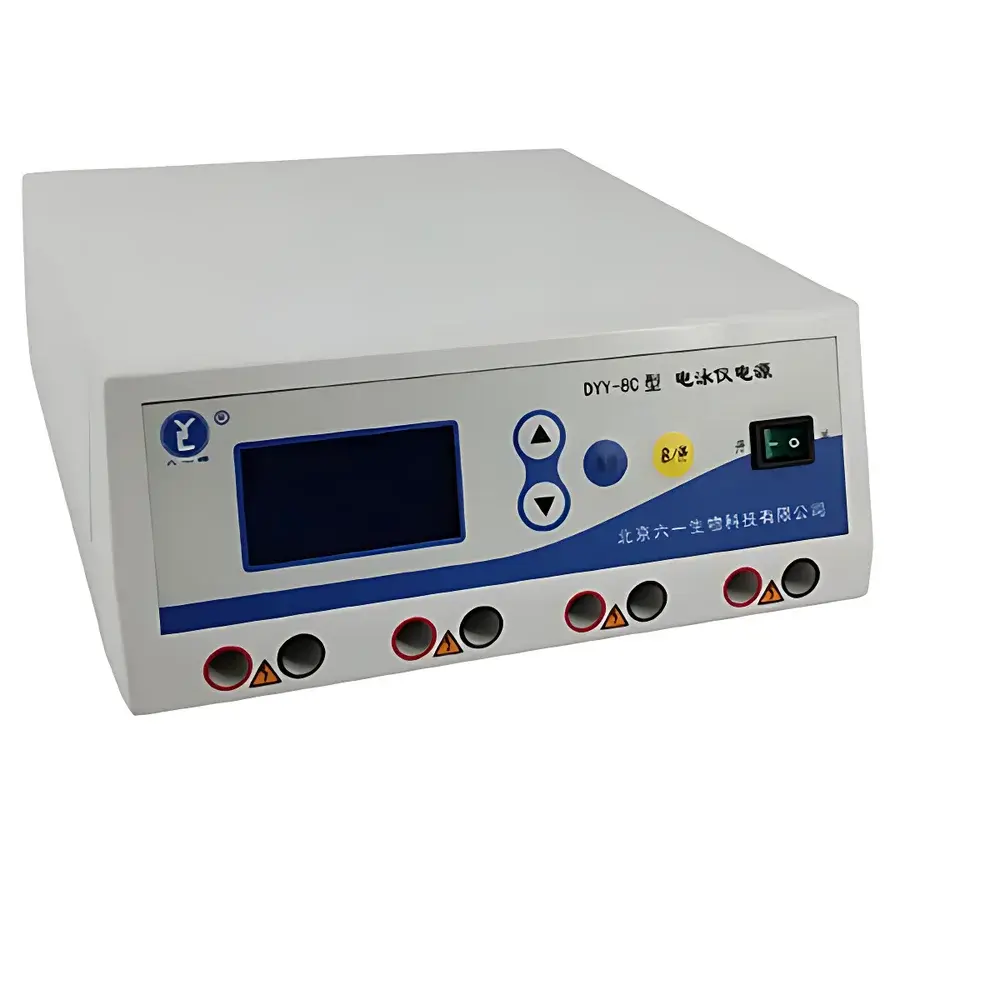
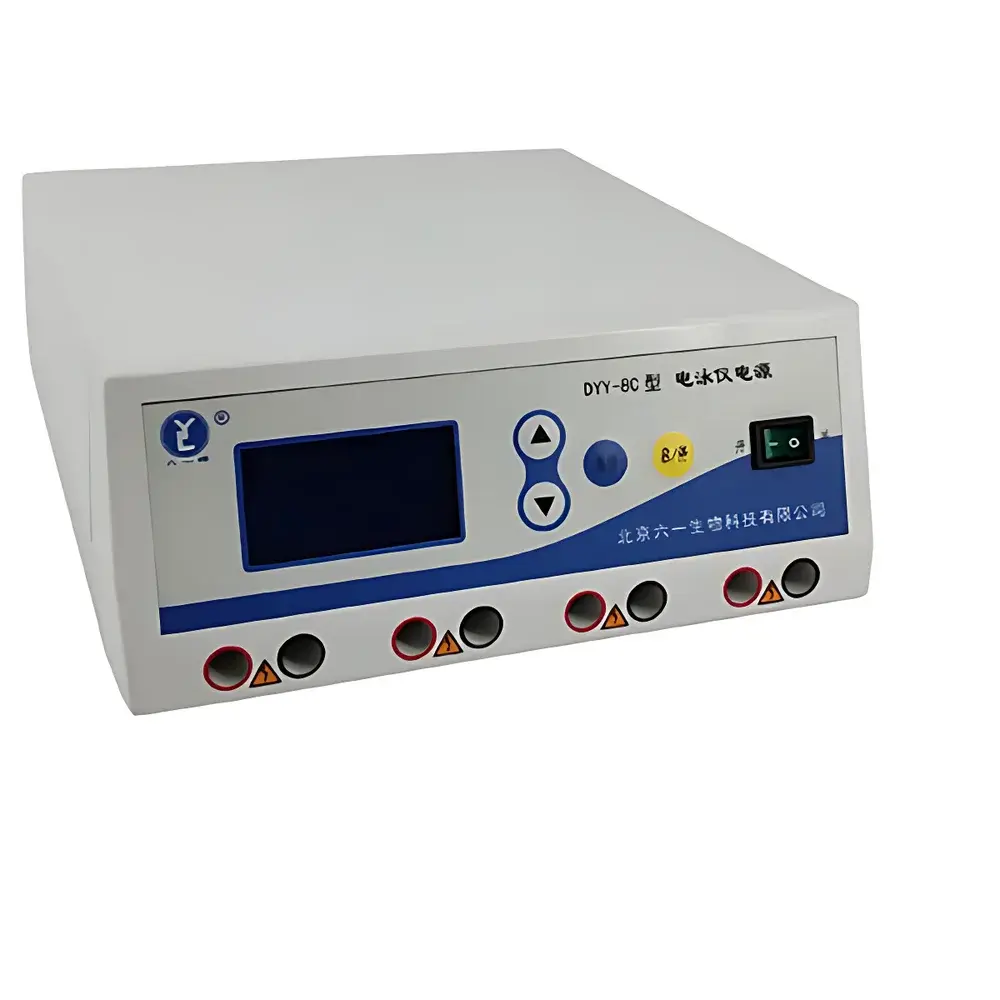
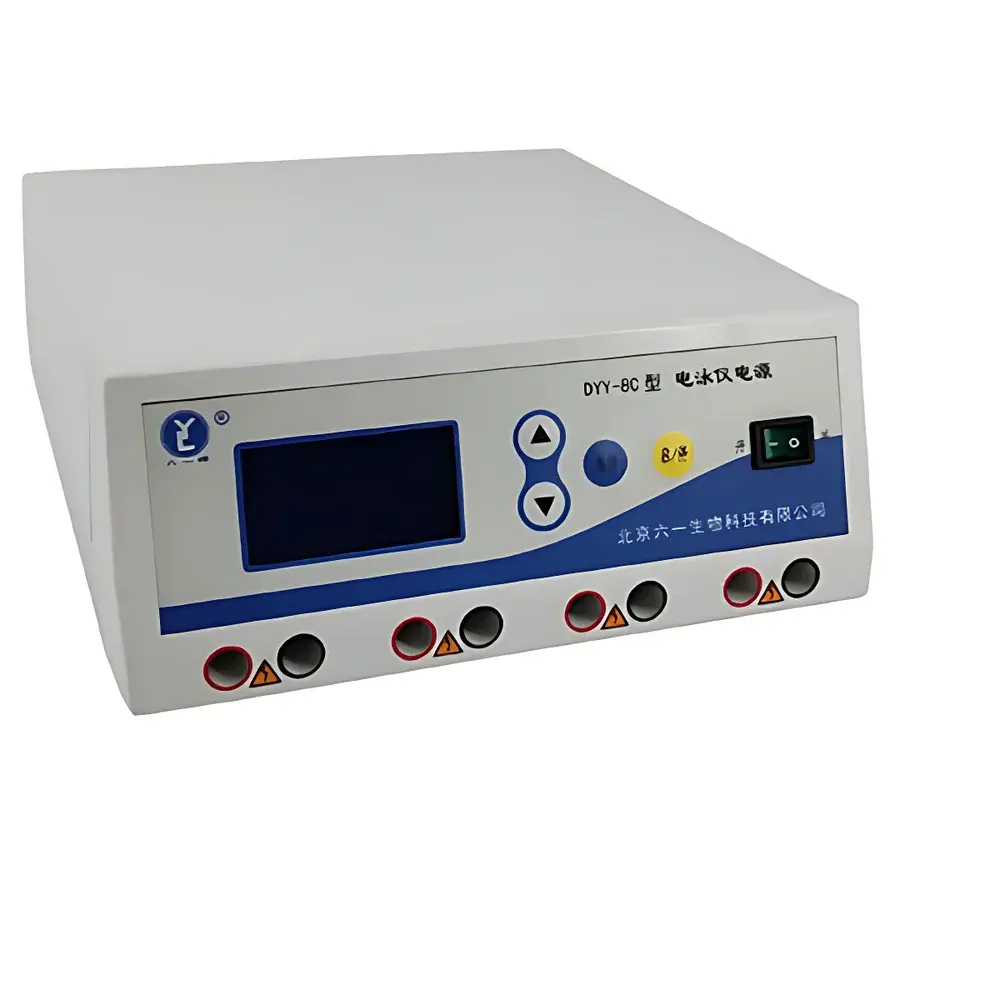
LY DYY-8C Dual-Mode Constant Voltage/Constant Current Electrophoresis Power Supply
| Brand | LY (Beijing Liuyi) |
|---|---|
| Origin | Beijing, China |
| Model | DYY-8C |
| Output Modes | Constant Voltage & Constant Current |
| Voltage Range | 5–600 V (1 V resolution) |
| Current Range | 2–200 mA (1 mA resolution) |
| Max Power | 120 W |
| Output Channels | 4 parallel DC outputs |
| Dimensions (W×D×H) | 235 × 295 × 95 mm |
| Weight | 2.5 kg |
| Display | LCD showing real-time voltage, current, and timer |
| Protection Features | Over-voltage, over-current, over-load, load variation, and no-load detection |
| Control System | Microprocessor-based with memory recall function |
| Cooling | Integrated forced-air cooling system |
| Compliance | Designed for laboratory electrophoresis applications per standard molecular biology protocols (e.g., SDS-PAGE, agarose gel electrophoresis) |
Overview
The LY DYY-8C Dual-Mode Constant Voltage/Constant Current Electrophoresis Power Supply is an engineered power source specifically designed for precision-controlled electrophoretic separation of biomolecules in academic, clinical, and industrial laboratories. Operating on the fundamental principle of controlled direct current (DC) delivery, the DYY-8C supports both constant voltage (CV) and constant current (CC) modes—enabling optimal performance across diverse electrophoretic techniques including sodium dodecyl sulfate–polyacrylamide gel electrophoresis (SDS-PAGE), native PAGE, isoelectric focusing (IEF), and nucleic acid separation in agarose or polyacrylamide matrices. Its dual-mode architecture ensures consistent electric field strength or charge transfer rate regardless of gel resistance drift during run progression—a critical requirement for reproducible band resolution, migration linearity, and quantitative densitometry. The unit integrates a high-efficiency switched-mode power supply (SMPS) topology, minimizing thermal drift and enabling stable output under variable load conditions typical of multi-gel or long-duration runs.
Key Features
- Dual operational modes: Independent selection of constant voltage (5–600 V, 1 V resolution) or constant current (2–200 mA, 1 mA resolution) via intuitive front-panel controls
- Four isolated DC output channels supporting simultaneous operation of multiple electrophoresis units or large-format gel systems
- Real-time LCD display concurrently monitoring voltage, current, and countdown timer—enabling precise endpoint control without external instrumentation
- Microprocessor-based digital regulation with non-volatile memory for storing up to 10 user-defined protocols, facilitating rapid method recall and inter-operator consistency
- Comprehensive safety architecture: automatic shutdown triggered by over-voltage, over-current, over-load, sudden load variation, or open-circuit (no-load) conditions
- Thermally optimized design featuring intelligent fan control and aluminum heatsink integration, maintaining ambient operating temperature below 40 °C even at full 120 W output
- Front-panel fine-tuning capability allows real-time parameter adjustment during active electrophoresis—essential for optimizing separation in gradient gels or temperature-sensitive samples
Sample Compatibility & Compliance
The DYY-8C is validated for use with standard horizontal and vertical electrophoresis apparatuses compatible with common commercial gel casting systems (e.g., mini-PROTEAN®, Hoefer SE260, and equivalent). It meets functional requirements outlined in ISO 13485-aligned quality management practices for laboratory equipment and supports Good Laboratory Practice (GLP) workflows through deterministic output behavior and repeatable timing accuracy. While not certified to IEC 61010-1 as a standalone medical device, its electrical isolation, creepage/clearance distances, and transient overvoltage category II compliance align with general-purpose laboratory instrument safety expectations. The unit is routinely deployed in workflows compliant with ASTM D5225 (for nucleic acid analysis), USP (electrophoretic purity assessment), and internal SOPs governing protein characterization in QC/QA environments.
Software & Data Management
The DYY-8C operates as a standalone hardware controller without proprietary software dependency. All configuration, execution, and monitoring occur locally via the integrated LCD interface and tactile keypad. Parameter logging is not performed internally; however, the device’s deterministic output stability and memory recall functionality support traceable manual recordkeeping in accordance with 21 CFR Part 11–aligned documentation practices when paired with laboratory notebooks or LIMS-integrated electronic lab notebooks (ELNs). Time-stamped protocol recalls facilitate audit-ready procedural verification during internal or regulatory inspections.
Applications
- Denatured and native protein separation in polyacrylamide gels for molecular weight estimation, purity assessment, and post-translational modification analysis
- Genomic DNA, plasmid, PCR product, and RNA fragment analysis in agarose and high-resolution polyacrylamide gels
- Preparative electrophoresis for downstream extraction and mass spectrometry sample preparation
- Electroblotting (Western/Northern transfer) where precise current control minimizes membrane damage and improves transfer efficiency
- Teaching laboratories requiring robust, entry-level power supplies with fail-safe protection for student-operated systems
FAQ
What electrophoresis tanks are compatible with the DYY-8C?
The DYY-8C delivers standard DC output suitable for all major commercial horizontal and vertical electrophoresis units rated ≤600 V and ≤200 mA—including but not limited to Bio-Rad, Thermo Fisher, C.B.S. Scientific, and generic OEM gel boxes.
Does the DYY-8C support constant power (CP) mode?
No. The DYY-8C implements only constant voltage and constant current regulation modes, consistent with conventional electrophoresis power supply design standards.
Can output parameters be remotely controlled via RS-232 or USB?
No. The DYY-8C is a manually operated, front-panel–controlled instrument without digital communication interfaces.
Is calibration required, and how often should it be performed?
Annual calibration against NIST-traceable reference meters is recommended for laboratories operating under ISO/IEC 17025 or GLP frameworks. Field verification using calibrated multimeters is advised before critical experiments.
What maintenance procedures are necessary for long-term reliability?
Periodic inspection of ventilation grilles, cleaning of dust from heatsinks and fan intakes, and visual verification of output terminal integrity constitute essential preventive maintenance. No consumable parts require replacement under normal usage conditions.



