
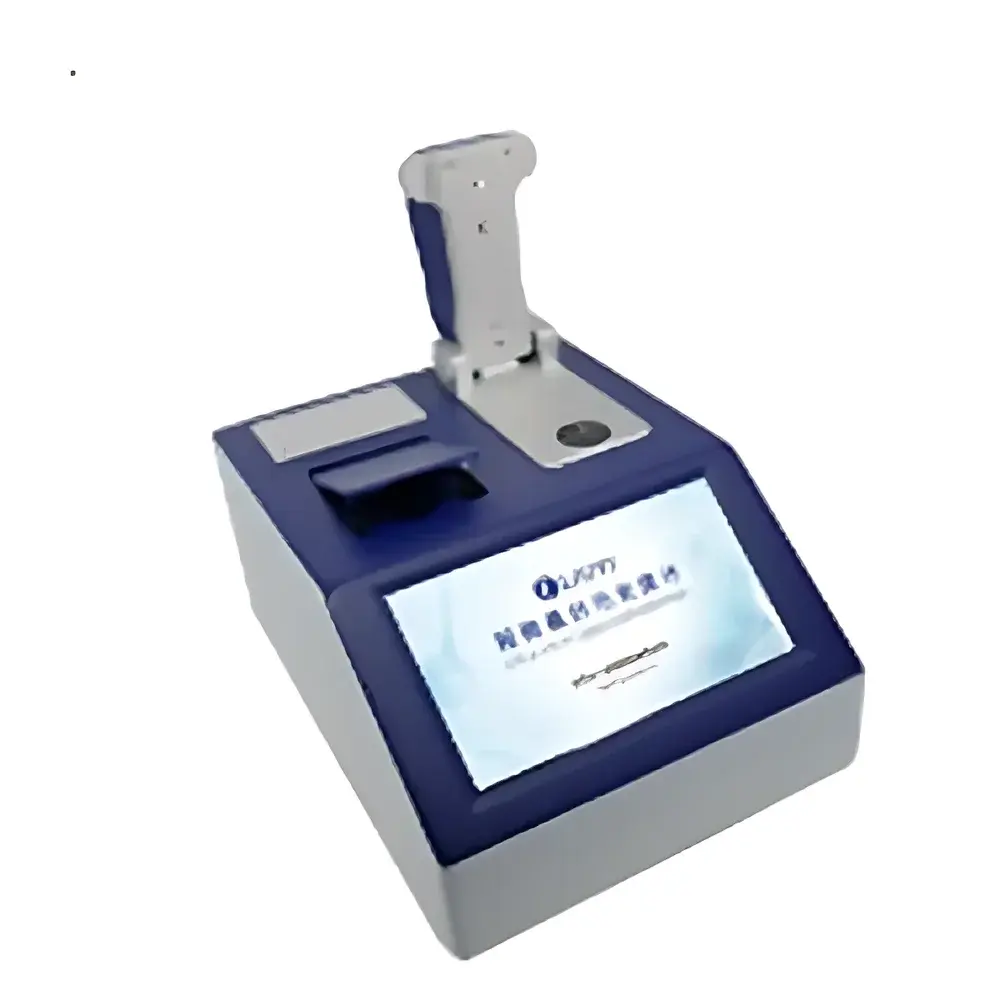
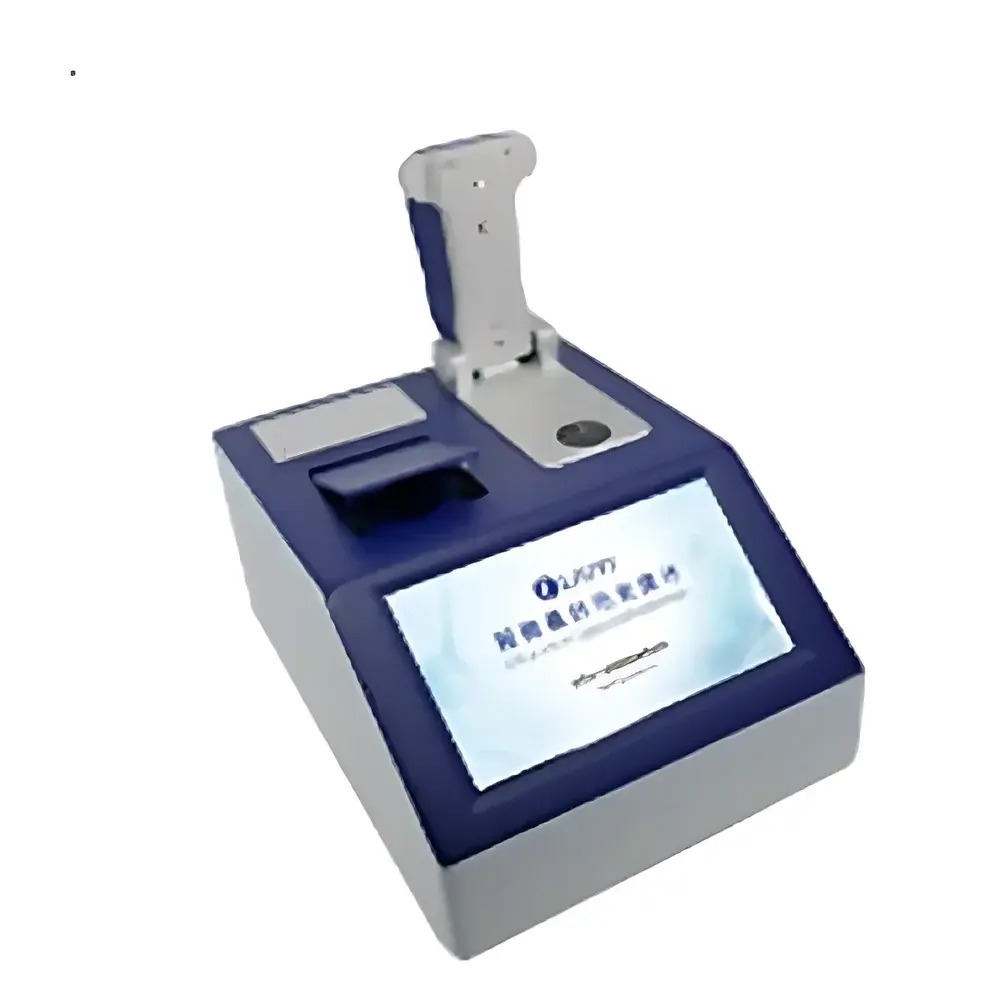
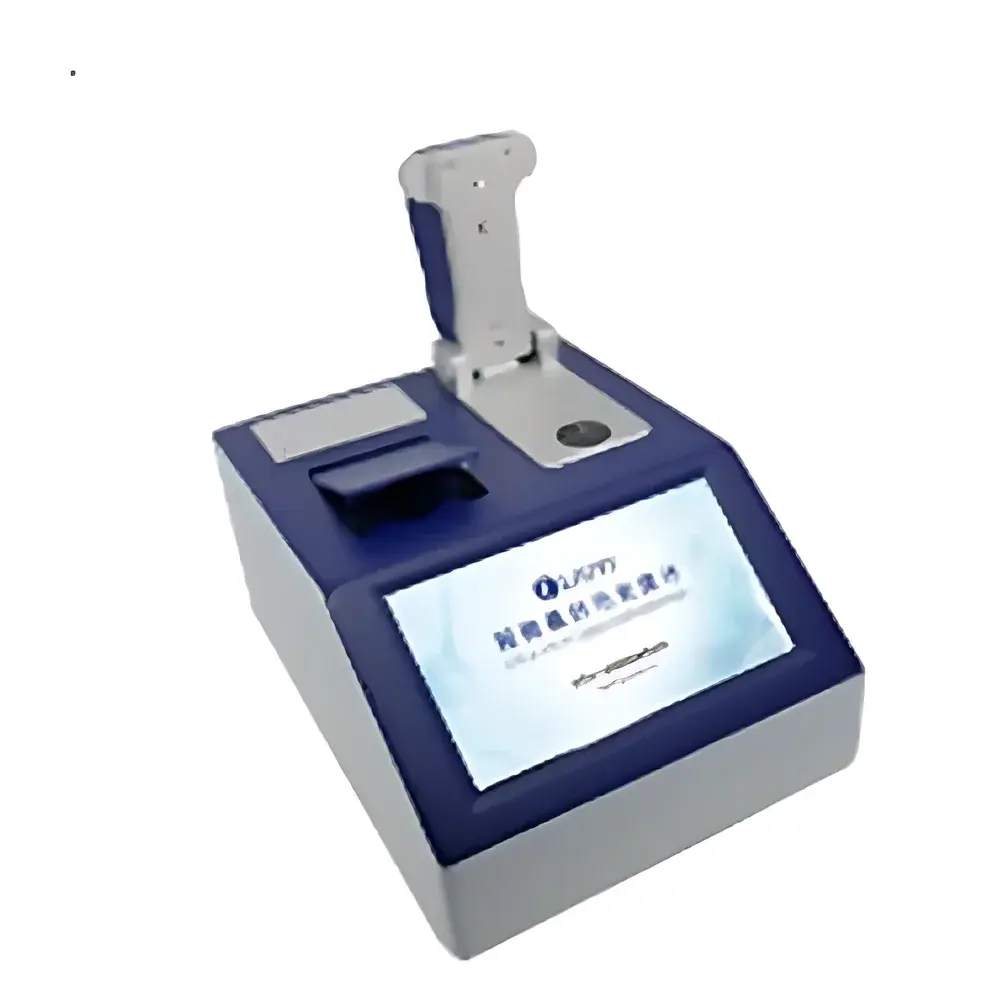
LY WD-2112B Ultra-Micro Spectrophotometer with Integrated Fluorescence Detection
| Brand | LY |
|---|---|
| Origin | Beijing, China |
| Model | WD-2112B |
| Wavelength Accuracy | ±1 nm |
| Wavelength Range | 190–850 nm |
| Sample Volume Requirement | 0.5–2 µL |
| Optical Pathlengths | 0.02, 0.05, 0.2, and 1.0 mm |
| dsDNA Detection Range | 0–27,500 ng/µL |
| BSA Detection Range | 0.06–820 mg/mL |
| Fluorescence Sensitivity (dsDNA) | 0.5 pg/µL |
| Fluorescence Linearity | ≤1.5% |
| OD₆₀₀ Accuracy | ±0.005 A (0–2 A), ±1% (2–3 A), ±2% (3–4 A) |
| Absorbance Precision | ±0.005 A or ±1% |
| Spectral Resolution | <1 nm |
| Measurement Time | <5 s |
| Power Consumption (Operating) | 25 W |
| Dimensions | 200 × 260 × 165 mm |
| Weight | 5 kg |
Overview
The LY WD-2112B Ultra-Micro Spectrophotometer is a benchtop, non-medical-grade analytical instrument engineered for rapid, label-free quantification and quality assessment of nucleic acids, proteins, and other UV-absorbing biomolecules in ultra-small sample volumes. It operates on the principle of absorbance spectroscopy across a broad spectral range (190–850 nm), utilizing a pulsed xenon flash lamp as its broadband light source and a Hamamatsu UV-enhanced CMOS linear array detector for high-fidelity spectral acquisition. Unlike conventional cuvette-based spectrophotometers requiring dilution and millilitre-scale volumes, the WD-2112B employs a fixed, motor-controlled, four-pathlength quartz fiber optic measurement base—offering optical pathlengths of 0.02 mm, 0.05 mm, 0.2 mm, and 1.0 mm—to dynamically match pathlength to sample concentration. This architecture eliminates manual dilution steps, reduces photodegradation risk through minimal light exposure duration (<5 s per measurement), and extends lamp lifetime via low-duty-cycle flashing. The system integrates fluorescence detection capability using compatible reagent kits (e.g., dsDNA-specific dyes), enabling parallel absorbance and fluorescence readouts without external hardware.
Key Features
- Four-step motorized optical pathlength selection (0.02 / 0.05 / 0.2 / 1.0 mm) for automatic dynamic range optimization and extended linear quantification (up to 27,500 ng/µL dsDNA)
- UV-enhanced Hamamatsu CMOS linear array detector with <1 nm spectral resolution and ±1 nm wavelength accuracy
- Pulsed xenon flash lamp with low photostress profile—minimizes nucleic acid degradation and ensures long-term source stability
- Integrated thermal-stabilized quartz fiber–stainless steel measurement base; requires only 0.5–2 µL native sample volume
- Onboard Android OS with 7-inch capacitive touchscreen interface—fully standalone operation, no PC dependency
- Built-in thermal printer for immediate report generation (PDF/CSV export via USB also supported)
- Fluorescence module calibrated for quantitative dsDNA detection down to 0.5 pg/µL using standard intercalating dyes
- OD600 measurement mode compliant with microbial culture density protocols, with accuracy validated across 0–4.0 A range
Sample Compatibility & Compliance
The WD-2112B accommodates a wide range of biological and chemical samples including purified dsDNA, ssDNA, RNA, oligonucleotides, proteins (BSA, lysozyme), peptides, and small-molecule UV-active compounds. Its optical design supports direct analysis of crude lysates, PCR products, and column-eluted fractions without centrifugation or filtration. While classified as a non-medical research instrument, the device meets general laboratory safety standards (IEC 61010-1) and incorporates electrical isolation and thermal management consistent with Class I equipment requirements. Data integrity features—including timestamped measurements, user-defined sample IDs, and audit-ready CSV logs—support adherence to GLP documentation practices. Though not FDA 21 CFR Part 11 certified out-of-the-box, raw data files are immutable and exportable for integration into validated LIMS or ELN environments.
Software & Data Management
The embedded Android-based firmware provides an intuitive graphical interface optimized for routine lab workflows. Users can define custom assay templates (e.g., “dsDNA 260/280”, “Protein A280”, “Fluorescence Standard Curve”) with configurable wavelength pairs, baseline correction methods, and unit conversions. All spectra and quantitative results are stored locally with date/time stamps, operator ID fields, and optional password-protected user accounts. Data export is supported via USB mass storage (CSV, PNG, PDF formats); no proprietary software installation is required on host computers. Firmware updates are delivered via microSD card or USB drive, ensuring long-term maintainability without cloud dependency. For laboratories operating under regulated quality systems, the device’s deterministic measurement sequence and absence of network connectivity reduce validation burden.
Applications
- High-throughput nucleic acid quantification in NGS library preparation and qPCR workflow QC
- Routine protein concentration determination in purification monitoring and formulation development
- Verification of RNA integrity via 260/230 and 260/280 ratios without dilution-induced error
- Microbial growth monitoring via OD600 with trace-volume compatibility for anaerobic or precious cultures
- Fluorescence-based dsDNA quantification in low-abundance samples (e.g., cfDNA, ChIP-seq inputs)
- Educational use in undergraduate biochemistry and molecular biology labs due to robustness and ease of operation
- QC testing of nanomaterial suspensions and dye-conjugated probes exhibiting UV-Vis absorption
FAQ
Does the WD-2112B require external calibration standards?
No—factory calibration is performed using NIST-traceable reference materials. Optional user recalibration kits (e.g., potassium dichromate solution) are available for periodic verification.
Can the instrument measure turbid or particulate samples?
It is not designed for highly scattering samples. For cloudy lysates, centrifugation or filtration is recommended prior to measurement to avoid stray-light artifacts.
Is fluorescence detection quantitative or qualitative?
Quantitative: the system supports two-point or multi-point standard curve generation using supplied or user-prepared dsDNA standards, with R² > 0.995 linearity over 0.5–100 pg/µL.
What maintenance is required for the optical base?
The quartz fiber surface should be wiped gently with ethanol-dampened lint-free tissue after each use. No alignment or lamp replacement is needed during normal operation (rated lamp life: >1×10⁶ flashes).
How does the 4-pathlength system improve measurement reproducibility?
By selecting the optimal pathlength for each sample’s absorbance range, the system maximizes signal-to-noise ratio and minimizes digitization error—resulting in ≤0.5% intra-run CV below 3.0 A and ≤2% up to 4.0 A.





