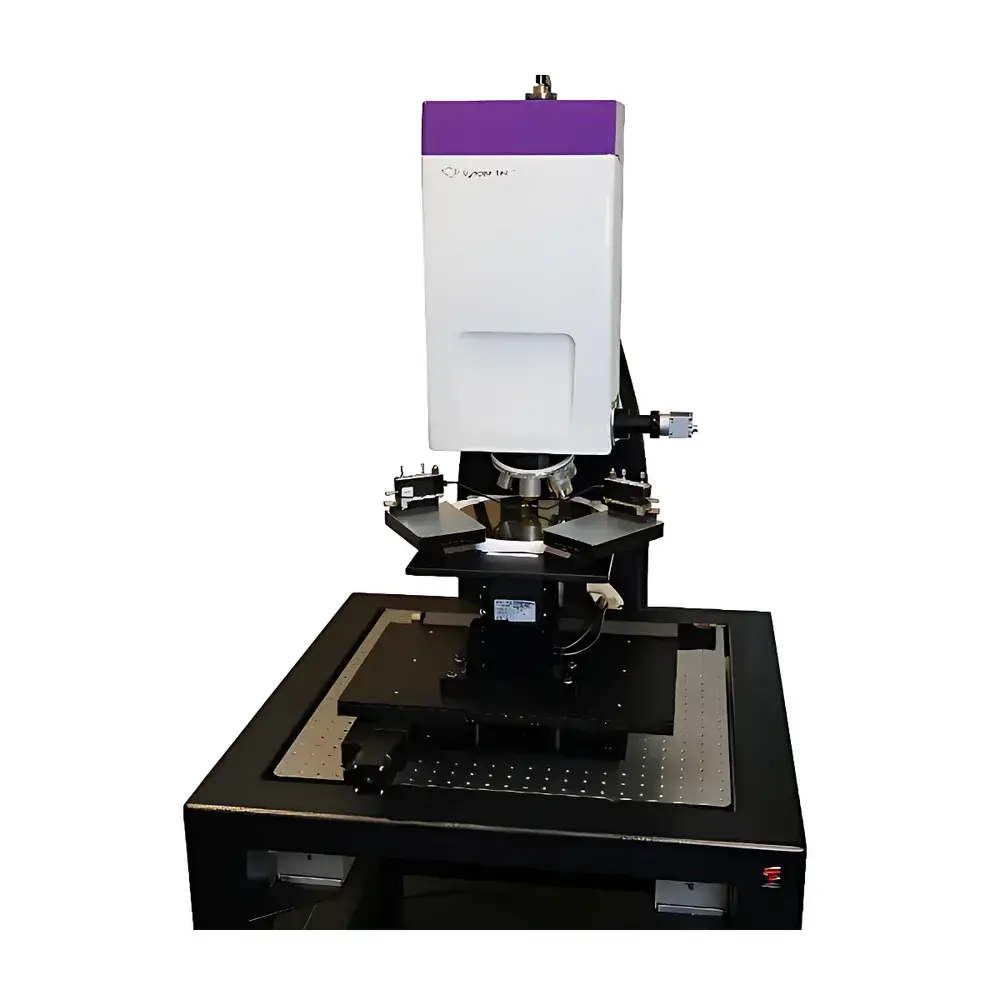
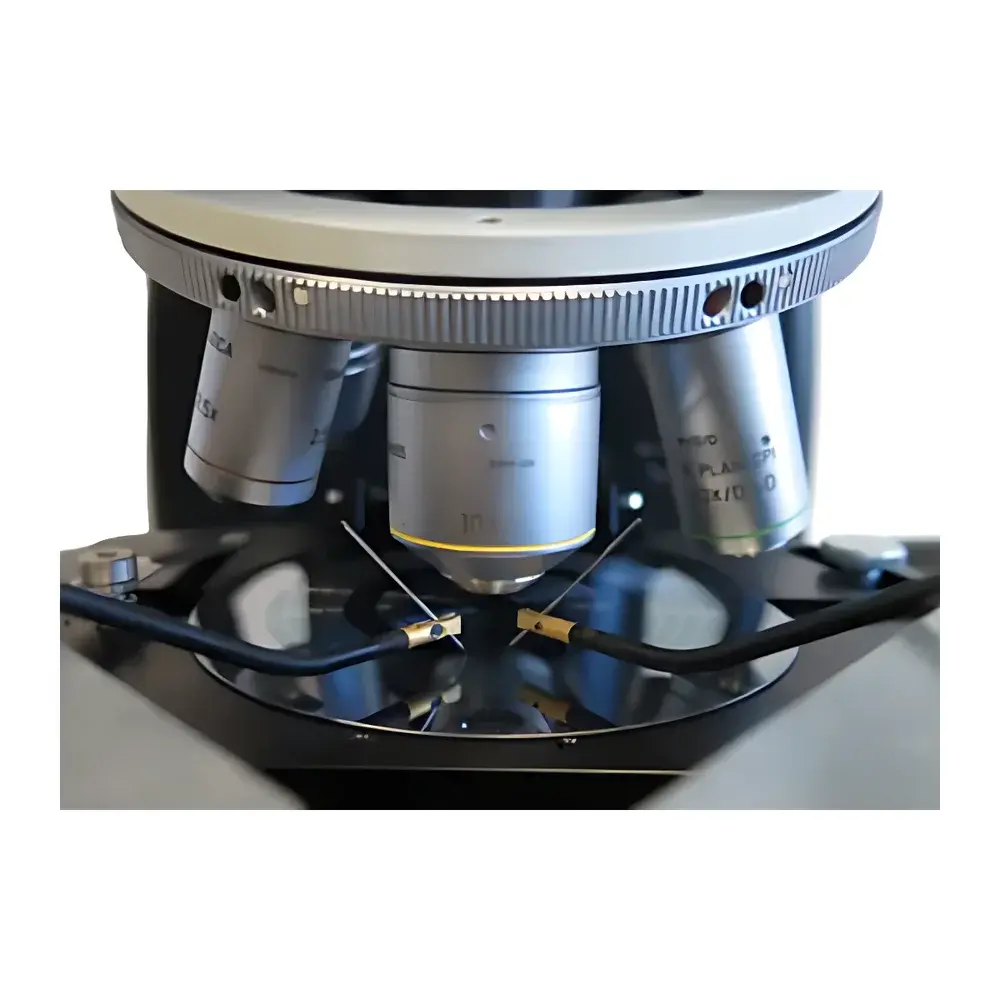
LynceeTec DHM R1000 MEMS Holographic Vibration Analyzer
| Brand | LynceeTec |
|---|---|
| Origin | Switzerland |
| Model | DHM R1000 MEMS |
| Measurement Principle | Digital Holographic Interferometry (DHI) |
| Operating Mode | Non-contact, Full-field, Single-shot 4D Imaging (3D topography + time) |
| Vertical Resolution | ≤5 pm |
| In-plane Displacement Resolution | ≤1 nm (sub-pixel algorithm) |
| Maximum Excitation Frequency | 25 MHz |
| Frame Rate | Up to 1.25 MHz (with burst mode) |
| Software | MEMSAnalysis Tool v5.x |
| Compliance | ASTM E2558, ISO/IEC 17025-compatible workflows, FDA 21 CFR Part 11 audit trail support (optional), GLP/GMP-ready metadata logging |
Overview
The LynceeTec DHM R1000 MEMS Holographic Vibration Analyzer is an engineered solution for quantitative, non-contact dynamic characterization of microelectromechanical systems (MEMS) at wafer-level and device-level. It implements digital holographic microscopy (DHM®) — a coherent interferometric technique that records the full complex optical field (amplitude and phase) in a single camera exposure. Unlike point-scanning methods such as laser Doppler vibrometry (LDV) or scanning white-light interferometry, the DHM R1000 captures instantaneous 3D surface topography across the entire field of view (FOV), synchronized with high-speed temporal sampling. This enables true 4D measurement: three spatial dimensions plus time-resolved evolution of displacement fields. The system operates on the principle of off-axis digital holography, where interference between object and reference beams is digitized and numerically reconstructed to yield quantitative phase maps proportional to optical path difference — directly convertible to nanoscale out-of-plane and in-plane displacements. Designed specifically for semiconductor packaging and MEMS process development labs, it supports real-time modal identification, resonance mapping, and validation of finite element method (FEM) simulations under operational conditions.
Key Features
- Single-shot, full-field 4D vibration imaging without mechanical scanning — eliminates motion artifacts and accelerates test throughput by up to two orders of magnitude versus raster-based techniques.
- Sub-picometer vertical resolution (≤5 pm RMS) and sub-nanometer in-plane sensitivity (≤1 nm via sub-pixel correlation algorithms), enabling detection of thermoelastic noise floors and low-amplitude parasitic modes.
- Integrated high-bandwidth electro-mechanical excitation up to 25 MHz, compatible with piezoelectric actuators, RF signal generators, and arbitrary waveform sources.
- Dedicated flash-synchronized stroboscopic module for phase-locked acquisition at resonant frequencies, supporting both transient and steady-state response analysis.
- Modular environmental integration: optional heated probe station (−40 °C to +200 °C), vacuum-compatible chamber (<10⁻³ mbar), and electrical interface for concurrent electromechanical response monitoring.
- Real-time 3D topography streaming at >100 fps (full resolution) and burst-mode acquisition at up to 1.25 MHz for ultrafast transient capture.
Sample Compatibility & Compliance
The DHM R1000 accommodates standard 100–300 mm MEMS wafers, diced dies, and packaged devices mounted on custom carriers or commercial probe stations. Its non-contact nature eliminates risk of probe-induced damage or loading effects common in contact profilometry. The system complies with industry-standard metrology frameworks: measurement uncertainty budgets align with ISO/IEC 17025 requirements for calibration traceability; software audit trails and electronic signatures satisfy FDA 21 CFR Part 11 when configured with secure user authentication and immutable log archiving. All vibration data files embed timestamped metadata (excitation parameters, environmental conditions, reconstruction settings), ensuring full GLP/GMP traceability for qualification testing and failure analysis reports. It supports ASTM E2558-19 guidelines for MEMS resonator characterization, including modal confidence factor (MCF) calculation and coherence-based filtering of spurious modes.
Software & Data Management
MEMSAnalysis Tool v5.x provides a unified environment for acquisition control, reconstruction, and physics-based post-processing. Its modular architecture separates hardware abstraction layers from analytical engines, ensuring reproducibility across instrument generations. Core capabilities include: time-domain displacement vector field extraction (out-of-plane Z + in-plane X/Y); Fourier-transform-based frequency response function (FRF) mapping; Bode and Nyquist plot generation; automated resonance peak detection with quality factor (Q) estimation; multi-device comparative modal clustering; and export of ASCII/HDF5 datasets for third-party FEM co-simulation (ANSYS, COMSOL, Coventor). All processing steps are scriptable via Python API, enabling integration into automated test sequences and statistical process control (SPC) pipelines. Raw hologram data is stored losslessly using TIFF64 format with embedded EXIF tags for metrological provenance.
Applications
- Wafer-level screening of MEMS gyroscope, accelerometer, and microphone arrays for resonance uniformity and damping variation.
- Failure root-cause analysis of stiction, packaging-induced stress, or electrode delamination through localized phase anomaly detection.
- Validation of structural dynamics models — direct comparison of simulated mode shapes against experimentally measured displacement vectors at identical boundary conditions.
- Characterization of RF-MEMS switches and tunable capacitors under bias, correlating electrical S-parameters with mechanical deformation.
- Thermo-mechanical coupling studies via synchronized thermal ramping and vibration tracking across temperature gradients.
- Development of AI-assisted defect classification models using labeled 4D displacement tensor datasets.
FAQ
What is the minimum measurable vibration amplitude?
The system achieves ≤5 pm RMS vertical displacement resolution under optimal SNR conditions (e.g., reflective surfaces, stabilized environment). In-plane resolution is ≤1 nm using sub-pixel cross-correlation on phase difference maps.
Can the DHM R1000 measure both out-of-plane and in-plane motion simultaneously?
Yes — dual-axis in-plane sensitivity is enabled by lateral shearing interferometry combined with numerical angular spectrum reconstruction, allowing vectorial displacement field mapping without orthogonal beam alignment.
Is vacuum operation supported?
Yes — optional vacuum-compatible optical chamber maintains <10⁻³ mbar pressure while preserving interferometric stability and thermal drift compensation.
How does the system handle highly reflective or transparent MEMS structures?
Adaptive illumination control and polarization-diverse hologram acquisition minimize specular saturation and enhance contrast for silicon-on-insulator (SOI), glass-capped, or polymer-based devices.
Does MEMSAnalysis Tool support batch processing of multiple wafers?
Yes — workflow templates enable unattended acquisition and analysis of >100 die per wafer, with automated ROI selection based on mask alignment marks or machine vision fiducials.