M2 ABS Acoustic Bubble Spectrometer
| Origin | France |
|---|---|
| Manufacturer Type | Distributor |
| Origin Category | Imported |
| Model | M2 |
| Price | Upon Request |
Overview
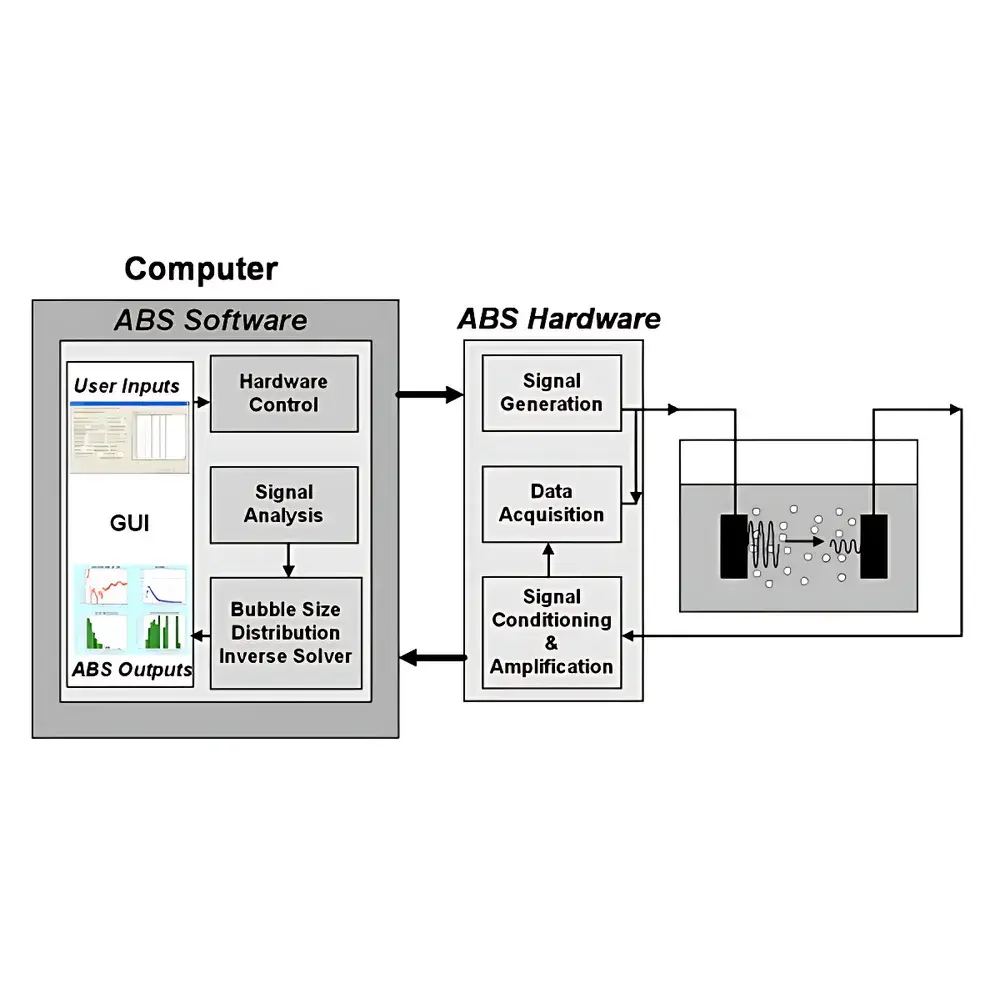
The M2 ABS Acoustic Bubble Spectrometer is a rigorously engineered, non-invasive acoustic instrumentation system designed for real-time, in-situ quantification of bubble size distribution (BSD) and void fraction in opaque or optically challenging liquid-phase environments. Unlike optical methods—such as high-speed imaging, laser diffraction, or phase-Doppler anemometry—the ABS operates on the physical principle of broadband acoustic attenuation and sound speed dispersion. When a multi-frequency acoustic wave propagates through a bubbly liquid, bubbles of different radii resonate at distinct frequencies (governed by the Minnaert resonance condition), inducing frequency-dependent attenuation and phase velocity shifts. The M2 system exploits this physics by transmitting swept or discrete-frequency signals via a calibrated pair of transducers/hydrophones and measuring the resulting complex transmission response. From these raw acoustical measurements, the instrument reconstructs the bubble number density function n(R) (bubbles per unit volume per radius interval) and integrated void fraction α = ∫0∞ (4π/3)R³n(R)dR using a mathematically grounded inversion framework.
Key Features
- Multi-frequency acoustic interrogation (typically 10–500 kHz range) enabling resolution of bubble radii from ~10 µm to >1 mm
- Real-time data acquisition and processing with latency under 2 seconds—optimized for closed-loop process monitoring and control integration
- Robust signal conditioning and noise-suppression architecture, including adaptive filtering and dynamic range optimization for high-SNR operation in turbulent or high-background-noise environments
- Constrained optimization-based inversion algorithm solving two Fredholm integral equations of the first kind—validated against micro-photographic ground truth across multiple fluid systems (water, glycerol-water mixtures, industrial slurries)
- Modular hardware design: transducer pair (pressure-compensated, stainless-steel housing), USB- or PCIe-based DAQ board, and ruggedized enclosure rated for IP65 industrial deployment
- No optical access required—fully functional in turbid, opaque, high-temperature, or high-pressure processes (with appropriate hydrophone rating)
Sample Compatibility & Compliance
The M2 ABS is compatible with Newtonian and weakly non-Newtonian liquids across a broad temperature range (−10 °C to +80 °C standard; extended options available). It has been successfully deployed in seawater, wastewater effluents, chemical reactor slurries, and cryogenic coolants. As a measurement device—not a safety-critical control actuator—it complies with IEC 61000-6-2 (EMC immunity) and IEC 61000-6-4 (EMC emissions). While not certified for SIL-rated applications, its data output meets traceability requirements for GLP-compliant laboratory reporting and supports audit-ready documentation when used with Dynaflows software configured for FDA 21 CFR Part 11 compliance (electronic signatures, audit trails, user access controls). The system adheres to ASTM E2983–22 (Standard Guide for Acoustic Characterization of Bubbly Flows) and supports validation protocols aligned with ISO/IEC 17025 for accredited testing laboratories.
Software & Data Management
Data acquisition, inversion, visualization, and export are handled exclusively through Dynaflows v5.x—a Windows-based application developed in collaboration with Oak Ridge National Laboratory and validated in peer-reviewed publications. The software provides: (1) time-resolved BSD plots (dN/dlogR vs. R), cumulative distributions, and statistical moments (Sauter mean diameter D₃₂, modal radius, span); (2) void fraction trend logging with configurable sampling intervals (1 Hz to 1 sample/min); (3) batch analysis mode for post-processing archival datasets; (4) CSV, HDF5, and MATLAB .mat export formats; (5) OPC UA and Modbus TCP server modules for integration into SCADA and DCS platforms (e.g., Siemens PCS7, Emerson DeltaV). All raw acoustic spectra and inverted distributions are timestamped and stored with metadata (transducer calibration ID, temperature, pressure if sensor-integrated), ensuring full chain-of-custody for regulatory submissions.
Applications
- Oceanography & Environmental Monitoring: Quantifying near-surface bubble populations for modeling air-sea gas exchange, oceanic sound-speed profiles, and carbon flux estimation in climate models
- Wastewater Aeration Control: Optimizing blower energy consumption by correlating real-time void fraction and mean bubble size with oxygen transfer efficiency (OTE) in activated sludge basins
- Hydropower & Naval Engineering: Mapping cavitation nuclei concentration upstream of turbines, pumps, and propellers to inform erosion-resistant material selection and blade geometry refinement
- Chemical & Pharmaceutical Processing: Monitoring gas dispersion quality in stirred-tank reactors, hydrogenation vessels, and fermentation bioreactors where optical access is impractical
- Food & Beverage: Characterizing CO₂ nucleation and growth kinetics during carbonation, beer foam stability assessment, and inline quality verification in dairy homogenization lines
- Emerging Biomedical Use Cases: Non-invasive sizing of microbubble contrast agents in preclinical ultrasound studies and monitoring of gas emboli formation in extracorporeal circuits
FAQ
Can the M2 operate in pressurized pipelines?
Yes—when equipped with pressure-rated hydrophones (up to 100 bar standard; custom ratings available), the M2 supports continuous in-line monitoring of multiphase flows in chemical, petrochemical, and power-generation infrastructure.
Does it require calibration against a reference method for each new fluid?
No. The inversion algorithm incorporates fluid property inputs (density, viscosity, bulk modulus) that are either preloaded or measured in situ. Validation studies confirm <±12% relative error in D₃₂ across water, seawater, and 40% glycerol solutions without retraining.
How is temperature drift compensated?
The system accepts external PT100 or RTD input; sound speed and attenuation models are dynamically updated using temperature-dependent thermophysical property databases embedded in Dynaflows.
Is the M2 suitable for GMP manufacturing environments?
When deployed with validated Dynaflows configuration (21 CFR Part 11 mode enabled), electronic records meet ALCOA+ principles and support inspection readiness for pharmaceutical and biotech clients.
What is the minimum detectable bubble concentration?
Detection threshold is fluid-dependent but typically ≤10⁴ bubbles/mL for R ≥ 30 µm in water at 20 °C, verified via controlled air-injection experiments with calibrated mass flow controllers.
Related Products