
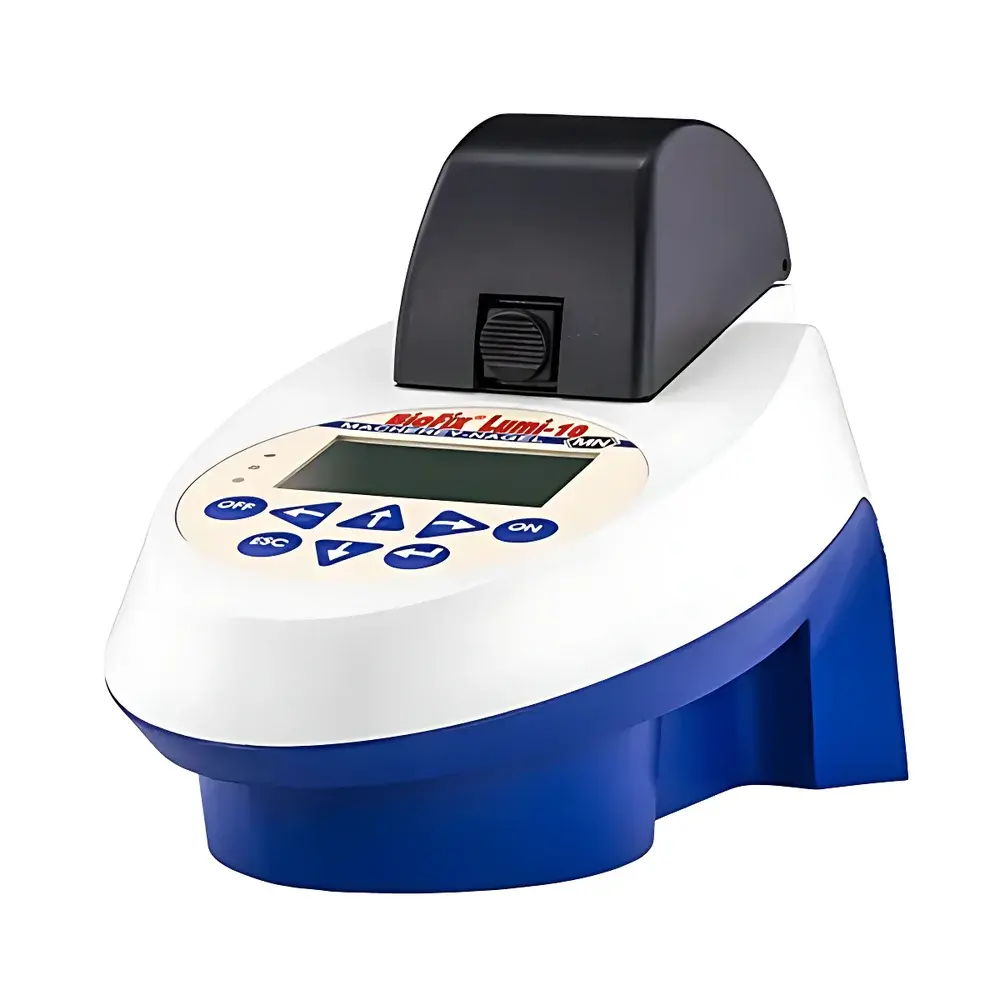
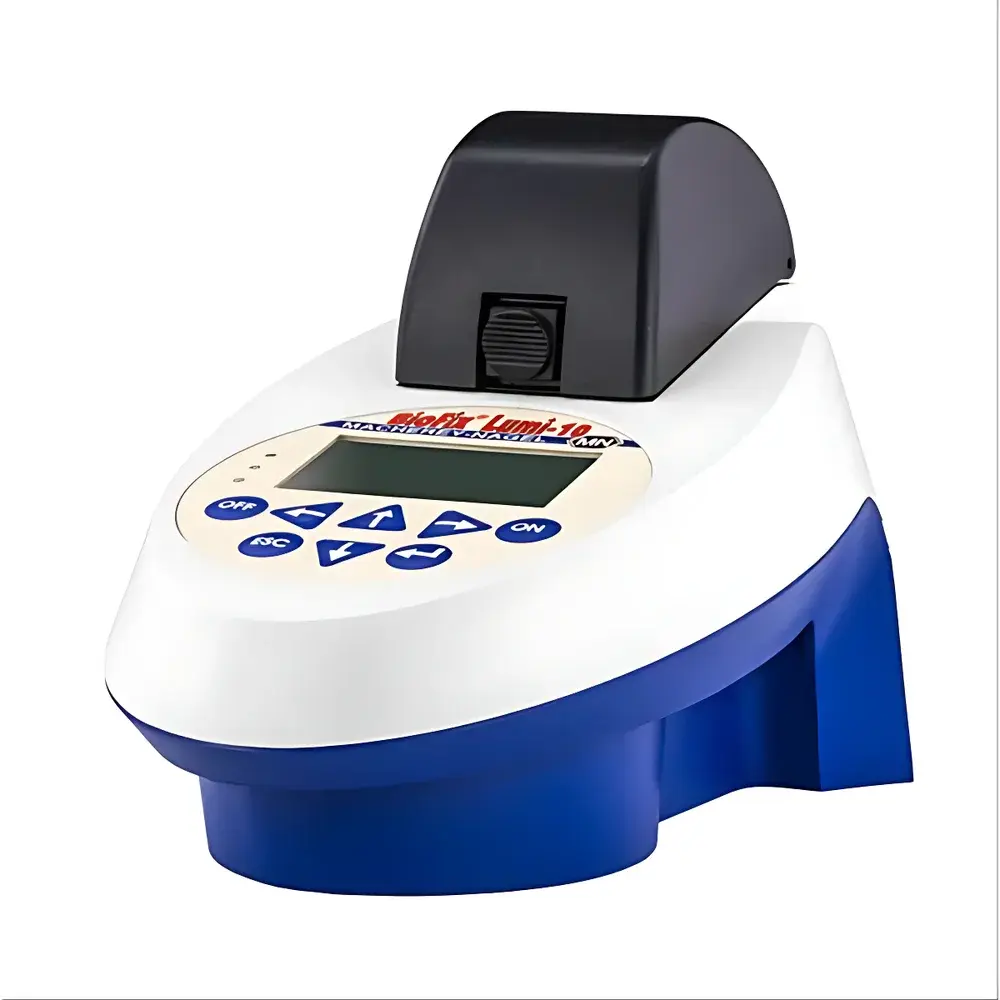
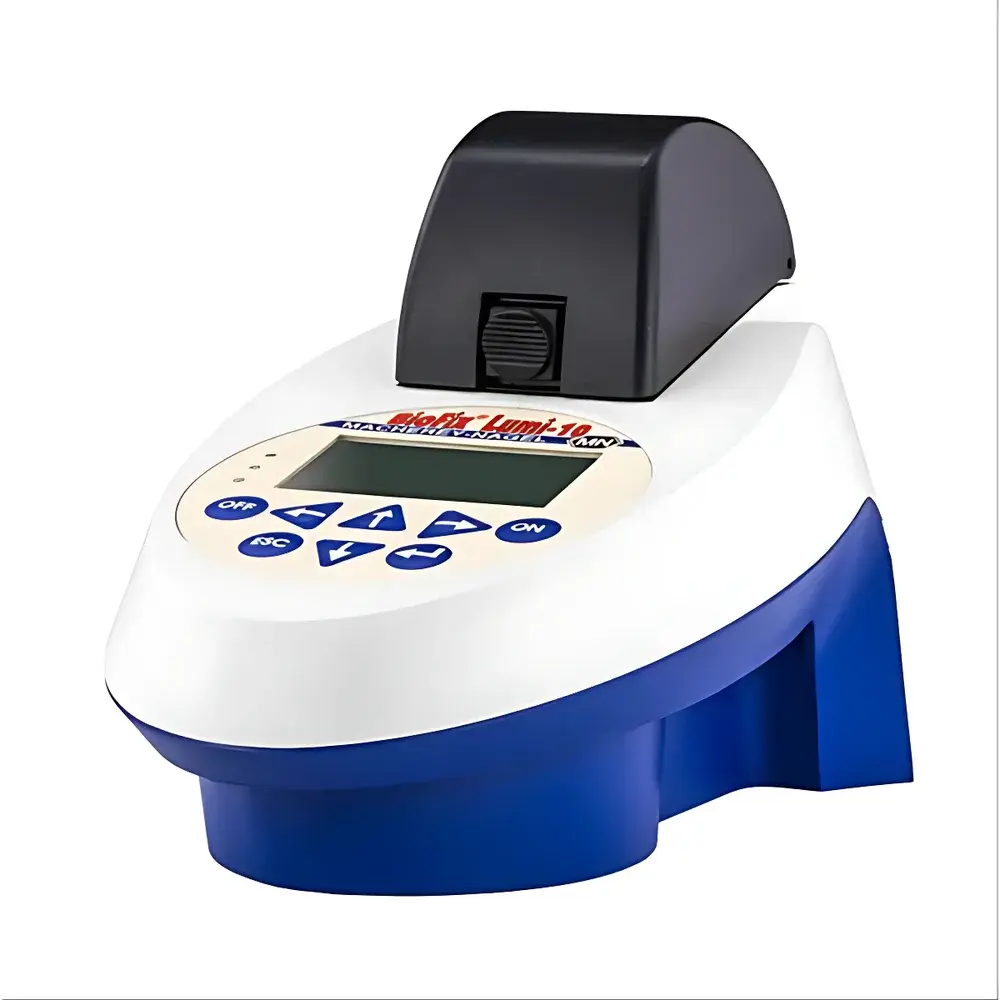
Macherey-Nagel BioFix Lumi-10 Portable Bioluminescence-Based Water Toxicity Analyzer
| Brand | Macherey-Nagel |
|---|---|
| Origin | Germany |
| Model | BioFix Lumi-10 |
| Instrument Type | Laboratory |
| Biological Agent | *Aliivibrio fischeri* (formerly *Vibrio fischeri*) |
| Operating Temperature | 18–25 °C |
| Reagent Storage & Assay Temperature | 20–25 °C |
| Coefficient of Variation (CV) | ≤5% (RSD) |
| Batch Capacity | 10 samples per run |
| Assay Duration | 30 minutes per batch |
| Detection Principle | Bioluminescence Inhibition/Enhancement |
| Photomultiplier Detector | Ultrafast Single-Photon Counter |
| Wavelength Range | 380–630 nm |
| Light Intensity Range | 0–120,000,000 photons/s |
| Detection Limit | 1 RLU |
| Display | Backlit monochrome LCD (128 × 64 pixels) |
| Data Storage | 2000 test records |
| Environmental Operating Range | 15–30 °C, 10–90% RH (non-condensing) |
| Power Supply | Rechargeable battery or AC adapter (230 V/50 Hz or 115 V/60 Hz) |
| Dimensions | 170 × 150 × 280 mm |
| Weight | 2.0 kg (including battery) |
| Compliance | EN ISO 11348-1/2/3, CE marked per 2006/95/EC (LVD) and 2004/108/EC (EMC) |
Overview
The Macherey-Nagel BioFix Lumi-10 is a portable, laboratory-grade bioluminescence-based water toxicity analyzer engineered for rapid, standardized assessment of acute aquatic toxicity. It operates on the principle of *Aliivibrio fischeri* (formerly *Vibrio fischeri*) bioluminescence inhibition—or, less commonly, enhancement—induced by toxicants in aqueous samples. This organism maintains a stable, oxygen-dependent luminescent metabolic pathway; disruption by chemical stressors results in quantifiable reduction (or occasionally augmentation) of photon emission within minutes. The Lumi-10 implements this biological endpoint in strict accordance with EN ISO 11348-1, -2, and -3, enabling regulatory-compliant screening for industrial effluents, drinking water sources, surface waters, and emergency response scenarios. Its compact architecture, integrated single-photon counting detector, and temperature-controlled assay chamber ensure reproducible light-intensity measurements across diverse field and lab environments—without requiring cell culture infrastructure or specialized microbiological training.
Key Features
- Portable benchtop design (2.0 kg), suitable for both laboratory and on-site deployment—including mobile environmental response units and remote monitoring stations.
- Dual power operation: rechargeable internal battery or universal AC adapter (115/230 V, 50/60 Hz), ensuring uninterrupted operation during extended field campaigns or power-limited conditions.
- High-sensitivity photodetection system featuring an ultrafast single-photon counter with spectral response from 380 to 630 nm—optimized for native *A. fischeri* bioluminescence (peak ~490 nm).
- Integrated assay temperature control (18–25 °C operating range; reagent use at 20–25 °C), critical for maintaining bacterial metabolic stability and assay reproducibility.
- Onboard data management with 2000-record storage capacity; supports user-defined metadata including sampling location, sample ID, date/time stamp, and operator code.
- Six preconfigured test templates plus three built-in standard methods (e.g., ISO 11348-3 freeze-dried protocol) and three customizable protocols for method adaptation.
- RS232 serial interface for direct export of raw luminescence values (RLU), inhibition percentages, and metadata to PCs or printers—enabling traceable data archiving and downstream statistical analysis.
Sample Compatibility & Compliance
The BioFix Lumi-10 accepts liquid samples directly—no filtration or extraction required for most matrices—including raw wastewater, treated effluent, potable water, river/lake water, leachates, and industrial process streams. Sample turbidity up to 100 NTU is tolerated without interference, provided particulates do not physically shield bacteria from dissolved toxicants. The instrument complies fully with EN ISO 11348 parts 1–3 for determination of inhibition of the luminescence of *Aliivibrio fischeri*. Its validation data align with internationally recognized sensitivity benchmarks—for example, IC50 values for key heavy metals (e.g., Hg: 0.04 mg/L; Cd: 0.04 mg/L; Cu: 0.11 mg/L) fall within published reference ranges for *A. fischeri*-based assays. CE marking confirms conformity with EU Low Voltage Directive 2006/95/EC and EMC Directive 2004/108/EC. While not inherently GLP- or 21 CFR Part 11-compliant out-of-the-box, audit-ready data export enables integration into validated QA/QC workflows when paired with controlled documentation practices.
Software & Data Management
The Lumi-10’s embedded firmware provides real-time calculation of relative luminescence units (RLU), inhibition rate (%I = [(RLUcontrol − RLUsample) / RLUcontrol] × 100), and statistical summaries (mean, SD, CV). All measurement parameters—including exposure time, temperature log, and calibration history—are timestamped and stored alongside results. Data export via RS232 yields ASCII-formatted files compatible with Excel, LabArchives, or LIMS platforms. No proprietary software installation is required for basic transfer; however, third-party scripting (e.g., Python or MATLAB) can automate batch processing, outlier detection, and report generation. Firmware updates are delivered via manufacturer-provided HEX files and standard terminal emulators—ensuring long-term maintainability without vendor lock-in.
Applications
- Emergency response to chemical spills, industrial accidents, or natural disasters affecting water supplies.
- Routine toxicity screening in municipal water treatment plants (influent, effluent, distribution points).
- Compliance monitoring for discharge permits under national water frameworks (e.g., EU WFD, US Clean Water Act).
- Research applications in ecotoxicology, including mixture toxicity assessment and wastewater treatability studies.
- Validation of advanced oxidation processes (AOPs) or membrane filtration efficacy via whole-effluent toxicity (WET) testing.
- Surveillance in public health laboratories (e.g., CDC-affiliated facilities) for untargeted contaminant detection where chemical-specific assays are unavailable.
FAQ
What biological indicator does the BioFix Lumi-10 use?
It employs lyophilized *Aliivibrio fischeri* (strain NRRL B-11177), supplied as standardized, quality-controlled test kits compliant with EN ISO 11348.
Can the instrument detect non-polar organic compounds?
Yes—while sensitivity varies, the assay responds to a broad spectrum of toxicants including heavy metals, pesticides, PAHs, phenols, surfactants, and cyanides, provided they are bioavailable in aqueous phase.
Is temperature control mandatory during measurement?
Yes—assay temperature must be stabilized between 20–25 °C during reagent rehydration and exposure; the device’s thermal regulation ensures compliance with ISO 11348-3 incubation requirements.
How is data integrity ensured during field use?
Each record includes immutable timestamps, operator ID, and environmental logs (temperature, humidity); exported files retain full traceability for audit purposes.
Does the Lumi-10 require daily calibration?
No routine calibration is needed—the photomultiplier is factory-calibrated; periodic verification using certified reference standards (e.g., quinine sulfate solutions) is recommended annually or after instrument service.
Related Products







