
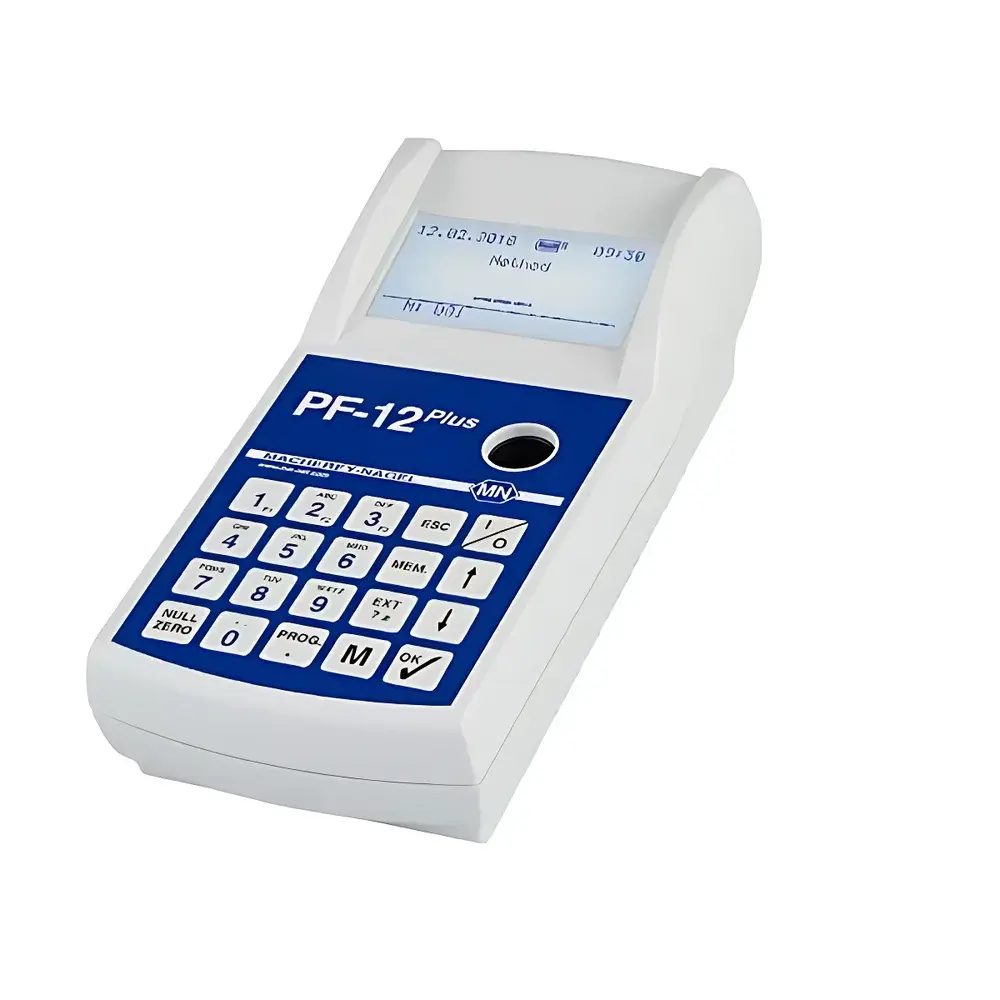
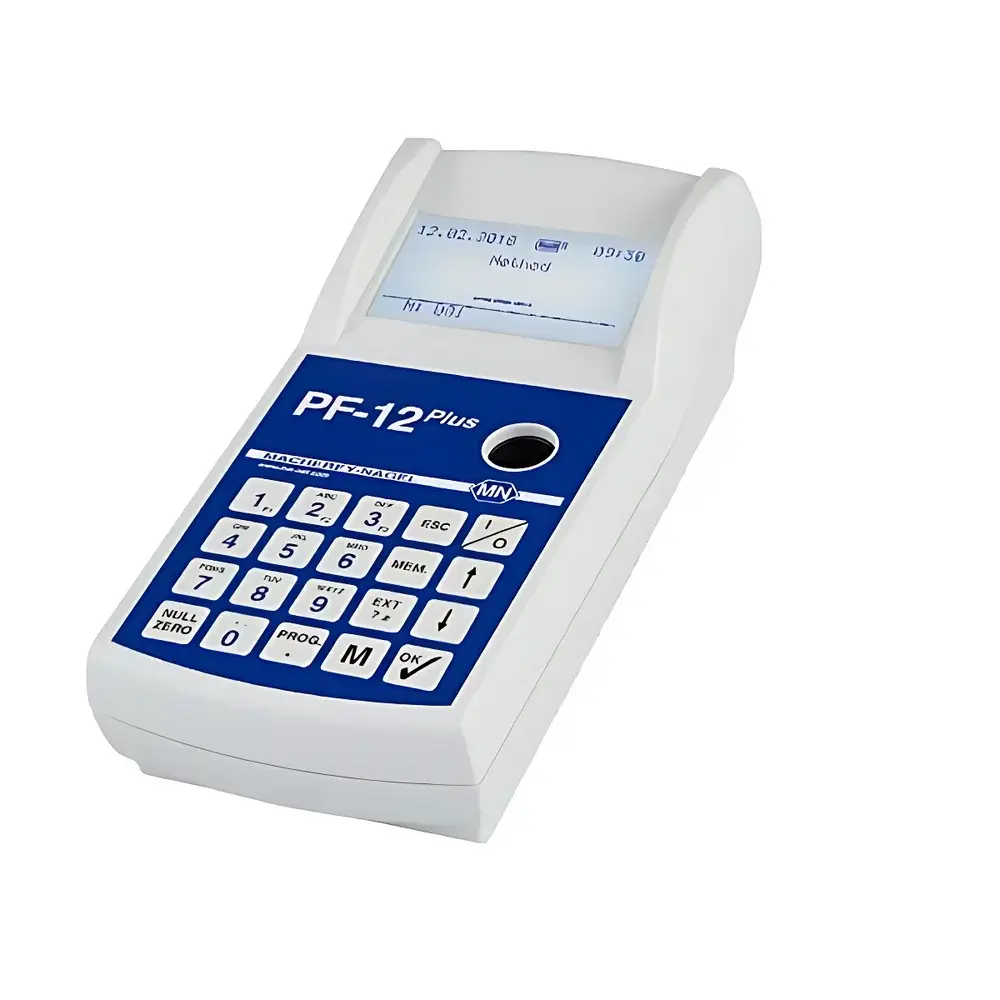
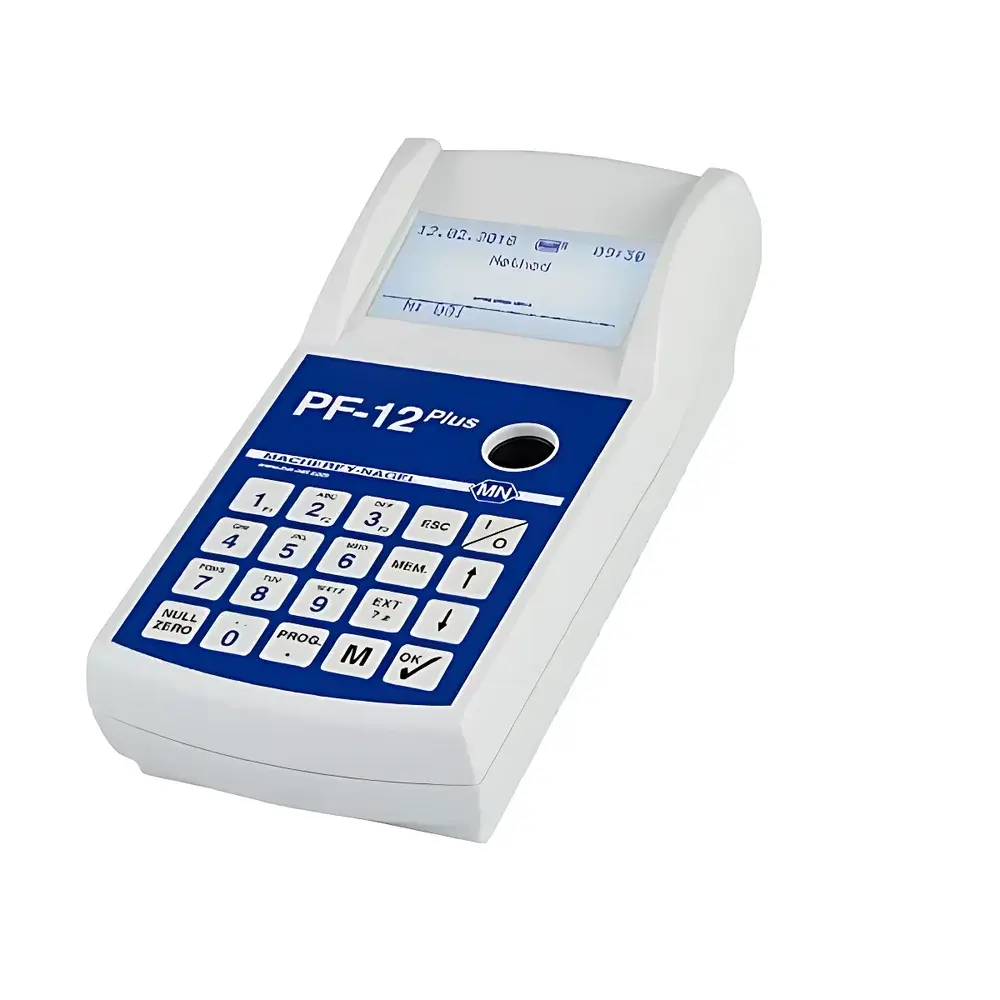
Macherey-Nagel PF-12 Plus Portable Multi-Parameter Water Quality Analyzer
| Brand | Macherey-Nagel |
|---|---|
| Origin | Germany |
| Model | PF-12 Plus |
| Instrument Type | Portable / Handheld Water Quality Analyzer |
| Detection Principle | Colorimetric Method |
| Measurable Parameters | Ni, Cu, Cr, COD, Ammonia-N, Total Phosphorus, Total Nitrogen, Turbidity (1–1000 NTU), Residual Chlorine, and up to 60 parameters |
| Optical System | Single-beam filter photometer with 7-position filter wheel (345, 436, 470, 540, 585, 620, 690 nm) + optional 860 nm LED for turbidity |
| Wavelength Accuracy | ±2 nm |
| Spectral Bandwidth | 10–12 nm |
| Photometric Range | ±3 A |
| Photometric Accuracy | ±1% |
| Stability | <0.002 A/h |
| Sample Cell | 16 mm round cuvette |
| Data Storage | 1000 measurements, GLP-compliant |
| Display | Backlit LCD (64×128 pixels) |
| Interface | USB 2.0 |
| Protection Rating | IP68 |
| Operating Temperature | 10–40 °C, RH ≤80% |
| Power Supply | USB bus power, AA alkaline/rechargeable batteries, or 12 V automotive adapter |
| Dimensions | 215 × 100 × 65 mm |
| Weight | 0.7 kg |
| Certification | CE |
Overview
The Macherey-Nagel PF-12 Plus is a field-deployable, microprocessor-controlled multi-parameter water quality analyzer engineered for precision colorimetric analysis of drinking water, surface water, wastewater, and industrial process streams. It operates on the principle of absorbance-based photometry using a single-beam optical architecture with a motorized 7-position interference filter wheel—ensuring spectral selectivity without ambient light interference. Unlike spectrophotometers, the PF-12 Plus employs discrete wavelength selection (345, 436, 470, 540, 585, 620, and 690 nm), each optimized for specific analyte reactions per standard methods (e.g., ASTM D1253 for residual chlorine, ISO 6060 for COD, ISO 11908 for ammonia-nitrogen). An integrated 860 nm LED enables nephelometric turbidity measurement compliant with ISO 7027. The instrument’s self-diagnostic routines, automatic zeroing, and built-in calibration verification support routine metrological integrity in uncontrolled environments.
Key Features
- Preloaded library of over 100 validated colorimetric test methods—including EPA, ISO, and DIN-compliant protocols for Ni²⁺ (ISO 8585), Cu²⁺ (ISO 8586), Cr⁶⁺ (ISO 11348), COD (ISO 6060), NH₃-N (ISO 11908), total phosphorus (ISO 6878), and total nitrogen (ISO 11905)
- User-definable method creation for up to 50 custom assays via intuitive parameter configuration (wavelength, reaction time, curve type, units)
- True portable operation: IP68-rated housing withstands submersion at 1.5 m for 30 min; operational in rain, dust, high humidity, or temperature fluctuations (10–40 °C)
- Backlit monochrome LCD (64 × 128 pixels) with context-sensitive graphical guidance—no prior training required for method selection or result interpretation
- USB 2.0 interface supports three concurrent functions: data export (CSV/Excel-compatible), firmware updates (free lifetime upgrades via MN Connect software), and direct power sourcing
- Flexible power architecture: powered by four AA alkaline or NiMH batteries (≥1000 tests per charge), USB host (e.g., laptop, power bank), or 12 V DC vehicle adapter
- GLP-compliant data management: each stored result includes timestamp, operator ID (configurable), method ID, cuvette ID (optional), and raw absorbance values
Sample Compatibility & Compliance
The PF-12 Plus accepts standard 16 mm round glass or plastic cuvettes, compatible with all MN-certified reagent kits (e.g., NANOCONTROL® and NANOCHECK® series). Its optical design eliminates stray-light error through mechanical shutter synchronization and dark-current compensation—critical for low-concentration metal ion detection in compliance with ISO/IEC 17025 laboratory requirements. All preprogrammed methods align with internationally recognized standards: COD per ISO 6060 (closed reflux, dichromate oxidation); ammonia-nitrogen per ISO 11908 (salicylate-hypochlorite); total phosphorus per ISO 6878 (persulfate digestion + ascorbic acid reduction); and turbidity per ISO 7027 (formazin equivalence). The device meets CE marking requirements under the EU Electromagnetic Compatibility Directive 2014/30/EU and Low Voltage Directive 2014/35/EU. While not inherently 21 CFR Part 11 compliant, audit trails and electronic signatures can be implemented via MN Connect software in conjunction with validated IT infrastructure.
Software & Data Management
MN Connect—a Windows-based desktop application—enables bidirectional communication with the PF-12 Plus via USB. Users export datasets directly into Excel (.xlsx) or CSV format, preserving GLP metadata (date/time, method version, calibration status). The software supports batch report generation with customizable templates, statistical evaluation (mean, SD, CV%), and trend visualization across sampling events. Firmware updates are distributed free-of-charge and include expanded method libraries, enhanced stability algorithms, and improved battery-life estimation. All firmware revisions undergo traceable validation per IEC 62304 Class B software lifecycle requirements. Data encryption during transfer is not applied; however, local storage adheres to ISO/IEC 27001-aligned access controls when deployed within institutional networks.
Applications
- Regulatory monitoring by municipal water utilities and environmental agencies performing routine checks for heavy metals (Ni, Cu, Cr), nutrients (NH₃-N, TP, TN), and organic load (COD)
- In-process control in electroplating and metal finishing facilities—real-time verification of rinse water compliance prior to discharge
- Wastewater treatment plant (WWTP) operators conducting rapid grab-sample analysis for nitrification/denitrification optimization
- Field technicians assessing aquaculture pond water quality (turbidity, ammonia, nitrite) under variable ambient conditions
- Academic and government research labs requiring rugged, method-validated instrumentation for comparative studies across diverse aquatic matrices
- Emergency response teams deploying for post-flood or industrial spill assessments where lab access is unavailable
FAQ
Does the PF-12 Plus require external calibration standards for daily use?
No—each assay includes an automated blank correction and internal reference check. Certified reference materials (e.g., NIST-traceable standards) are recommended for initial qualification and periodic performance verification per ISO/IEC 17025.
Can the instrument store method modifications made in the field?
Yes—up to 50 user-defined methods may be saved onboard with full parameter retention (wavelength, kinetics, calibration curve coefficients, units).
Is turbidity measurement traceable to formazin standards?
Yes—the 860 nm LED turbidimeter is factory-calibrated against formazin suspension and conforms to ISO 7027 for ratio-based nephelometry.
What is the expected battery life under typical field use?
Approximately 1,200 measurements per set of alkaline AA batteries (assuming 5 sec measurement cycle, 10% display-on time); rechargeable NiMH extends operational cycles but requires external charger.
How does the PF-12 Plus handle interferences from colored or turbid samples in colorimetric assays?
The instrument applies dual-wavelength correction (where supported by method protocol) and offers optional sample pretreatment guidance (e.g., filtration, digestion) embedded in method-specific instructions.
Related Products







