
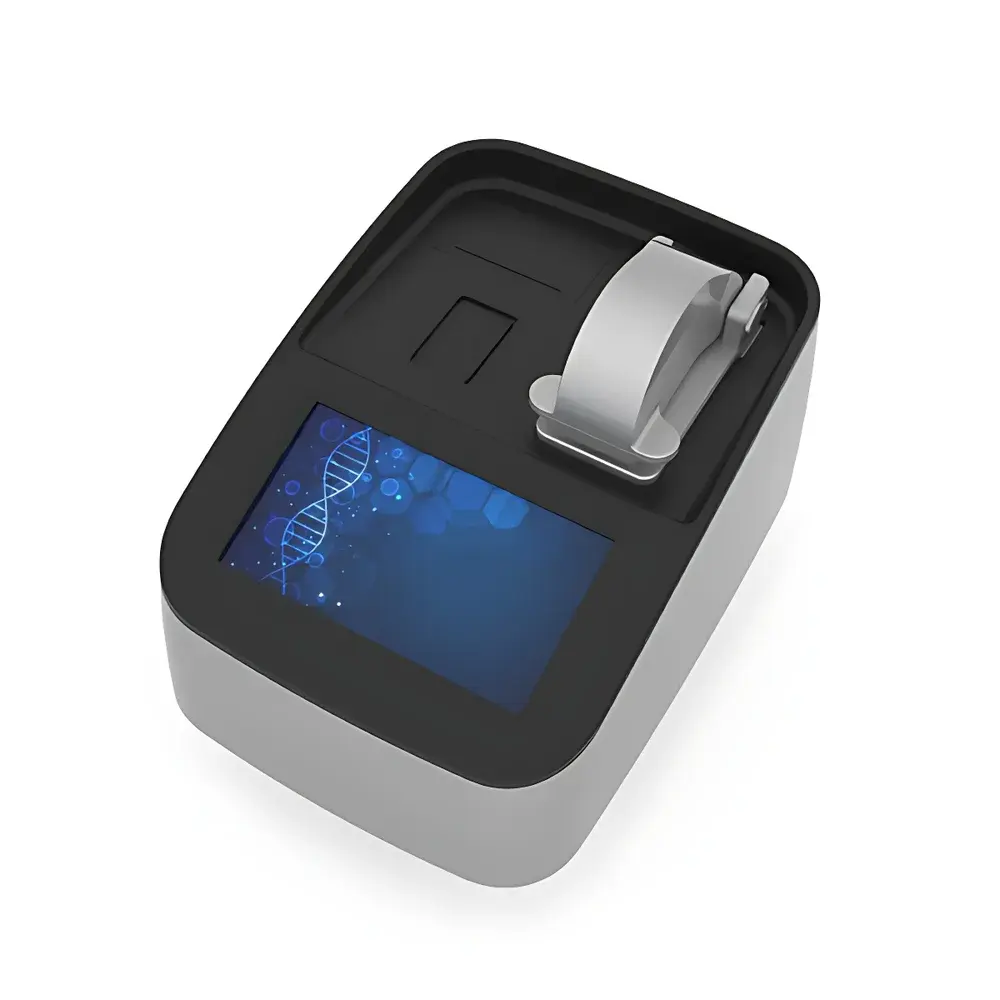
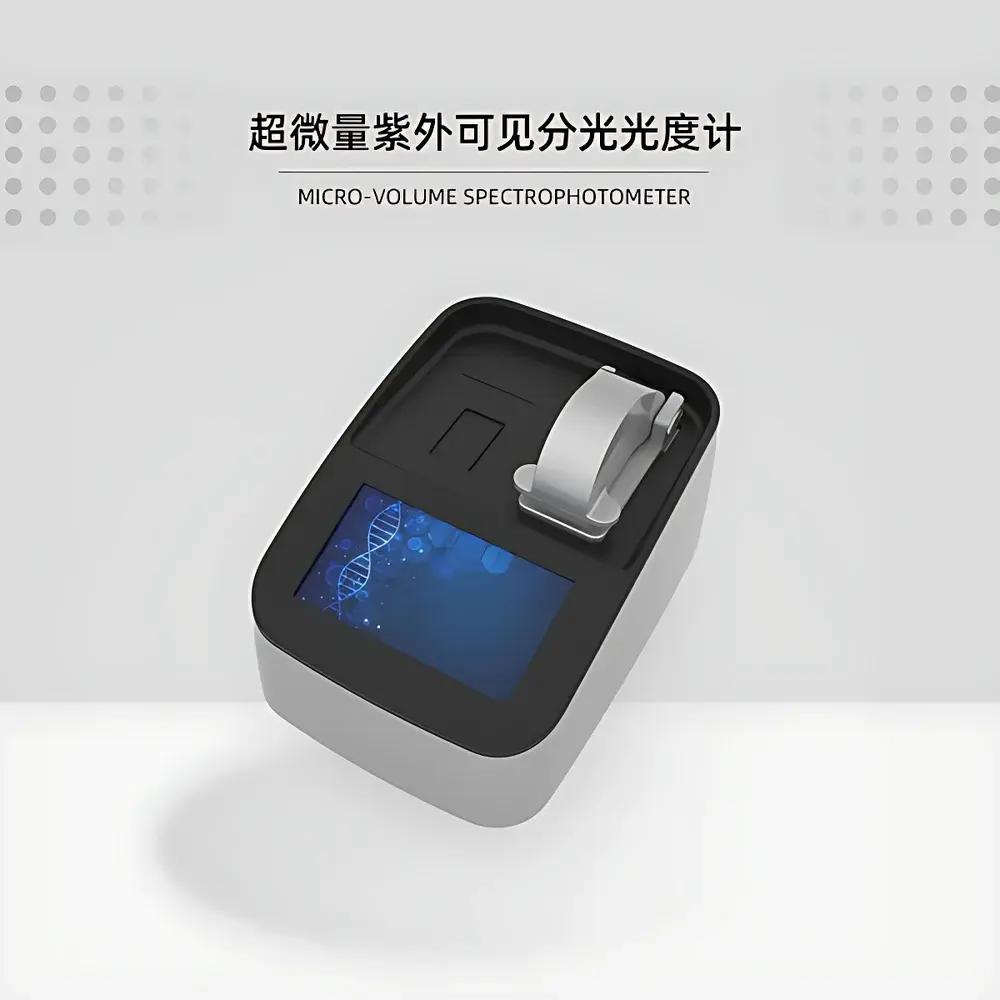
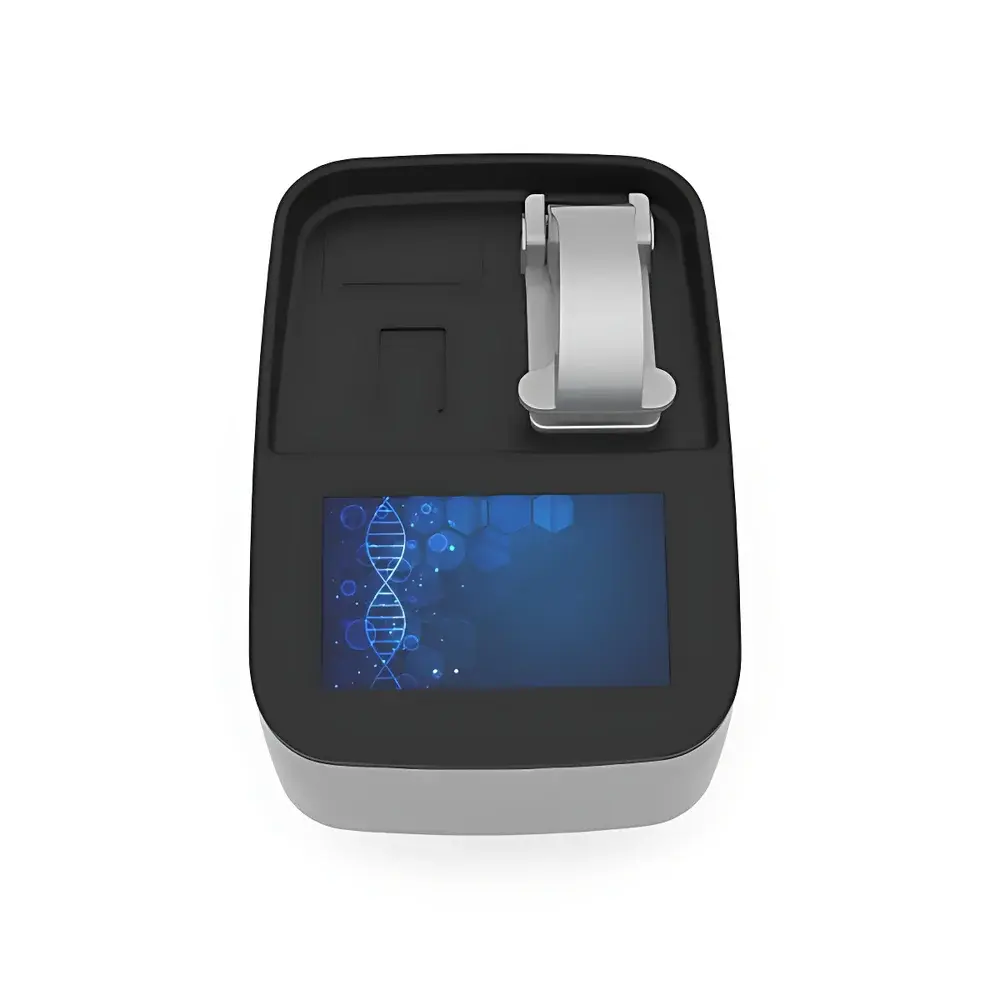
Macylab UL-5000 Ultra-Micro Volume UV-Vis Spectrophotometer
| Brand | Macylab |
|---|---|
| Origin | Beijing, China |
| Model | UL-5000 |
| Wavelength Range | 190–900 nm |
| Wavelength Accuracy | ±1% (0.76 at 260 nm) |
| Wavelength Repeatability | ≤0.5% for OD < 3, ≤2% for OD 3–4 |
| Photometric Range | 0–4.000 Abs (OD600) |
| Minimum Sample Volume | 0.3 µL |
| Pathlength Options | 0.02–1 mm (auto-adjustable), 1/2/5/10 mm cuvette |
| Absorbance Resolution | 0.002 Abs (1 mm path) |
| Detector | UV-enhanced CMOS linear array sensor |
| Light Source | Imported miniature xenon flash lamp (≥10⁹ flashes, >10-year lifetime) |
| Measurement Time | <3 s |
| Display | 7-inch Android-based touchscreen |
| Optical Principle | Fixed-pathlength, direct-drop microvolume absorbance measurement |
Overview
The Macylab UL-5000 Ultra-Micro Volume UV-Vis Spectrophotometer is a benchtop-grade, fixed-pathlength microvolume spectrophotometer engineered for rapid, precise quantification and spectral characterization of nucleic acids, proteins, and microbial suspensions. It operates on the principle of direct-drop absorbance measurement—where a small liquid column bridges two optical surfaces, establishing a defined pathlength without capillary action or mechanical adjustment. This eliminates calibration drift associated with variable-pathlength systems and ensures long-term photometric stability. The instrument integrates a high-stability xenon flash lamp and a UV-optimized CMOS linear array detector to deliver full-spectrum acquisition from 190 nm to 900 nm in under three seconds. Its design adheres to core spectroscopic fundamentals: Beer–Lambert law compliance, stray-light suppression below 0.05% at 220 nm, and wavelength accuracy traceable to NIST-traceable standards. The UL-5000 is not a portable field device in the ruggedized sense, but its compact footprint (240 × 180 × 160 mm) and integrated Android interface enable deployment in shared core facilities, QC labs, and teaching laboratories where space, speed, and sample economy are critical.
Key Features
- Ultra-low sample consumption: Quantifies nucleic acids and proteins using only 0.3 µL of undiluted sample—reducing reagent cost and preserving precious clinical or synthetic biomaterials.
- Auto-adjusting microvolume pathlength: Dynamically selects optimal pathlength between 0.02 mm and 1 mm based on sample absorbance, extending linear dynamic range up to 750 A (equivalent to 10 mm cuvette), far exceeding conventional 1 mm instruments.
- Dual-platform operation: Supports both microvolume drop analysis and standard cuvette measurements (1, 2, 5, and 10 mm pathlengths) without hardware modification.
- No warm-up or zeroing required: Xenon flash lamp provides stable intensity across >10⁹ pulses; system performs internal reference correction before each measurement, eliminating baseline drift and manual blanking.
- Fixed-optics architecture: Permanent optical alignment ensures lifelong wavelength and photometric accuracy—no user-serviceable calibration needed per ISO/IEC 17025 maintenance requirements.
- Integrated Android interface: 7-inch capacitive touchscreen enables standalone operation with preloaded nucleic acid (dsDNA, RNA, oligos), protein (BSA, IgG), and cell density (OD600) calculation modules.
Sample Compatibility & Compliance
The UL-5000 accommodates aqueous buffers, ethanol/water mixtures, low-concentration chaotropic agents (e.g., 0.1% SDS), and volatile solvents including acetone and isopropanol—enabled by its inert 304 stainless steel and fused quartz sample stage. It meets essential performance criteria outlined in ASTM E275, ISO 6425 (for optical stability), and USP <857> for spectrophotometric assay validation. While not certified for GMP production environments, its audit-ready data export (CSV, PDF, XML), timestamped measurement logs, and absence of consumable optical components support GLP-compliant workflows in academic and contract research settings. The instrument’s OD600 mode complies with ISO 8199:2018 for bacterial suspension turbidity measurement, with documented repeatability ≤0.5% below OD 3.0 and ≤2% up to OD 4.0.
Software & Data Management
Data acquisition and analysis are managed via an embedded Android OS platform with local storage (16 GB eMMC) and USB-C export capability. The firmware supports configurable report templates—including sample ID, operator, date/time stamp, wavelength scan plots, and concentration outputs—with optional integration into LIMS via CSV batch export. All raw spectral data (absorbance vs. wavelength) are retained with metadata, enabling retrospective reprocessing. For advanced users, a PC-based control application (Windows/macOS) provides extended functionality: kinetic time-course monitoring, multi-curve overlay, custom extinction coefficient entry, and export of spectral data in JCAMP-DX format for third-party chemometrics software. Audit trails record all parameter changes and measurement events—fully compliant with FDA 21 CFR Part 11 requirements when deployed with network authentication and electronic signature protocols.
Applications
- Nucleic acid quantification: dsDNA (1.5–37,500 ng/µL), ssDNA, RNA, and oligonucleotides using sequence-specific or generic extinction coefficients.
- Protein analysis: BSA (0.05–1,110 mg/mL), IgG (0.03–540 mg/mL), and other purified proteins via A280, A205, or dual-wavelength methods.
- Cell culture monitoring: Routine OD600 measurement for E. coli, yeast, and mammalian suspension cultures with validated linearity up to 4.000 Abs.
- Purity assessment: 260/280 and 260/230 ratios for nucleic acid integrity; A260/A280 and A215/A225 for protein contamination screening.
- Small-molecule characterization: UV-Vis scanning of dyes, catalysts, and pharmaceutical intermediates in research-scale synthesis.
FAQ
Does the UL-5000 require daily calibration or wavelength verification?
No. Its fixed-pathlength optical architecture and xenon flash lamp stability eliminate routine calibration. Wavelength accuracy is factory-verified against NIST-traceable holmium oxide and didymium filters, and remains invariant over instrument lifetime.
Can the UL-5000 measure samples in organic solvents like DMSO or acetonitrile?
Yes—the quartz and 304 stainless steel sample stage is chemically resistant to common polar aprotic solvents. Avoid prolonged exposure to hydrofluoric acid or concentrated strong bases.
Is the OD600 mode traceable to international standards?
Yes. The instrument’s photometric linearity and repeatability in the 600 ± 5 nm band meet the repeatability thresholds specified in ISO 8199:2018 for turbidimetric microbial enumeration.
How is data integrity ensured during regulatory audits?
All measurements include immutable timestamps, operator IDs (if configured), and full spectral data. Export formats support ALCOA+ principles (Attributable, Legible, Contemporaneous, Original, Accurate), and the PC software enables 21 CFR Part 11-compliant electronic signatures when paired with enterprise authentication.
What is the expected lifetime of the light source?
The imported xenon flash lamp is rated for ≥10⁹ flashes, corresponding to >10 years of typical lab use (≈500 measurements/day). No user-replaceable lamp module is required—source degradation is monitored internally and reported via firmware diagnostics.




