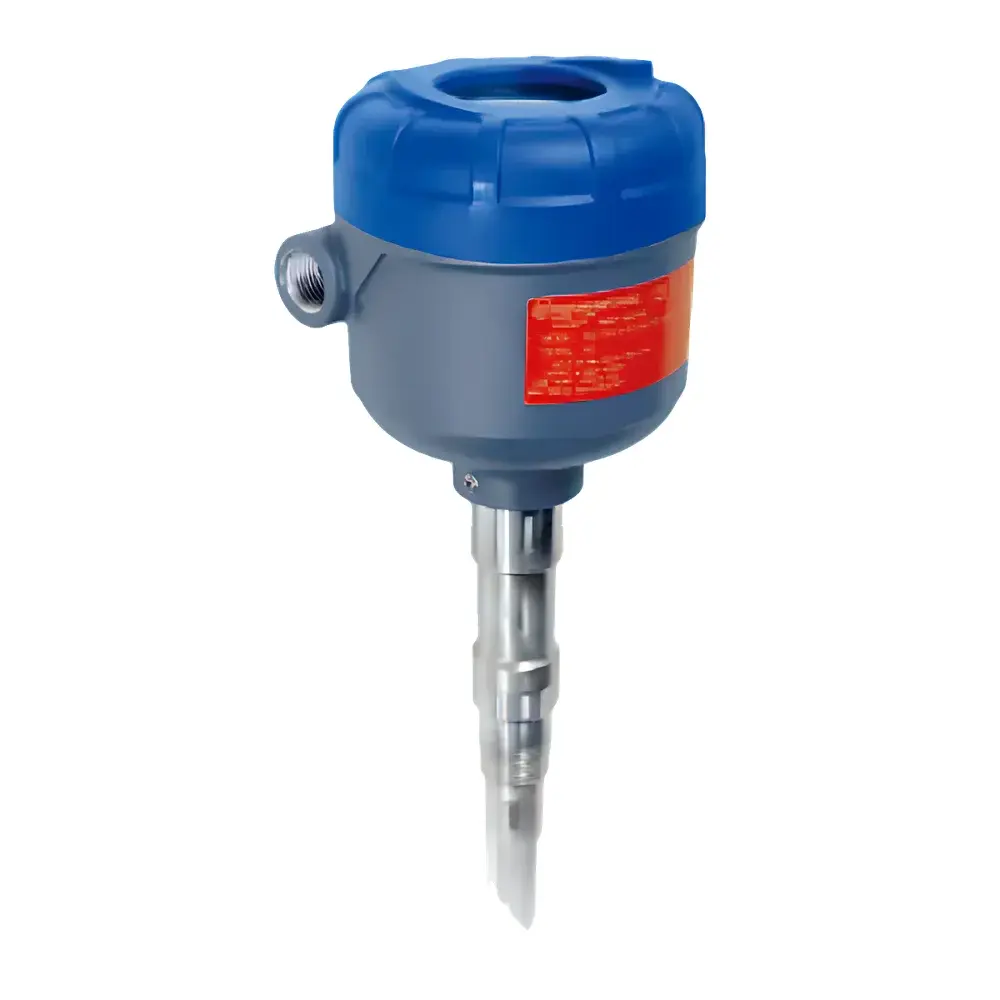
MAGNETROL Eclipse® 700 Series Guided Wave Radar (GWR) Level Transmitter
| Brand | MAGNETROL |
|---|---|
| Model | Eclipse® 700 Series |
| Measurement Principle | Time-Domain Reflectometry (TDR) |
| Power Supply | 24 VDC loop-powered |
| Output Signal | 4–20 mA with HART® digital communication |
| Intrinsic Safety Certification | FM, ATEX, IECEx (ia IIC T6 Ga) |
| Explosion-Proof Rating | Non-sparking (nA) |
| SIL Rating | SIL 2 / SIL 3 per IEC 61508 (SFF = 93%, FMEDA available) |
| Process Temperature Range | –196 °C to +220 °C (–320 °F to +400 °F) |
| Process Pressure Range | Full vacuum to 43 MPa (6250 psi) |
| Accuracy | ±2 mm typical (dependent on probe type and installation) |
| Probe Options | Flexible cable, rigid rod, coaxial, twin-lead |
| Display Option | Integrated LCD with echo curve visualization |
| Compliance | IEC 61000-6-2/-6-4, IEC 61326-1, NAMUR NE 21/NE 43, FCC Part 15 Subpart B |
Overview
The MAGNETROL Eclipse® 700 Series Guided Wave Radar (GWR) Level Transmitter is an intrinsically safe, loop-powered level measurement instrument engineered for high-reliability continuous level monitoring in demanding industrial process environments. Based on the time-domain reflectometry (TDR) principle, the device emits low-energy electromagnetic pulses along a metallic probe—either rigid rod, flexible cable, or coaxial—that extends into the process medium. When the pulse encounters a dielectric discontinuity—such as the interface between vapor and liquid or slurry—the portion of energy reflected back to the transmitter is measured. The time-of-flight between emission and return is converted into a precise distance value, enabling highly repeatable level determination independent of density, conductivity, viscosity, or dielectric constant variations within typical process ranges.
Key Features
- True loop-powered operation at 24 VDC with integrated diagnostics—no external power supply required for standard configurations
- Advanced signal processing architecture delivering enhanced signal-to-noise ratio, enabling stable measurement in foaming, turbulent, or low-dielectric media (e.g., hydrocarbons, solvents, aqueous solutions)
- No field calibration required post-installation; factory-trimmed probe geometry and built-in reference calibration ensure long-term stability
- Comprehensive intrinsic safety certification suite (FM, ATEX, IECEx) for Zone 0/1 and Div. 1 hazardous areas, plus non-sparking (nA) classification for non-hazardous locations
- Robust mechanical design rated for extreme process conditions: full vacuum up to 43 MPa pressure and –196 °C to +220 °C temperature range
- SIL 2 and SIL 3 compliance validated per IEC 61508, with documented Safe Failure Fraction (SFF) of 93% and full FMEDA report available upon request
- Integrated graphical LCD display option showing real-time echo curve, signal strength bar graph, and diagnostic status flags
Sample Compatibility & Compliance
The Eclipse® 700 is suitable for continuous level measurement of liquids, slurries, and emulsions across diverse chemical, petrochemical, pharmaceutical, and water/wastewater applications. It performs reliably in media with dielectric constants as low as εr = 1.4 (e.g., propane, butane), and maintains accuracy in vessels exhibiting internal obstructions, agitators, or foam layers up to 300 mm thick. All models comply with electromagnetic compatibility standards IEC 61326-1 and IEC 61000-6-2/-6-4, and meet NAMUR NE 21 (output signal limits) and NE 43 (diagnostic alarm thresholds). For regulated industries, the device supports audit-ready configuration logging and change tracking aligned with FDA 21 CFR Part 11 requirements when used with compatible host systems.
Software & Data Management
Configuration and diagnostics are performed via HART® 7 protocol using standard handheld communicators (e.g., AMS Device Manager, FieldCare) or PC-based tools. The transmitter supports dynamic variable mapping, multi-point verification, and automatic echo profile logging. Diagnostic data—including signal quality index, probe health status, and historical reflection amplitude trends—is embedded in the HART® dataset and exportable for predictive maintenance analysis. Optional firmware updates maintain alignment with evolving IEC 62591 (WirelessHART) and FDI (Field Device Integration) specifications.
Applications
- Level monitoring in pressurized hydrocarbon storage tanks (LPG, LNG, crude oil) under API RP 500/505 zoning
- Interface detection between immiscible liquids (e.g., oil/water separation vessels)
- Batch reactor level control in GMP-compliant pharmaceutical manufacturing
- High-temperature condensate return tanks in steam generation systems
- Agitated slurry vessels in mining and mineral processing where radar beam dispersion limits non-contact alternatives
- Cryogenic applications including liquid nitrogen and liquid oxygen storage (validated down to –196 °C)
FAQ
Does the Eclipse® 700 require recalibration after probe replacement?
No. Each probe is serialized and pre-matched to its transmitter during factory calibration. Replacement probes retain full metrological traceability without field recalibration.
Can it measure interface levels in dual-phase systems?
Yes—when configured with appropriate probe geometry (e.g., coaxial or twin-lead), the device resolves two distinct echoes corresponding to upper and lower phase interfaces, provided dielectric contrast exceeds εr ≥ 5 between phases.
Is wireless integration supported out of the box?
The base model supports wired HART® communication only. WirelessHART® functionality requires optional adapter modules compliant with IEC 62591 and certified for the same hazardous area classifications.
How is SIL certification maintained during firmware updates?
All firmware revisions undergo functional safety revalidation per IEC 61508. Version-controlled release notes and updated FMEDA reports are supplied with each certified update package.