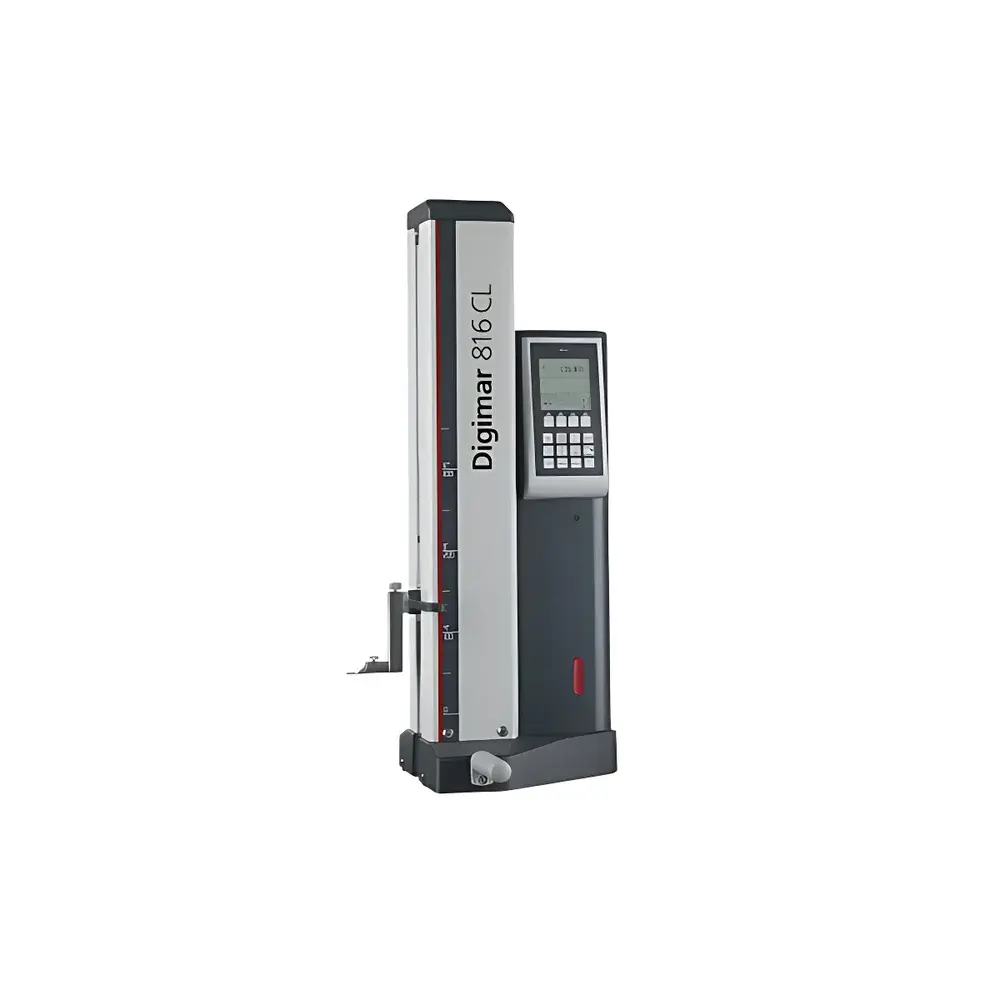
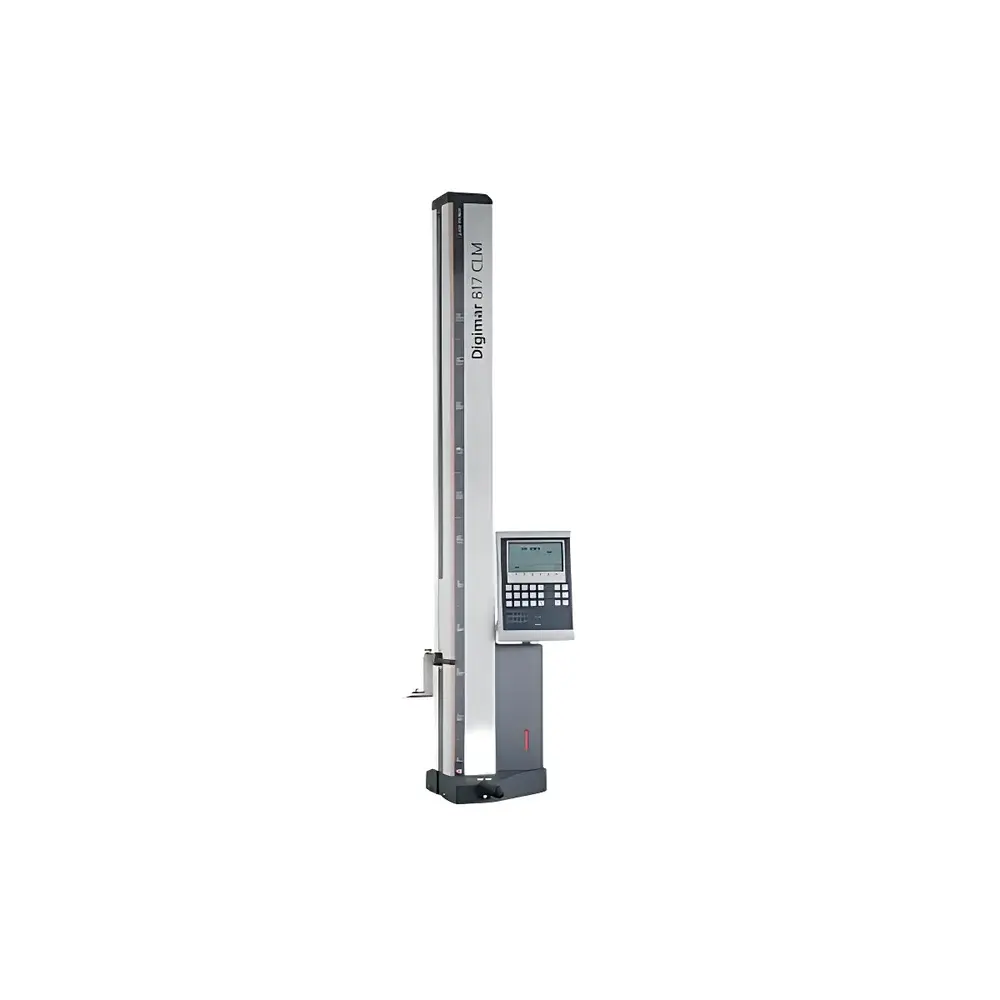
Mahr Digimar 817 CLM / 816 CL Precision Length Measuring Instrument
| Brand | Mahr |
|---|---|
| Origin | Germany |
| Model | Digimar 817 CLM / 816 CL |
| Measurement Principle | Dual-Head Optical Encoder-Based Linear Displacement Metrology |
| Motion System | Air-Bearing Guided Motorized Carriage |
| Guide Rail Material | Stainless Steel |
| Positioning Repeatability | ≤ ±0.3 µm (typical, per ISO 230-2) |
| Temperature Compensation | Integrated Pt100 Sensor with Real-Time Linear Expansion Correction |
| Display | Backlit Graphic LCD with Icon-Based Menu Navigation |
| Data Interface | RS232 (Opto-Isolated), USB 2.0 |
| Power Supply | Rechargeable Li-ion Battery (≥8 h continuous operation) |
| Zero Setting | User-Defined Reference Point on Workpiece |
| Compliance | Designed to Support ISO/IEC 17025 Calibration Traceability Requirements |
| Software Upgrade Path | Field-Programmable Firmware via USB |
Overview
The Mahr Digimar 817 CLM and 816 CL are high-precision, motorized length measuring instruments engineered for dimensional metrology in quality control laboratories, calibration facilities, and production environments requiring traceable linear displacement measurements. These instruments operate on a dual-head optical encoder principle—where two independent read heads simultaneously track position along a precision-ground stainless steel guideway—minimizing Abbe error and enhancing thermal stability across the full measurement range. The air-bearing carriage system eliminates mechanical friction, ensuring smooth, vibration-damped motion essential for sub-micrometer repeatability. Unlike manual comparators or basic digital calipers, the Digimar series integrates real-time temperature compensation via an embedded Pt100 sensor, dynamically adjusting measured values according to workpiece and instrument thermal expansion coefficients per ISO 16610-21 and ISO 230-3 guidelines. Its modular architecture supports both benchtop and integrated metrology station configurations, with all critical calibration parameters retained in non-volatile memory—even after power-down—ensuring continuity of measurement integrity across shifts and audit cycles.
Key Features
- Dual-readhead optical grating scale system delivering enhanced linearity and long-term stability over extended travel ranges
- Air-bearing guided motorized carriage enabling consistent velocity control and minimizing hysteresis during bidirectional movement
- Stainless steel precision guideways with hardened, lapped surfaces for wear resistance and geometric fidelity
- Integrated rechargeable lithium-ion battery supporting ≥8 hours of uninterrupted operation—ideal for mobile metrology tasks or cleanroom deployment
- Backlit graphical LCD with intuitive icon-driven interface; multilingual menu support (English, German, French, Spanish, Chinese, Japanese)
- User-definable zero reference directly on the workpiece surface—eliminating reliance on fixed mechanical stops
- Automatic standby mode and configurable auto-shutdown with full data retention in flash memory
- Real-time thermal compensation algorithm compliant with ISO 9001 and ISO/IEC 17025 documentation requirements
Sample Compatibility & Compliance
The Digimar 817 CLM and 816 CL accommodate a broad spectrum of geometrically stable workpieces—including gauge blocks, plug gauges, ring gauges, shafts, stepped components, and machined prismatic parts—within their respective travel envelopes (e.g., 100 mm to 500 mm depending on model variant). The contact probe is interchangeable with standard Mahr tactile stylus options (e.g., spherical ruby tips, flat-faced anvils), allowing adaptation to surface geometry and material hardness. All instruments are supplied with factory calibration certificates traceable to PTB (Physikalisch-Technische Bundesanstalt) standards. The design supports GLP/GMP-aligned workflows: firmware logs include timestamped operator ID, environmental conditions (temperature/humidity), and measurement sequence metadata—facilitating audit-ready recordkeeping per FDA 21 CFR Part 11 when paired with validated Mahr MarWin software.
Software & Data Management
Data export is supported via opto-isolated RS232 and USB 2.0 interfaces, enabling seamless integration into SPC platforms (e.g., Minitab, Q-DAS), MES systems, or custom LabVIEW-based acquisition environments. The onboard controller stores up to 1,000 measurement records locally, each tagged with date/time stamp, user-defined part ID, and temperature-corrected value. Firmware updates are delivered as signed binary packages via USB stick—validated prior to installation to preserve configuration integrity. Optional MarWin 6.x software provides statistical analysis (Cp/Cpk, X̄-R charts), GD&T evaluation (per ASME Y14.5–2018), and automated report generation compliant with ISO 10012 and ISO 17025 clause 7.7.
Applications
- Calibration of end standards and line standards in accredited metrology labs
- In-process verification of turned, ground, or EDM-finished components in aerospace and medical device manufacturing
- Dimensional validation of injection-molded plastic parts where thermal drift must be compensated in real time
- Comparative measurement of master gauges against working standards under controlled environmental conditions
- Research-grade linear displacement characterization in materials science laboratories studying creep or thermal expansion behavior
FAQ
Does the Digimar retain calibration data after battery depletion?
Yes—the instrument uses non-volatile memory to preserve all calibration coefficients, user-defined zero points, and historical measurement logs even during complete power loss.
Can the Digimar connect to modern PC operating systems without legacy drivers?
Yes—USB connectivity operates in HID-compliant mode; no additional drivers are required for Windows 10/11, macOS 12+, or Linux distributions with kernel ≥5.4.
Is temperature compensation active during manual positioning?
Yes—thermal correction is continuously applied regardless of motion mode (motorized or manual jog), provided the internal Pt100 sensor is within its specified operating range (15–30 °C).
What is the maximum permissible deviation from nominal temperature for certified measurements?
Per ISO 1.5 and ISO 230-3, the recommended ambient operating range is 20 ±1 °C; deviations beyond this require documented environmental monitoring and may necessitate expanded uncertainty budgets in calibration certificates.
How often does the system require recalibration?
Annual recalibration is recommended under normal use; however, interval adjustments must follow risk-based assessment per ISO/IEC 17025 clause 7.8.1 and documented evidence of ongoing performance verification (e.g., daily check standards).