
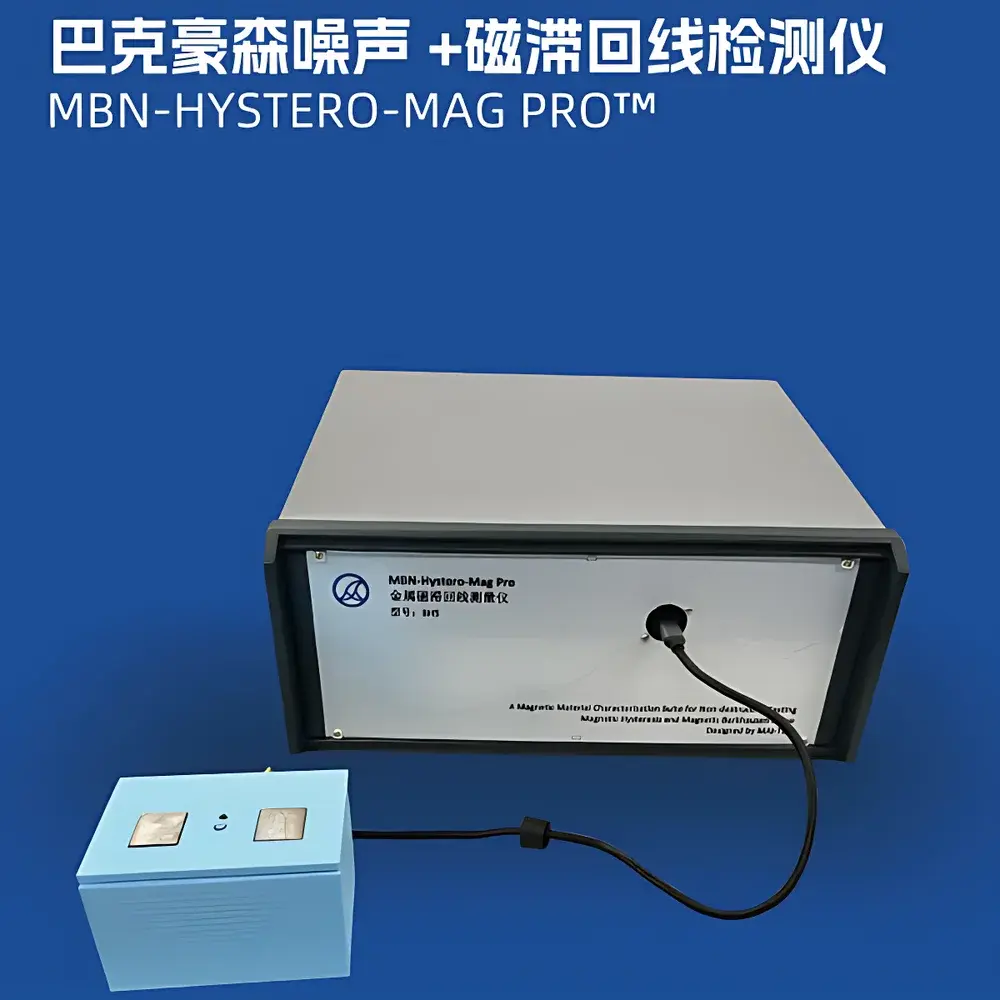
MAIERIC BH Hysteresis Loop & Magnetic Barkhausen Noise (MBN) Analyzer
| Brand | MAIERIC |
|---|---|
| Origin | Anhui, China |
| Model | BH-MBN-1000 |
| Measurement Principle | Dual-mode electromagnetic induction + Hall-effect field sensing + high-sensitivity MBN coil detection |
| Excitation Frequency Range | 1 Hz – 10 kHz (programmable) |
| MBN Bandpass Filter | 20 kHz – 2 MHz (adjustable center frequency & bandwidth) |
| Signal Acquisition | Simultaneous real-time sampling of B (flux density), H (magnetic field strength), and MBN voltage waveform |
| Data Output Format | SQLite (.db) with timestamped raw channels, calculated coercivity (Hc), remanence (Br), and MBN RMS/peak amplitude |
| Interface | Wi-Fi 802.11n (IEEE 802.11 compliant), USB 2.0 fallback |
| Software Platform | Windows 10/11 native application with GLP-compliant audit trail logging (user action timestamps, parameter change history, export metadata) |
Overview
The MAIERIC BH-MBN-1000 is a dual-function electromagnetic characterization system engineered for non-destructive evaluation of ferromagnetic materials. It integrates two complementary magnetic measurement modalities—quasi-static BH hysteresis loop analysis and high-frequency Magnetic Barkhausen Noise (MBN) emission detection—within a single, co-located U-core probe architecture. The system operates on the principle of controlled magnetization via low-frequency AC excitation (1–10 kHz) applied to bifilar windings on the arms of a soft magnetic U-core. Flux density (B) is derived from induced voltage in a secondary pickup coil wound at the core base, while magnetic field strength (H) is measured directly using a calibrated Hall-effect sensor positioned across the air gap between the pole faces. A miniature, shielded MBN sensing coil—centered precisely between the poles and maintained at sub-millimeter standoff from the sample surface—captures stochastic domain-wall jump events as broadband voltage transients (20 kHz–2 MHz). This concurrent acquisition enables correlation of macroscopic hysteresis parameters (e.g., coercivity Hc, remanence Br, permeability μ) with microstructural features reflected in MBN spectral energy distribution, noise amplitude, and pulse count rate.
Key Features
- Dual-signal synchronized acquisition: Simultaneous real-time digitization of B(t), H(t), and MBN(t) waveforms at configurable sampling rates up to 10 MS/s per channel.
- Programmable excitation control: Independent adjustment of excitation voltage amplitude (0–20 Vpp), frequency (1 Hz–10 kHz), and waveform shape (sine, triangle, trapezoidal).
- Configurable MBN signal conditioning: Digitally tunable bandpass filter (center frequency: 50 kHz–1.5 MHz; bandwidth: 10–500 kHz); programmable preamplifier gain (20–80 dB).
- Wi-Fi–enabled remote operation: IEEE 802.11n wireless interface supports secure, latency-optimized command streaming and live data telemetry to Windows-based host PCs; USB 2.0 provided as deterministic fallback.
- GLP-compliant software architecture: Built-in audit trail logs all user-initiated parameter changes, measurement start/stop events, and data export actions with UTC timestamps and operator ID fields.
- Quantitative output suite: Automatic calculation and display of Hc, Br, saturation flux density Bs, differential permeability dM/dH, MBN RMS amplitude, peak pulse count per cycle, and spectral centroid frequency.
Sample Compatibility & Compliance
The BH-MBN-1000 is optimized for flat or gently curved ferromagnetic specimens—including low-carbon steels, bearing alloys, tool steels, and nickel-based superalloys—with surface roughness < Ra 3.2 µm and minimum thickness ≥ 2 mm. Probe geometry accommodates samples with widths ≥ 15 mm and lengths ≥ 40 mm. The system adheres to electromagnetic compatibility requirements per IEC 61326-1:2013 (industrial environment). Data handling protocols support traceability under ISO/IEC 17025:2017 (clause 7.7) and analytical method validation per ASTM E3095–21 (Standard Guide for Magnetic Barkhausen Emission Testing). While not FDA-cleared, its audit-trail functionality aligns with documentation expectations for GMP-regulated material qualification workflows where magnetic properties serve as surrogate indicators of mechanical integrity.
Software & Data Management
The proprietary MAIERIC Control Suite (v4.2+) runs natively on Windows 10/11 x64 platforms and provides a modular, tab-driven interface. Key modules include: (1) Real-time oscilloscope view with independent X–Y scaling for B–H loops and MBN time-domain plots; (2) Parameter configuration panel with hardware-level lockout for critical settings; (3) Batch measurement scheduler supporting sequential multi-point scans; (4) SQLite-based database engine (.db files) storing raw ADC samples, computed metrics, and full metadata (probe calibration ID, ambient temperature, operator name, test standard reference). Export options include CSV (for MATLAB/Python post-processing), PDF reports with embedded plots and pass/fail annotations, and XML schemas compatible with LIMS integration. All exported datasets retain cryptographic hash signatures for integrity verification.
Applications
- Residual stress mapping in case-hardened gears and shafts: Correlation of MBN amplitude suppression and Hc broadening with compressive near-surface stresses induced by shot peening or roller burnishing.
- Grinding burn detection: Identification of thermally altered microstructures (e.g., untempered martensite) via elevated MBN pulse counts and anomalous B–H loop asymmetry during in-process inspection.
- Hardness estimation in heat-treated steels: Empirical regression models linking MBN spectral centroid shift and coercivity hysteresis width to Rockwell C-scale values, validated against ASTM E18.
- Material batch consistency screening: Statistical process control (SPC) of Hc and MBN RMS across production lots using automated threshold-based pass/fail classification.
- Fundamental domain dynamics research: Time-resolved MBN pulse train analysis under variable DC bias fields to investigate pinning site density and domain wall mobility in nanocrystalline ribbons.
FAQ
What standards does the BH-MBN-1000 comply with for industrial NDT use?
It conforms to IEC 61326-1:2013 for EMC and implements measurement traceability aligned with ASTM E3095–21 and ISO 10893-13 for MBN-based integrity assessment.
Can the system quantify absolute residual stress values?
No—it provides relative stress ranking and qualitative classification (e.g., “burned” vs. “unaffected”) based on calibrated MBN/Hc response curves; quantitative stress requires separate calibration against destructive hole-drilling or XRD reference data.
Is the .db file format compatible with third-party analysis tools?
Yes—SQLite databases are natively readable by Python (sqlite3), MATLAB (Database Toolbox), and R (RSQLite); schema documentation is included in the software installation package.
Does the Wi-Fi connection support enterprise security protocols?
It supports WPA2-PSK and WPA3-SAE encryption modes, and integrates with 802.1X RADIUS authentication when deployed within managed corporate networks.
What is the recommended recalibration interval for the Hall sensor and MBN coil?
Annual recalibration against NIST-traceable magnetic field and voltage standards is recommended; the software includes built-in self-test routines for drift monitoring between formal calibrations.



