
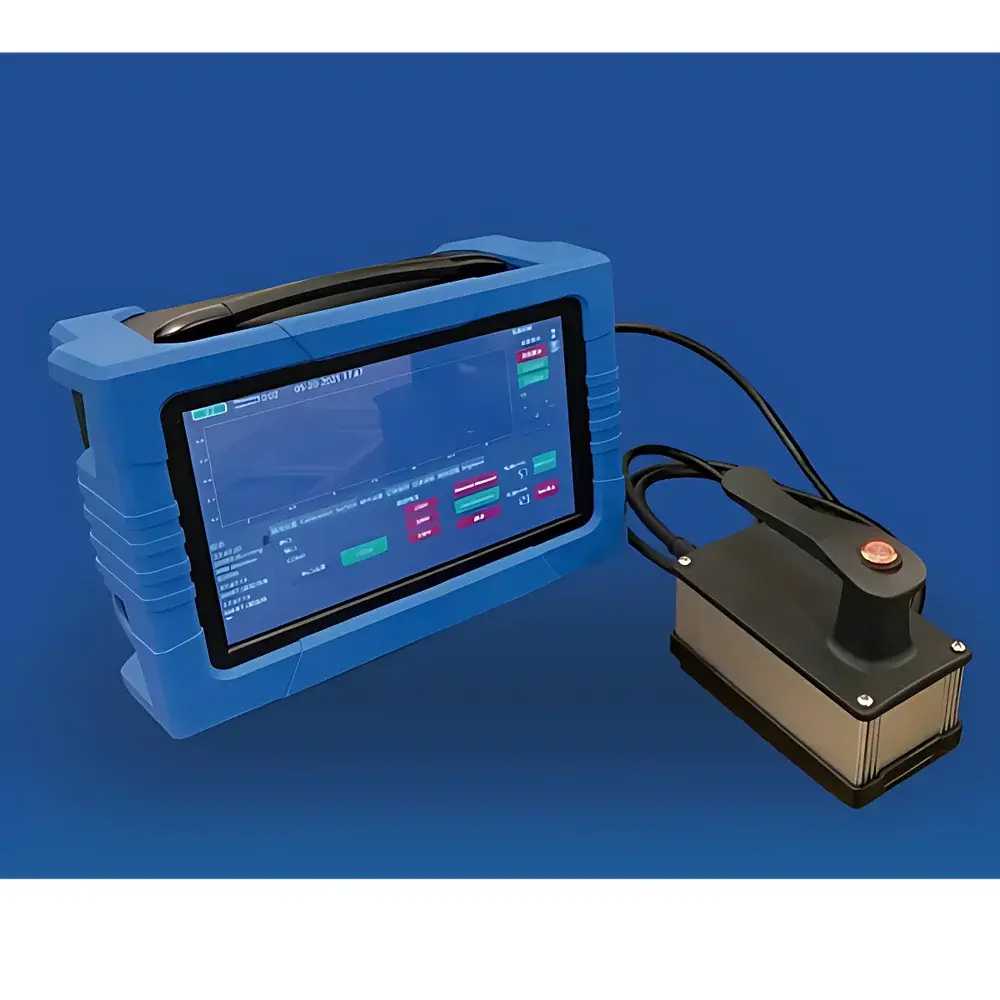
MAIERIC CFT-1 Portable Coercivity Tester for Ferromagnetic Materials
| Brand | MAIERIC |
|---|---|
| Origin | Anhui, China |
| Model | CFT-1 |
| Coercivity Range | 1–50 A/cm |
| Measurement Depth | Up to 30 mm |
| Surface Clearance | Up to 6 mm |
| Measurement Speed | ~3.5 s per reading |
| Excitation Levels | 3 adjustable intensity settings |
| Data Storage | 32 GB internal (DB & CSV export) |
| Display | 2K full-touchscreen interface |
| Compliance | Designed for field-deployable non-destructive evaluation (NDE) of ferromagnetic components |
| Interface | USB, HDMI, sensor port |
Overview
The MAIERIC CFT-1 Portable Coercivity Tester is an engineered solution for rapid, non-destructive assessment of coercivity (Hc) in ferromagnetic metallic materials—principally carbon steels, low-alloy steels, and cast irons—under field or workshop conditions. It operates on the principle of magnetic hysteresis loop analysis using controlled AC excitation and high-sensitivity flux sensing. Unlike destructive metallographic methods, the CFT-1 infers microstructural state—including dislocation density, residual stress distribution, grain boundary integrity, and phase transformation extent—through quantitative correlation between measured coercivity and empirically validated metallurgical response models. This makes it particularly suitable for in-service inspection of pressure vessels, pipelines, structural welds, turbine blades, and heat-treated forgings where thermal history, fatigue accumulation, or embrittlement risk must be evaluated without component removal or surface preparation.
Key Features
- Non-contact surface tolerance: Measures through paint, oxide layers, or light corrosion up to 6 mm air gap—eliminating need for grinding, polishing, or chemical cleaning.
- Depth-resolved capability: Penetrates up to 30 mm into bulk material, enabling subsurface defect screening and gradient analysis in thick-walled components.
- Three-level excitation control: Adjustable magnetic field amplitude ensures optimal signal-to-noise ratio across varying material thicknesses, permeability, and geometry (e.g., curved surfaces, weld beads, or bolted joints).
- Dual acquisition modes: Supports single-point manual triggering and continuous scanning mode for line profiling or area mapping.
- Real-time visualization: Integrated 2K full-touch display renders coercivity values numerically and graphically—including 1D trend plots and 2D false-color heatmaps aligned with physical probe position.
- Intelligent calibration workflow: On-device guided calibration reduces operator dependency; reference standards traceable to NIST-traceable secondary standards are supported via user-defined database import.
Sample Compatibility & Compliance
The CFT-1 is validated for use on ferromagnetic alloys exhibiting saturation magnetization above 1.2 T and relative permeability >100 at low-field excitation. It complies with ASTM E1444/E1444M (Standard Practice for Magnetic Particle Testing) for qualitative magnetic property screening and aligns with ISO 10893-13 (Non-destructive testing of steel tubes — Part 13: Magnetic leakage flux testing of seamless and welded steel tubes for detection of surface imperfections) in methodology principles. While not a certified metrology instrument per ISO/IEC 17025, its measurement repeatability (±3% RSD under controlled lab conditions) supports trend-based condition monitoring in accordance with API RP 579-1/ASME FFS-1 (Fitness-for-Service) Annex G guidelines for magnetic property assessment.
Software & Data Management
Data acquisition, annotation, and reporting are managed via embedded firmware supporting dual export formats: structured relational database (.db) for long-term archival and interoperability with SQL-based CMMS platforms, and comma-separated values (.csv) for statistical process control (SPC) integration in Minitab, JMP, or Python-based analytics pipelines. Timestamped records include GPS metadata (when external module connected), ambient temperature, excitation level, probe orientation, and raw hysteresis loop snapshots. Audit trails meet GLP-aligned requirements for data integrity: all modifications are logged with user ID, timestamp, and action type. Firmware updates are delivered via USB-hosted secure package verification (SHA-256 checksum validation).
Applications
- Post-weld heat treatment (PWHT) verification in ASME Section VIII pressure equipment
- In-service fatigue life estimation of crane hooks, rail axles, and mining conveyor components
- Sorting of mixed batches of unknown steel grades based on coercivity fingerprinting
- Monitoring thermal aging effects in nuclear reactor piping and steam generator tubing
- Quality gate screening for induction-hardened gear teeth and bearing races
- Corrosion-fatigue coupling assessment in offshore platform structural nodes
FAQ
Does the CFT-1 require sample magnetization prior to measurement?
No—built-in excitation coil provides controlled, low-frequency AC field; no external magnetizing yoke or power supply is needed.
Can it distinguish between hardness and residual stress contributions to coercivity?
Not independently; coercivity reflects their combined influence. Correlative studies with Vickers hardness and XRD stress mapping are recommended for deconvolution.
Is calibration traceable to national standards?
Calibration uses factory-characterized reference samples with documented Hc values traceable to NIST SRM 3252 (low-coercivity iron-cobalt alloy standard); end-user recalibration requires certified reference blocks.
What environmental conditions limit operational use?
Operating temperature range: −10 °C to +50 °C; IP54-rated enclosure protects against dust ingress and water splashing—but not submersion or high-humidity condensation environments.
How is measurement uncertainty quantified?
Uncertainty budget includes repeatability (±2.8% k=2), probe alignment sensitivity (±1.2%), temperature drift compensation (±0.6%/°C), and excitation stability (±0.4%), yielding combined expanded uncertainty of ±4.1% (k=2) under nominal conditions.



