
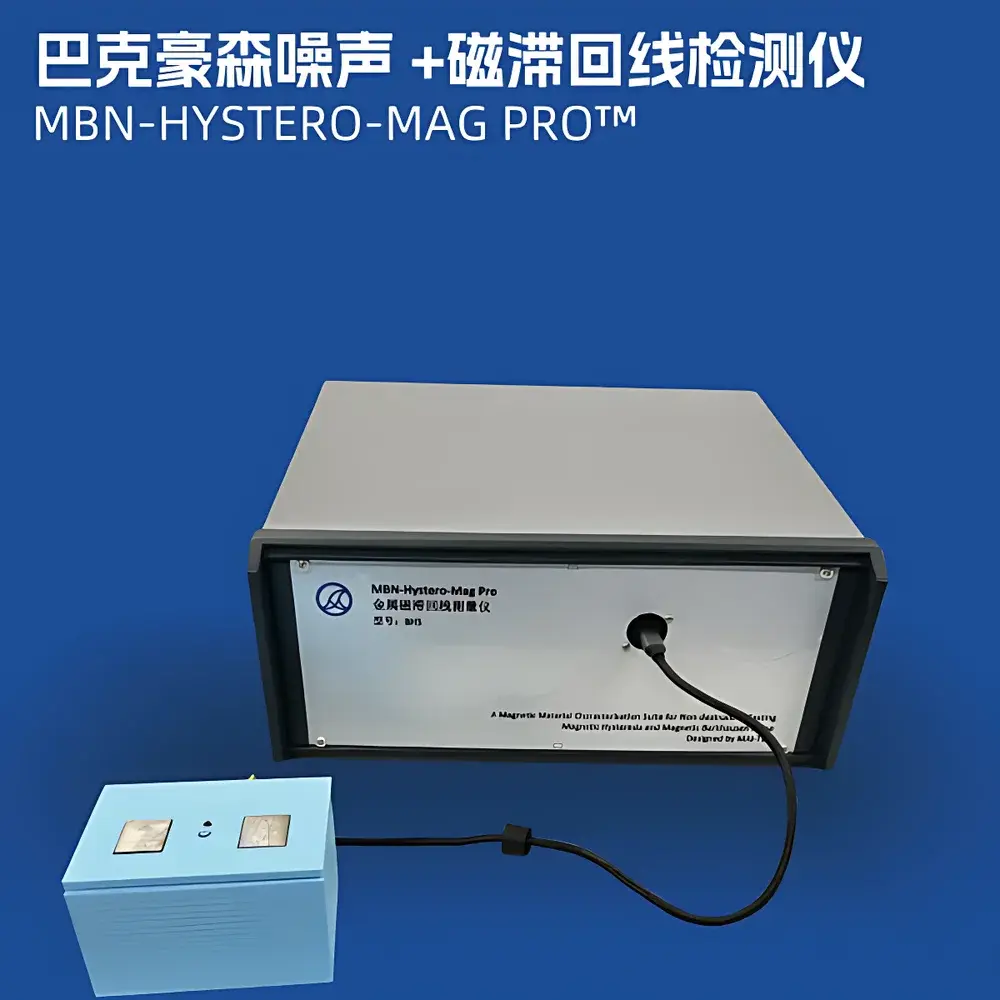
MAIERIC MBN-2000 Barkhausen Noise & BH Hysteresis Loop Analyzer
| Brand | MAIERIC |
|---|---|
| Origin | Anhui, China |
| Model | MBN-2000 |
| Measurement Principle | Electromagnetic Induction + Hall Effect + High-Frequency Eddy Current Coupling |
| Signal Bandwidth | 10 kHz – 2 MHz (programmable bandpass) |
| MBN Preamp Gain | 20–80 dB (software-adjustable) |
| Excitation Frequency Range | 1 Hz – 1 kHz |
| Excitation Voltage Amplitude | 0–20 Vpp (programmable) |
| Data Storage Format | SQLite (.db) with timestamped raw MBN, B, and H waveforms |
| Real-time Display | Dual-axis XY plot (H vs. B, MBN envelope vs. H) with scalable axes |
| Connectivity | IEEE 802.11n Wi-Fi (2.4 GHz), USB 2.0 fallback |
| Compliance | Designed per IEC 60404-6 (magnetic measurement methods), compatible with ASTM A932/A932M (standard test method for Barkhausen noise evaluation of ferromagnetic materials) |
Overview
The MAIERIC MBN-2000 Barkhausen Noise & BH Hysteresis Loop Analyzer is a dual-mode electromagnetic characterization system engineered for non-destructive evaluation of ferromagnetic materials. It simultaneously acquires time-synchronized Barkhausen noise (MBN) emission signals and quasi-static B–H hysteresis loops using a single U-core probe architecture. The instrument operates on the physical principle that irreversible domain wall jumps—triggered by controlled magnetic excitation—generate transient voltage pulses (MBN) in a high-bandwidth detection coil, while the macroscopic magnetization response (B) and applied field intensity (H) are measured concurrently via induction and Hall-effect sensing. This co-located, multi-parameter acquisition enables direct correlation between microstructural features (e.g., dislocation density, precipitate distribution, residual stress gradients) and bulk magnetic properties (coercivity, remanence, differential permeability). The system is calibrated to support quantitative analysis under controlled excitation waveforms (sinusoidal, triangular, or DC-biased ramp), making it suitable for laboratory-based materials qualification as well as inline process monitoring in heat treatment and grinding environments.
Key Features
- Integrated U-core probe with dual-arm excitation windings, bottom-mounted B-sensing coil, centrally positioned MBN pickup coil (5 mm active diameter), and dual-axis Hall sensor array for precise H-field vector resolution
- Programmable bandpass filtering (10 kHz–2 MHz) optimized for MBN spectral energy concentration in steels, nickel alloys, and ferritic weldments
- Digitally controlled low-noise preamplifier (20–80 dB gain, 12-bit effective resolution) with automatic offset compensation
- Real-time synchronized acquisition of three analog channels: MBN voltage (20 MS/s), B flux density (100 kS/s), and H field strength (100 kS/s)
- Wi-Fi–enabled remote operation (IEEE 802.11n) with encrypted data streaming; optional USB 2.0 hardwired interface for GLP-compliant audit trails
- Graphical user interface supporting real-time XY scaling, overlay of multiple hysteresis cycles, and MBN RMS envelope extraction synchronized to H-phase
Sample Compatibility & Compliance
The MBN-2000 supports flat, curved, or cylindrical ferromagnetic specimens with surface roughness ≤ Ra 3.2 µm and minimum thickness ≥ 1.5 mm. Probe lift-off tolerance is ±0.1 mm; automated zero-lift calibration is performed prior to each measurement sequence. The system complies with the measurement methodology defined in IEC 60404-6 for magnetic property determination and aligns with the procedural framework of ASTM A932/A932M for MBN-based material condition assessment. Raw data files (.db) include embedded metadata (excitation parameters, probe ID, timestamp, operator ID) required for 21 CFR Part 11–compliant environments when used with validated software configuration. All firmware and control algorithms are traceable to NIST-traceable magnetic calibration standards.
Software & Data Management
The proprietary MAIERIC Analysis Suite (v4.2+) runs on Windows 10/11 (64-bit) and provides full signal processing chain control—from analog front-end configuration to post-acquisition statistical analysis. Key modules include: (1) Real-time waveform viewer with FFT and Hilbert transform options; (2) Hysteresis loop parameter extractor (Hc, Br, µmax, area loss); (3) MBN feature engine calculating RMS amplitude, peak count rate, and spectral centroid shift relative to reference spectra; (4) Batch processing workflow for comparative analysis across sample batches; (5) Export to CSV, MATLAB .mat, and HDF5 formats. Audit logs record all parameter changes, file saves, and user logins. SQLite database structure ensures ACID compliance for long-term archival integrity.
Applications
- Quantitative assessment of grinding burn in bearing steels (AISI 52100, M50) and aerospace alloys (Inconel 718, Ti-6Al-4V coatings)
- Residual stress mapping in welded joints (SAW, GMAW) via MBN amplitude and frequency shift correlation with XRD-validated stress profiles
- Hardness estimation in through-hardened and case-carburized components without mechanical indentation
- Early-stage fatigue damage detection in generator rotor laminations and transformer core stacks
- Quality gate verification for heat-treated gears, shafts, and turbine blades prior to final machining
FAQ
What is the minimum detectable coercivity resolution for soft magnetic alloys?
The system achieves ±0.2 A/m resolution for Hc in low-coercivity materials (e.g., Fe-Si, Ni-Fe) when using 10-cycle averaging and 0.1 Hz excitation sweep rate.
Can the MBN-2000 be integrated into an automated production line?
Yes—via Modbus TCP/IP or OPC UA interface (optional add-on module); probe positioning repeatability is ±5 µm with compatible XYZ stages.
Is calibration traceable to national metrology institutes?
Primary magnetic calibration uses certified Helmholtz coils and NIST-traceable Hall probes; annual recalibration service includes uncertainty budget documentation per ISO/IEC 17025.
Does the software support automated pass/fail decision logic based on MBN thresholds?
Yes—user-defined rule sets can trigger visual alerts, save flagged data subsets, and generate PDF reports compliant with internal QA protocols.
What probe replacement options are available for high-temperature applications?
High-temp variant (MBN-2000-HT) supports continuous operation up to 200°C using ceramic-coated windings and sapphire-insulated Hall sensors (separate model number).



