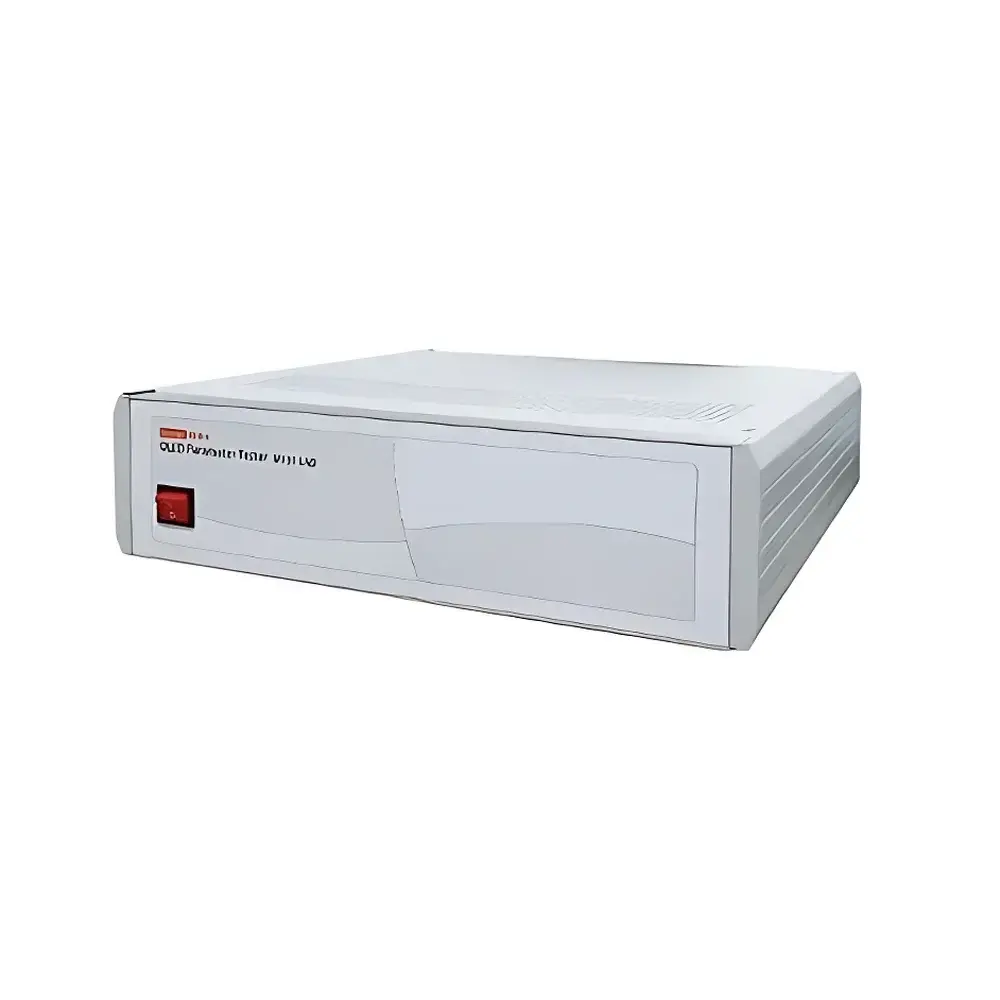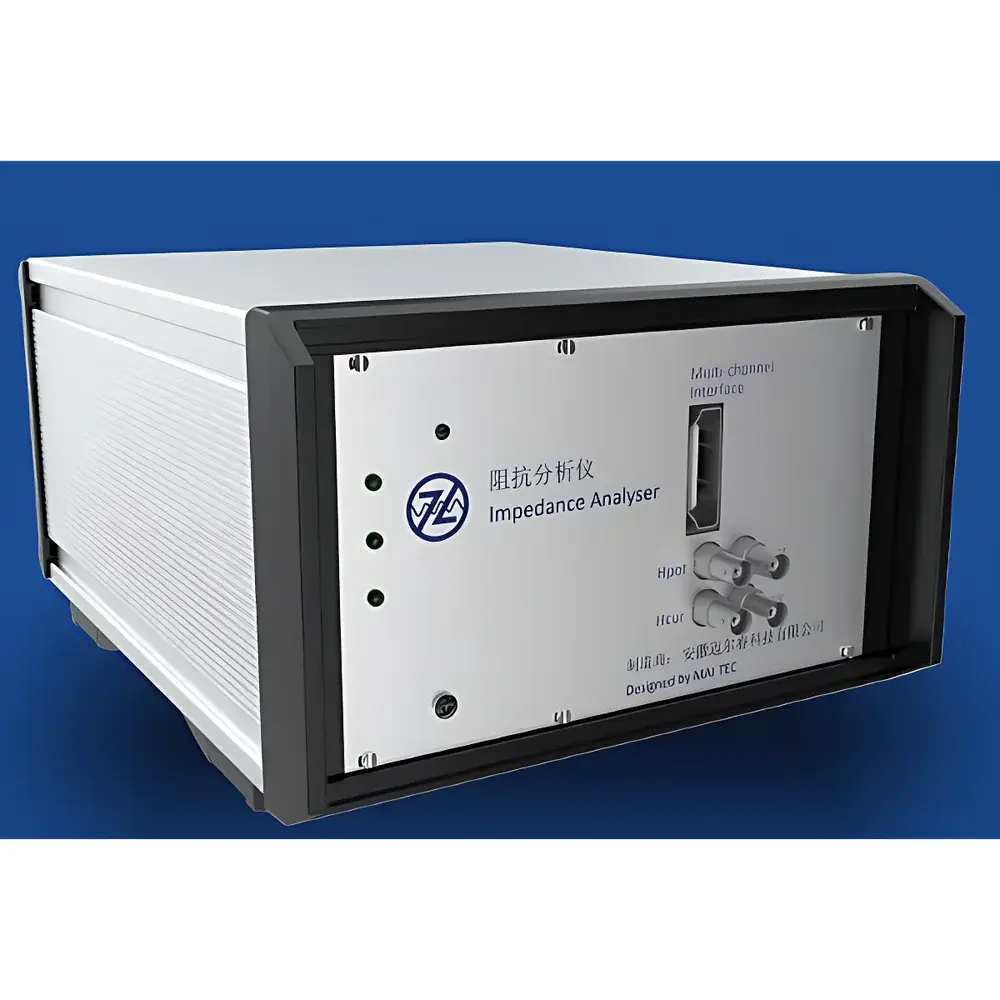
MAIERIC MTIA-8 Multi-Channel Impedance Analyzer
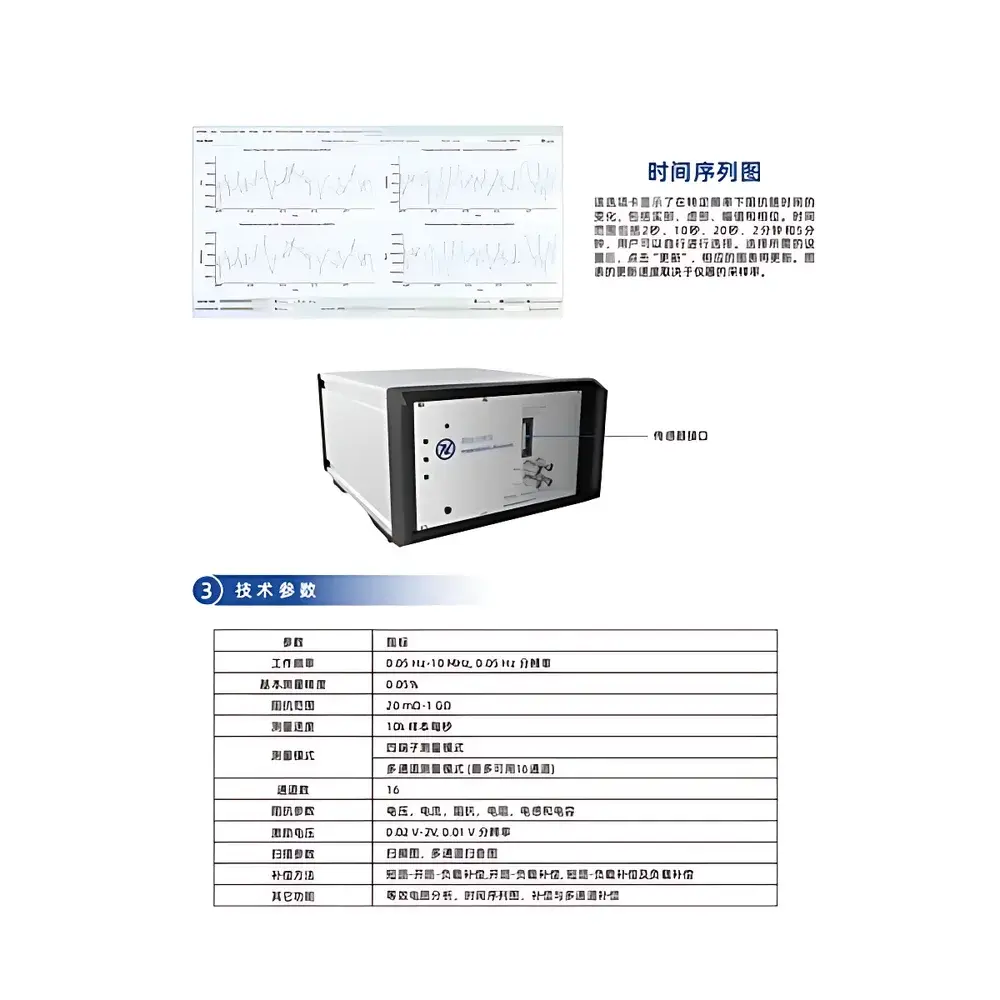
| Brand | MAIERIC |
|---|---|
| Origin | Anhui, China |
| Model | MTIA-8 |
| Instrument Type | Medium-Frequency Impedance Analyzer |
| Frequency Range | 0.01 Hz – 10 MHz |
| Frequency Resolution | 0.05 Hz |
| Basic Measurement Accuracy | ±0.05% |
| Impedance Range | 20 mΩ – 1 GΩ |
| Measurement Speed | 10,000 samples per second |
| Channel Capacity | Up to 128 parallel measurement channels (hardware-expandable) |
| Measurement Modes | Four-Terminal (Kelvin), Multi-Channel Synchronized Acquisition |
| Excitation Voltage Range | 0.02 V – 2.0 V (10 mV resolution) |
| Compensation Methods | Open-Short-Load, Open-Load, Short-Load, Load-only |
| Supported Parameters | Z, θ, R, X, Ls/Lp, Cs/Cp, D, Q, Y, G, B, Rs, Rp |
| Equivalent Circuit Fitting | Up to 7-element models (e.g., R-C, R-L-C, R-(C//R), etc.) |
Overview
The MAIERIC MTIA-8 Multi-Channel Impedance Analyzer is an engineered precision instrument designed for high-fidelity, time-resolved impedance spectroscopy across a broad frequency spectrum—from ultra-low frequencies (10 mHz) up to 10 MHz. It operates on the principle of sinusoidal steady-state excitation and vector-based synchronous demodulation, enabling accurate extraction of complex impedance (Z* = Z’ + jZ”) under controlled AC stimulus conditions. Unlike single-channel analyzers limited by sequential acquisition bottlenecks, the MTIA-8 implements synchronized parallel signal processing across up to 128 independently configurable analog front-ends—each with calibrated current-voltage sensing, programmable excitation amplitude, and real-time phase-sensitive detection. This architecture ensures temporal coherence in multi-point measurements critical for battery cell monitoring, EIS mapping of printed electronics, or distributed sensor array characterization where inter-channel phase alignment and absolute timing fidelity are non-negotiable.
Key Features
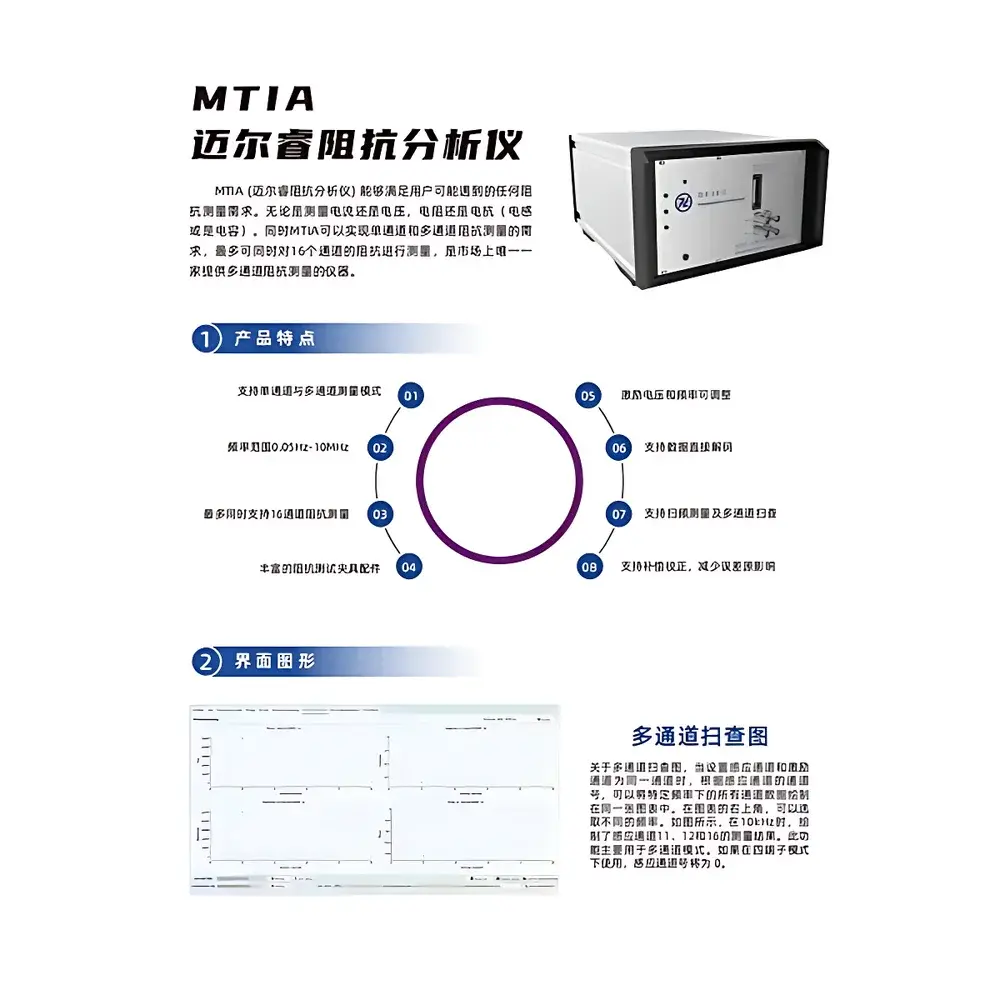
- True parallel multi-channel architecture supporting simultaneous acquisition from up to 128 terminals—enabling spatially resolved electrochemical impedance spectroscopy (EIS) without multiplexing-induced latency or phase drift.
- High-stability excitation source with 10 mV resolution over 0.02–2.0 V range, digitally synthesized and temperature-compensated to maintain spectral purity across full bandwidth.
- Four-terminal (Kelvin) measurement topology integrated per channel to eliminate lead resistance and contact impedance errors—essential for low-impedance (<100 mΩ) validation of battery tabs, busbars, or conductive inks.
- Multi-mode compensation suite compliant with IEC 60469-3 and ASTM E2977-22: includes open-short-load (OSL), open-load (OL), short-load (SL), and load-only calibration routines with traceable reference standards.
- Dual-domain analysis engine supporting both frequency-sweep (logarithmic/linear) and time-sequence (fixed-frequency dynamic tracking) modes—ideal for degradation studies, cure monitoring, or real-time process control feedback loops.
- Onboard equivalent circuit modeling (ECM) engine with nonlinear least-squares fitting for 2–7 parameter topologies (e.g., R(QR), R(C(RW)), R(LC)R), exportable as SPICE-compatible netlists.
Sample Compatibility & Compliance
The MTIA-8 accommodates passive and active components—including MLCCs, electrolytic capacitors, power inductors, piezoelectric transducers, fuel cell membranes, and biological tissue interfaces—via standardized BNC, triaxial, and spring-clip fixtures. Its hardware-level isolation and guarded input design meet EN 61000-4-3 (radiated immunity) and EN 61000-4-6 (conducted immunity) requirements. All calibration procedures follow ISO/IEC 17025 traceability paths, with documented uncertainty budgets available per channel. For regulated environments, the system supports audit-ready operation under FDA 21 CFR Part 11 (with optional electronic signature module), GLP-compliant data archiving, and IQ/OQ documentation packages aligned with USP <1058> Analytical Instrument Qualification guidelines.
Software & Data Management
The native MTIA Control Suite (v4.2+) provides a deterministic real-time acquisition environment built on RTX64 kernel extensions, ensuring sub-millisecond jitter control during high-speed sweeps. Data is stored in HDF5 format with embedded metadata (timestamp, stimulus settings, environmental telemetry, operator ID). Batch analysis workflows support automated pass/fail evaluation against user-defined limits, statistical process control (SPC) charting, and cross-channel correlation matrices. Export modules include CSV, MATLAB .mat, and IPC/JEDEC JESD22-A118-compliant JSON schemas for seamless integration into MES or PLM platforms. Remote API access via RESTful endpoints enables orchestration within Python-based test automation frameworks (e.g., PyTest + pytest-asyncio).
Applications
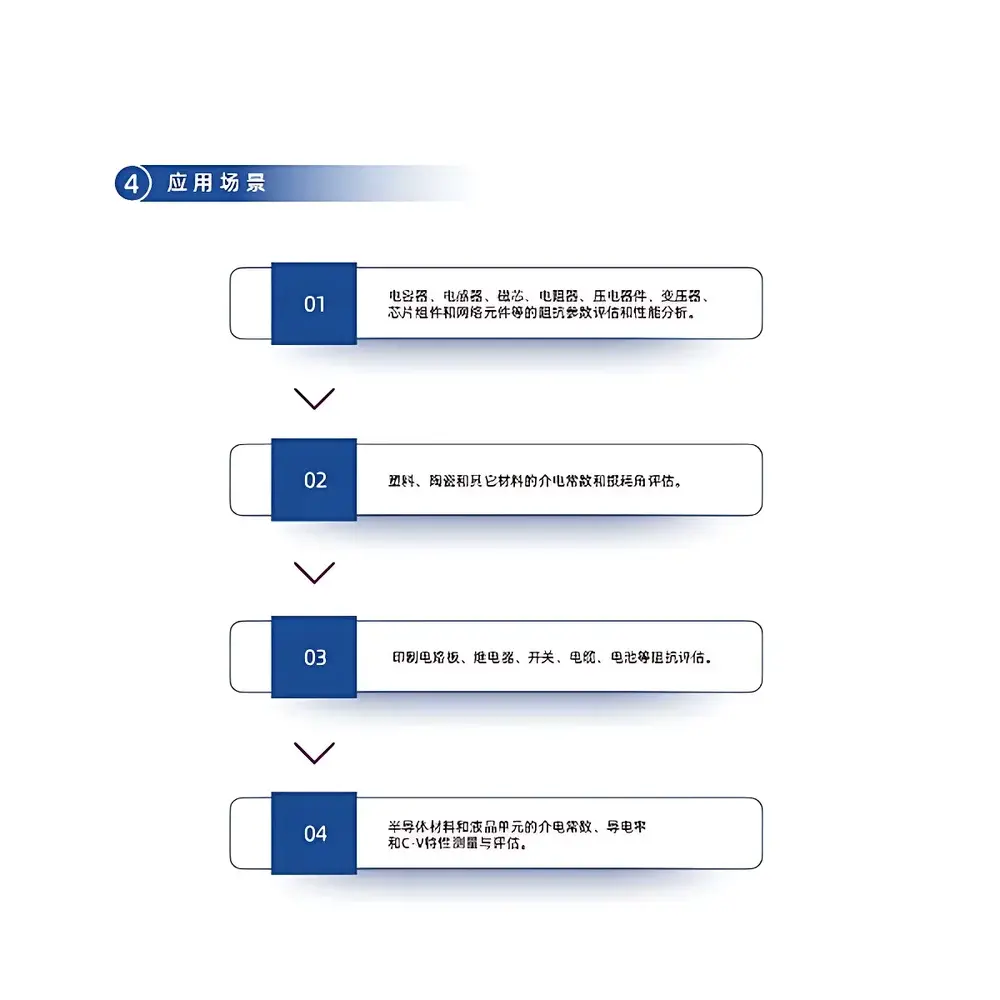
- Battery R&D: In-situ EIS of Li-ion pouch cells during charge/discharge cycles; inter-cell impedance variance mapping across 128-cell battery packs.
- PCB & Packaging QA: High-throughput screening of solder joint integrity, via impedance, and dielectric loss tangent (tan δ) of substrate laminates at 1 kHz–1 MHz.
- Biomedical Sensors: Real-time monitoring of electrode-tissue interface impedance shifts during chronic implantation simulations.
- Materials Science: Dielectric relaxation spectroscopy of polymer nanocomposites using multi-frequency time-domain averaging to suppress 1/f noise.
- Automotive Electronics: Functional safety validation of ADAS radar substrate impedance stability under thermal cycling (-40°C to +125°C).
FAQ
What is the maximum number of channels that can be actively measured simultaneously without time multiplexing?
Up to 128 channels operate in true parallel mode with independent ADCs, DACs, and lock-in detectors—no shared resources or scan delay.
Does the MTIA-8 support external trigger synchronization with other instruments (e.g., potentiostats or thermal chambers)?
Yes—TTL-compatible trigger I/O supports master-slave configuration with sub-100 ns edge alignment; IEEE-488 (GPIB) and LXI Class C Ethernet interfaces are standard.
How is measurement accuracy validated across the full impedance and frequency range?
Each unit ships with NIST-traceable calibration certificates covering all 128 channels; annual recalibration follows ISO/IEC 17025-accredited procedures at MAIERIC’s Anhui Metrology Center.
Can the equivalent circuit fitting engine handle distributed element models (e.g., transmission lines or constant-phase elements)?
Yes—the ECM solver supports CPE (n, Q) parameters, Warburg diffusion elements, and user-defined transfer functions via scripting interface.
Is firmware upgrade capability available over network connection, and does it preserve user-configured compensation data?
Firmware updates are delivered via signed OTA packages; all calibration coefficients, fixture definitions, and user profiles persist across version transitions.