
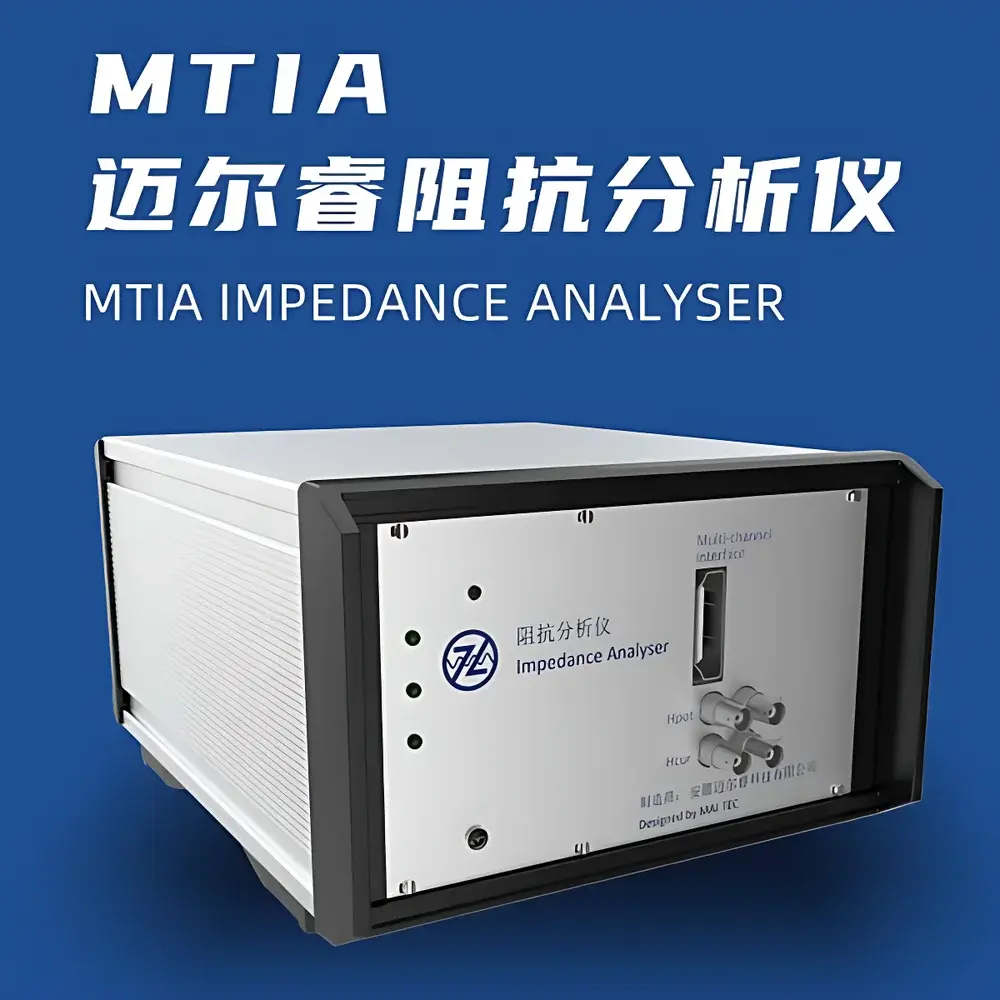
MAIERIC MTIA-A Advanced Multi-Channel Impedance Analyzer
| Brand | MAIERIC |
|---|---|
| Model | MTIA-A |
| Measurement Frequency Range | 0.05 Hz – 10 MHz |
| Basic Accuracy | ±0.05% |
| Impedance Range | 20 mΩ – 1 GΩ |
| Measurement Speed | Up to 10,000 samples/sec |
| Resolution | 0.05 Hz (frequency), 0.01 V (voltage) |
| Excitation Voltage Range | 0.02 V – 2 V |
| Measurement Modes | Four-Terminal (Kelvin), Multi-Channel (up to 128 channels, 16 active simultaneously) |
| Impedance Parameters | Z, R, X, L, C, D, Q, θ |
| Compensation Methods | Open-Short-Load, Open-Load, Short-Load, Load-only |
| Analysis Features | Equivalent Circuit Modeling, Time-Domain Sequence Plotting, Multi-Channel Compensation, Sweep & Multi-Channel Mapping |
Overview
The MAIERIC MTIA-A Advanced Multi-Channel Impedance Analyzer is a precision-engineered instrument designed for high-fidelity AC impedance characterization across broad frequency and impedance domains. Based on digital heterodyne detection and real-time DSP-based phase-sensitive demodulation, the MTIA-A implements a four-terminal (Kelvin) measurement architecture to eliminate lead and contact resistance errors—critical for low-impedance (100 MΩ) measurements alike. Its operational bandwidth spans six decades—from ultra-low-frequency dielectric relaxation studies at 0.05 Hz to high-frequency parasitic evaluation in RF components up to 10 MHz—enabling rigorous electrochemical impedance spectroscopy (EIS), material conductivity mapping, thin-film dielectric analysis, and passive component validation. The system’s modular hardware design supports deterministic synchronization of up to 128 physical test channels, with up to 16 channels actively measured in parallel under synchronized excitation and acquisition—making it uniquely suited for production-line screening, battery cell monitoring arrays, and multi-electrode sensor networks.
Key Features
- Dual-resolution frequency sweep: 0.05 Hz minimum step size for fine-grained dispersion analysis; programmable logarithmic or linear sweep profiles
- High-speed acquisition engine: Sustained throughput of 10,000 impedance magnitude/phase data points per second per active channel, with timestamp-accurate sample alignment
- Four-terminal (Kelvin) configuration standard on all channels—ensures traceable resistance and reactance separation without compensation artifacts
- Programmable excitation: 0.02 V–2 V RMS sinusoidal voltage output with 0.01 V resolution; optional current-source mode available via firmware upgrade
- Multi-channel synchronization: Hardware-triggered, phase-coherent excitation across all enabled channels; inter-channel skew < 50 ns
- Onboard compensation suite: Supports Open-Short-Load (OSL), Open-Load (OL), Short-Load (SL), and Load-only calibration routines—each configurable per channel or group
- Real-time equivalent circuit fitting: Built-in 5-parameter Randles, RC parallel, and series-RLC models with Levenberg-Marquardt convergence; exportable parameter time-series
Sample Compatibility & Compliance
The MTIA-A accommodates a wide range of sample geometries and electrical interfaces—including PCB-mounted SMD components, electrode-coated substrates, electrolyte-filled electrochemical cells, and flexible printed sensors—via interchangeable probe fixtures (e.g., spring-pin arrays, coaxial triaxial chucks, and guarded two-probe clamps). All measurement firmware complies with IEEE Std 1057 (Digitizing Waveform Recorders) and IEC 60469-1 (Definitions for Electrical Measurements). Calibration procedures follow ISO/IEC 17025 traceability requirements when performed using NIST-traceable standards. For regulated environments, audit trail logging, user-access controls, and electronic signature support are available through optional GLP/GMP-compliant software modules aligned with FDA 21 CFR Part 11 requirements.
Software & Data Management
The MTIA-A ships with MAIERIC Impedance Studio v4.x—a Windows-based application supporting both local operation and remote control via TCP/IP or USB 3.0. The software provides synchronized multi-channel sweep visualization, real-time Nyquist/Bode plot overlays, batch export in HDF5 and CSV formats (with metadata headers), and scriptable automation via Python API (PyMTIA). All raw I/Q data, compensation coefficients, and fit residuals are stored with full provenance—including operator ID, timestamp, environmental sensor readings (optional temperature/humidity integration), and instrument configuration snapshots. Data integrity is enforced through SHA-256 checksums and optional AES-256 encryption for exported archives.
Applications
- Electrochemical research: EIS of Li-ion battery electrodes, corrosion kinetics, fuel cell membrane hydration studies
- Electronic component validation: SMD capacitor ESR/D factor, inductor Q degradation, PCB trace impedance profiling
- Materials science: Conductivity mapping of conductive polymers, dielectric loss tangent (tan δ) of ceramics, percolation threshold analysis in nanocomposites
- Medical device testing: Impedance-based biosensor calibration, electrode-tissue interface characterization, wearable patch adhesion monitoring
- Automotive electronics: In-situ monitoring of EV battery module impedance drift, thermal runaway precursor detection via low-frequency capacitance shift
FAQ
What is the maximum number of channels that can be measured simultaneously?
Up to 16 channels may be acquired in parallel with full synchronization; the system supports up to 128 total physical channel connections via expansion modules.
Does the MTIA-A support automated calibration routines?
Yes—integrated OSL, OL, SL, and Load-only compensation sequences are fully programmable per channel group and可 executed via script or GUI.
Can impedance data be exported for third-party modeling tools?
Yes—HDF5 exports include complex impedance arrays (Z’ + jZ”), frequency vectors, and metadata required for COMSOL Multiphysics, MATLAB, or Python-based equivalent circuit solvers.
Is the instrument compliant with regulatory data integrity standards?
With optional GLP/GMP software package enabled, the system meets FDA 21 CFR Part 11 requirements for electronic records and signatures, including audit trails, role-based access, and immutable data archiving.
What types of probes or fixtures are compatible with the MTIA-A?
Standard configurations include Kelvin clips, coaxial triaxial chucks, and spring-pin test fixtures; custom probe interfaces (e.g., microfluidic electrode arrays) are supported via SMA or LEMO termination options.



