
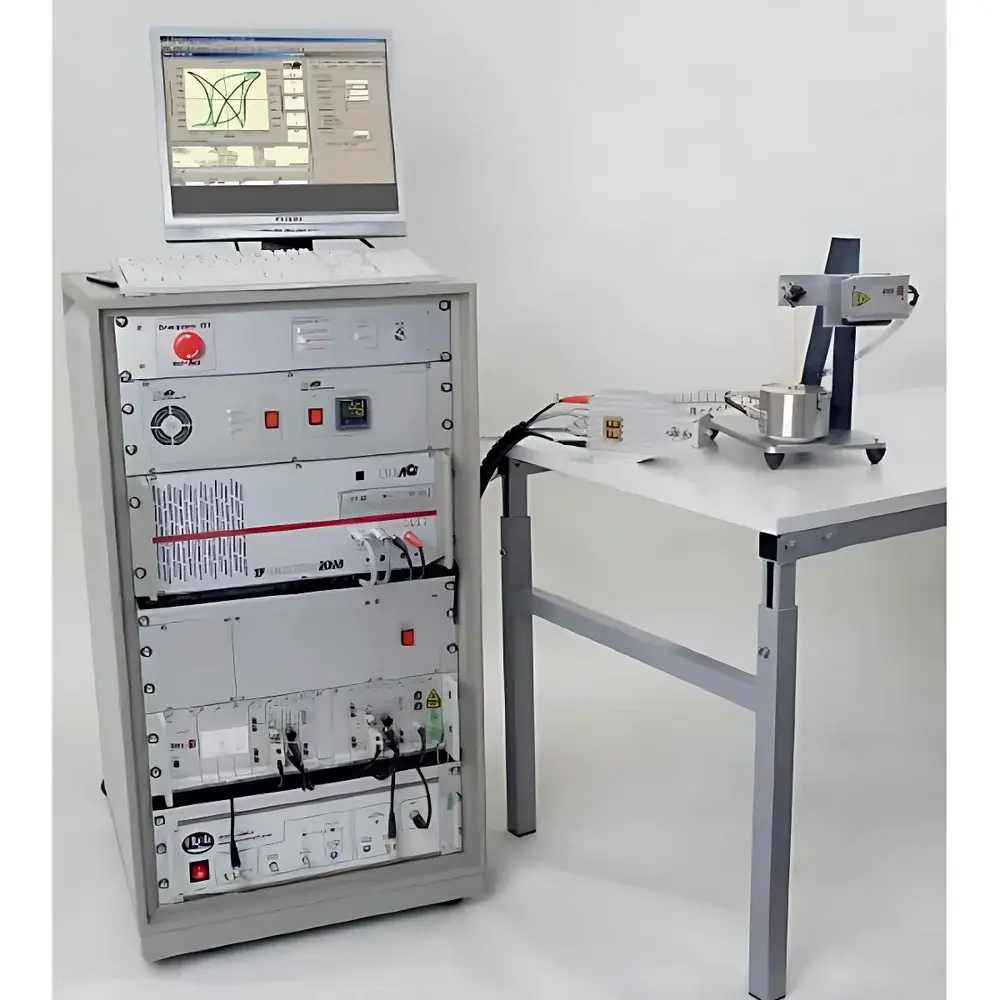
Makeway MKW-4900 Thermally Stimulated Depolarization Current (TSDC) Analyzer
| Brand | Makeway |
|---|---|
| Model | MKW-4900 |
| Origin | Shanghai, China |
| Magnet Type | Electromagnet |
| Temperature Range | 300 °C (max) |
| Measurement Principle | Thermally Stimulated Depolarization Current (TSDC) |
| Voltage Range | ±100 V to ±10 kV |
| Software Platform | aixPlorer / Resoce Analyzer |
| Interface | GPIB, Ethernet, ODBC |
| Output Format | ASCII |
Overview
The Makeway MKW-4900 Thermally Stimulated Depolarization Current (TSDC) Analyzer is a modular, high-precision physical property characterization system engineered for the quantitative evaluation of dielectric, ferroelectric, piezoelectric, and pyroelectric behavior in solid-state functional materials. It operates on the fundamental principle of thermally stimulated depolarization current measurement—a technique rooted in the controlled release of frozen-in polarization charges upon programmed thermal ramping after isothermal poling. This method provides direct access to relaxation spectra, trap energy distribution, dipole activation energies, and domain pinning mechanisms in ferroelectrics, polymers, relaxors, and multiferroics. Unlike conventional impedance spectroscopy or static hysteresis measurements, TSDC delivers time-resolved, temperature-dependent depolarization kinetics under well-defined electric field and thermal boundary conditions—making it indispensable for R&D labs investigating charge trapping, aging phenomena, and microstructural stability in advanced dielectrics.
Key Features
- Integrated multimodal testing architecture supporting simultaneous or sequential TSDC, ferroelectric hysteresis (P–E), piezoelectric coefficient (d33, d31) determination, pyroelectric current measurement, leakage current analysis, and fatigue cycling.
- Programmable high-voltage poling module with bipolar output range from ±100 V to ±10 kV, enabling precise control over poling field strength and polarity reversal protocols.
- Thermally regulated sample stage with calibrated temperature control up to 300 °C, compatible with commercial cryostats for extended low-temperature operation (optional).
- Modular hardware interface supporting external instrumentation via GPIB or Ethernet—including lock-in amplifiers, impedance analyzers, laser interferometers, capacitive displacement sensors, and programmable temperature controllers.
- Script-driven automation framework compliant with IEEE 488.2 and SCPI standards, facilitating reproducible test sequences, conditional branching, and real-time data logging.
- Robust mechanical design optimized for low-noise current measurement (sub-pA resolution achievable with appropriate shielding and grounding practices), minimizing electromagnetic interference during low-current TSDC signal acquisition.
Sample Compatibility & Compliance
The MKW-4900 accommodates standard bulk ceramic discs (diameter: 5–25 mm; thickness: 0.1–2 mm), thin films on conductive substrates (with top-electrode sputtering or evaporation), and polymer films with evaporated Au or Cr/Au electrodes. Sample holders are designed for uniform thermal contact and symmetric electrode configuration to minimize thermal gradients and field non-uniformity. The system supports compliance with ASTM D150 (dielectric constant and loss), IEC 60601-2-67 (for medical-grade piezoelectric transducers), and ISO 24370 (ferroelectric material characterization). Data audit trails, user authentication, and electronic signature support align with GLP and GMP documentation requirements where applicable.
Software & Data Management
Control and analysis are executed through two complementary software environments: aixPlorer for experiment sequencing, hardware orchestration, and real-time visualization; and Resoce Analyzer for advanced spectral deconvolution, Arrhenius and Cole–Cole modeling, and trap density quantification. Both platforms run natively on Windows 7 (64-bit) and support ODBC-compliant database integration for centralized metadata storage, cross-experiment querying, and LIMS interoperability. Raw current vs. temperature/time datasets are exported in ASCII format (tab-delimited), ensuring compatibility with MATLAB, Python (NumPy/Pandas), OriginLab, and commercial statistical analysis tools. All measurement parameters—including poling field, dwell time, heating rate, and sensor calibration coefficients—are embedded as metadata headers.
Applications
- Quantification of defect-related relaxation peaks in BaTiO3-based ceramics and PZT compositions.
- Correlation of TSDC peak positions with oxygen vacancy migration energies in perovskite oxides.
- Evaluation of interfacial polarization in polymer–nanofiller composites for energy storage applications.
- Assessment of domain wall freezing dynamics in relaxor ferroelectrics (e.g., PMN-PT) under DC bias.
- Thermal stability screening of piezoelectric thin films for MEMS actuators operating above 150 °C.
- Leakage current correction protocols integrated into TSDC data processing to isolate true depolarization contributions.
FAQ
What sample geometries and electrode configurations are supported?
Standard configurations include parallel-plate geometry with sputtered or painted electrodes. Custom fixtures for ring electrodes or interdigitated structures are available upon request.
Can the system perform TSDC under controlled atmosphere or vacuum?
Yes—when coupled with a sealed temperature chamber equipped with gas inlet/outlet ports and pressure monitoring, inert or reducing atmospheres can be maintained during poling and depolarization cycles.
Is the MKW-4900 compliant with FDA 21 CFR Part 11 for regulated environments?
While the base system does not include full Part 11 validation packages, audit trail logging, electronic signatures, and role-based access control modules are available as optional add-ons for pharmaceutical or medical device qualification.
How is current noise minimized during sub-nA TSDC measurements?
The system incorporates guarded triaxial cabling, battery-powered preamplifier options, Faraday cage integration guidelines, and synchronous lock-in detection pathways to suppress environmental and thermal EMF artifacts.
Does the software support custom waveform generation for non-standard poling protocols?
Yes—via Python or LabVIEW scripting interfaces, users may define arbitrary voltage vs. time profiles, including stepped fields, triangular ramps, or modulated AC superposition during poling.



