
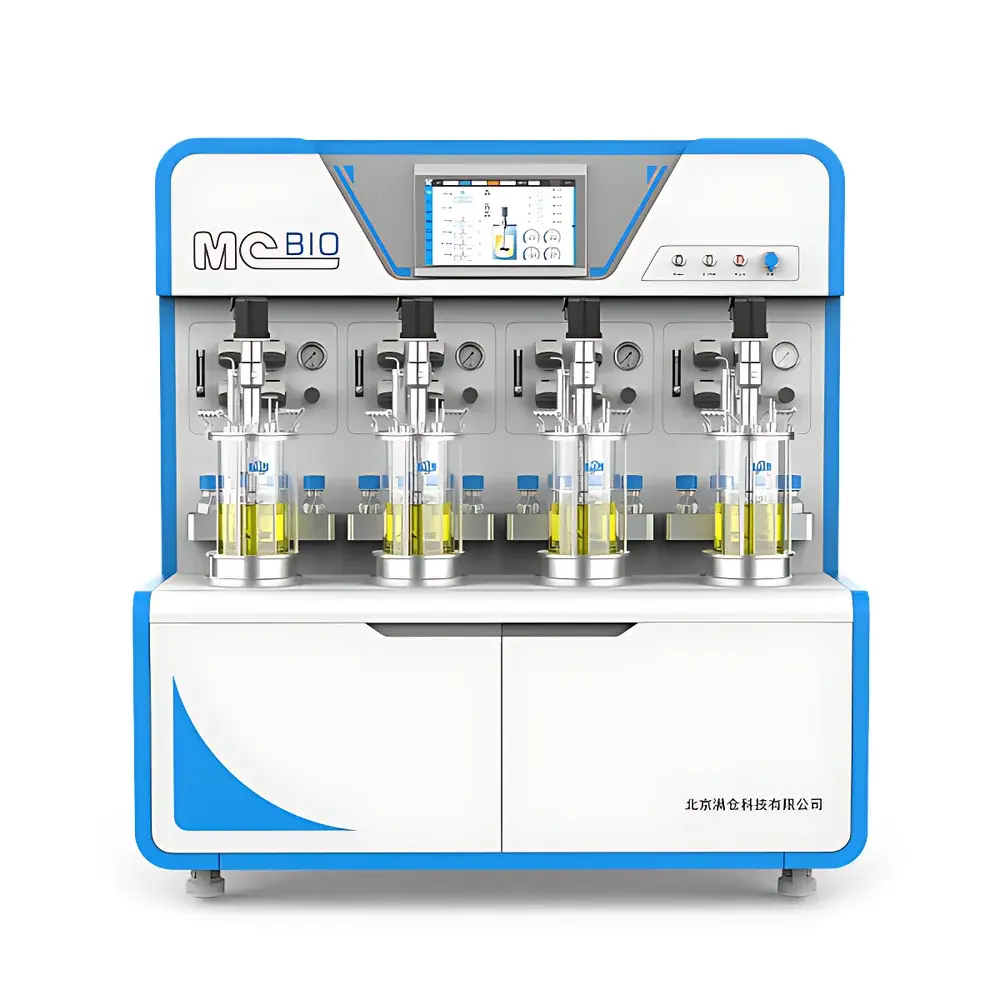
Mancang MC-JGF-5L/4 Parallel Glass Fermenter System
| Brand | Mancang |
|---|---|
| Origin | Beijing, China |
| Manufacturer Type | Direct Manufacturer |
| Product Category | Domestic |
| Model | MC-JGF-5L/4 |
| Vessel Volume Range | 0.5–500 L |
| Aeration System | Integrated |
| pH Control Range | 2–12 |
| Dissolved Oxygen (DO) Control Range | 0–100% |
| Temperature Control Range | 5–65 °C (chilled coolant + electric heating) |
Overview
The Mancang MC-JGF-5L/4 Parallel Glass Fermenter System is an engineered platform for high-fidelity, multi-vessel microbial fermentation studies under controlled, reproducible conditions. Designed around the Couette-type stirred-tank bioreactor principle, it enables simultaneous operation of up to four independent 5 L glass vessels—each equipped with real-time monitoring and actuation of critical process parameters including temperature, pH, dissolved oxygen (DO), agitation speed, airflow, foam, and feed addition. The system employs aseptic, in-situ sterilization via saturated steam (121 °C, 20–30 min), validated for compliance with GLP-aligned laboratory practices. Its modular architecture supports both benchtop and floor-standing configurations, facilitating seamless integration into R&D labs conducting strain screening, media optimization, kinetic modeling, and process scale-up validation—particularly for viscous or particulate-laden substrates such as crude mash fermentations.
Key Features
- Four parallel 5 L borosilicate glass vessels (DIN 28120-compliant), rated for operating pressures up to 0.3 bar(g); optional stainless steel (316L) vessel variants available for extended durability.
- Dual-mode agitation: bottom-mounted magnetic coupling drive (standard) or mechanical shaft seal (optional), supporting digital speed control from 50–1,000 rpm with ±1 rpm resolution; configurable impeller sets (Rushton, pitched-blade, axial-flow) for tailored mixing intensity and oxygen mass transfer (kLa).
- Integrated aeration train featuring 0.01 µm sterile-grade hydrophobic membrane filters (validated per ASTM F838), stainless steel ring spargers, calibrated rotameters, pressure gauges, and manual flow regulation; external compressed air supply required (oil-free, dew point ≤ −40 °C).
- Pt-100 temperature sensors with PID-controlled heating (bottom-mounted cartridge) and cooling (jacketed circulation via external chiller); setpoint accuracy ±0.2 °C over full 5–65 °C range.
- pH monitoring and titration using autoclavable, refillable glass electrodes (pH 2–12 range); two peristaltic pumps support automated acid/base addition with programmable dosing profiles.
- DO measurement via polarographic Clark-type sensors (0–100% air saturation); DO cascade control linked to agitation and/or airflow for dynamic regulation.
- Industrial-grade Ebio control system based on Siemens S7-1200 PLC; 32-bit color HMI touchscreen interface (C-type configuration) with data logging, alarm management, recipe storage, and audit trail capabilities compliant with FDA 21 CFR Part 11 requirements.
Sample Compatibility & Compliance
The MC-JGF-5L/4 accommodates a broad spectrum of microbial cultures—including bacteria (e.g., E. coli, Bacillus spp.), yeasts (Saccharomyces cerevisiae, Pichia pastoris), and filamentous fungi—under aerobic, microaerobic, or oxygen-limited conditions. Its transparent borosilicate construction allows direct visual inspection of broth rheology, pellet morphology, and foam dynamics without compromising sterility. All wetted parts meet USP Class VI and ISO 10993 biocompatibility standards. In-situ steam sterilization conforms to ISO 13408-2 for aseptic processing equipment. Electrical safety complies with IEC 61010-1; CE marking applies to the control cabinet and peripheral instrumentation.
Software & Data Management
The embedded Ebio control software provides real-time graphical trending (up to 64 channels), event-triggered data capture, and export in CSV/Excel formats. Historical datasets include timestamped sensor readings, actuator states, and user interventions—structured for traceability in QA/QC workflows. Optional OPC UA server integration enables bidirectional communication with LIMS or MES platforms. Audit trails record operator login/logout, parameter changes, alarm acknowledgments, and sterilization cycle logs—including duration, peak temperature, and pressure hold times—for regulatory review. Raw data files are stored locally on industrial-grade SD cards with cyclic overwrite protection.
Applications
- High-throughput strain selection and comparative growth kinetics across ≥4 culture conditions in identical environmental baselines.
- Empirical optimization of feeding strategies (e.g., exponential vs. pulse-addition) for recombinant protein expression or organic acid production.
- Validation of upstream process robustness during technology transfer from lab-scale to pilot bioreactors.
- DO-pH interplay studies in anaerobic-aerobic transitions (e.g., mixed-acid fermentation in Clostridia).
- Scale-down modeling for biopharmaceutical cell culture processes where oxygen transfer limitation is a key scale-dependent variable.
- Education and training in biochemical engineering principles, including mass balance calculations, oxygen uptake rate (OUR) derivation, and heat generation profiling.
FAQ
Can the system perform fully automated sterilization cycles?
No—sterilization requires external saturated steam supply and manual initiation; however, temperature/pressure profiles are continuously logged and validated.
Is the glass vessel suitable for organic solvent-containing media?
Borosilicate glass (e.g., Pyrex-type) exhibits excellent resistance to alcohols, esters, and weak acids; prolonged exposure to strong oxidizers (e.g., HNO₃) or halogenated solvents is not recommended.
What level of cybersecurity is implemented in the PLC-based control system?
The Siemens S7-1200 controller supports password-protected access levels, firmware signature verification, and network segmentation recommendations per IEC 62443-3-3; no remote internet connectivity is enabled by default.
Are calibration certificates provided for pH and DO sensors?
Factory calibration reports (per ISO/IEC 17025) are included; users must perform field calibration prior to first use and at defined intervals per internal SOPs.
Can the system be upgraded to support off-gas analysis?
Yes—ports for O₂/CO₂ infrared analyzers (e.g., BlueSens BCP-CO₂) and methanol/ethanol sensors are pre-installed; integration requires optional signal conditioning modules and software license extension.
Related Products




