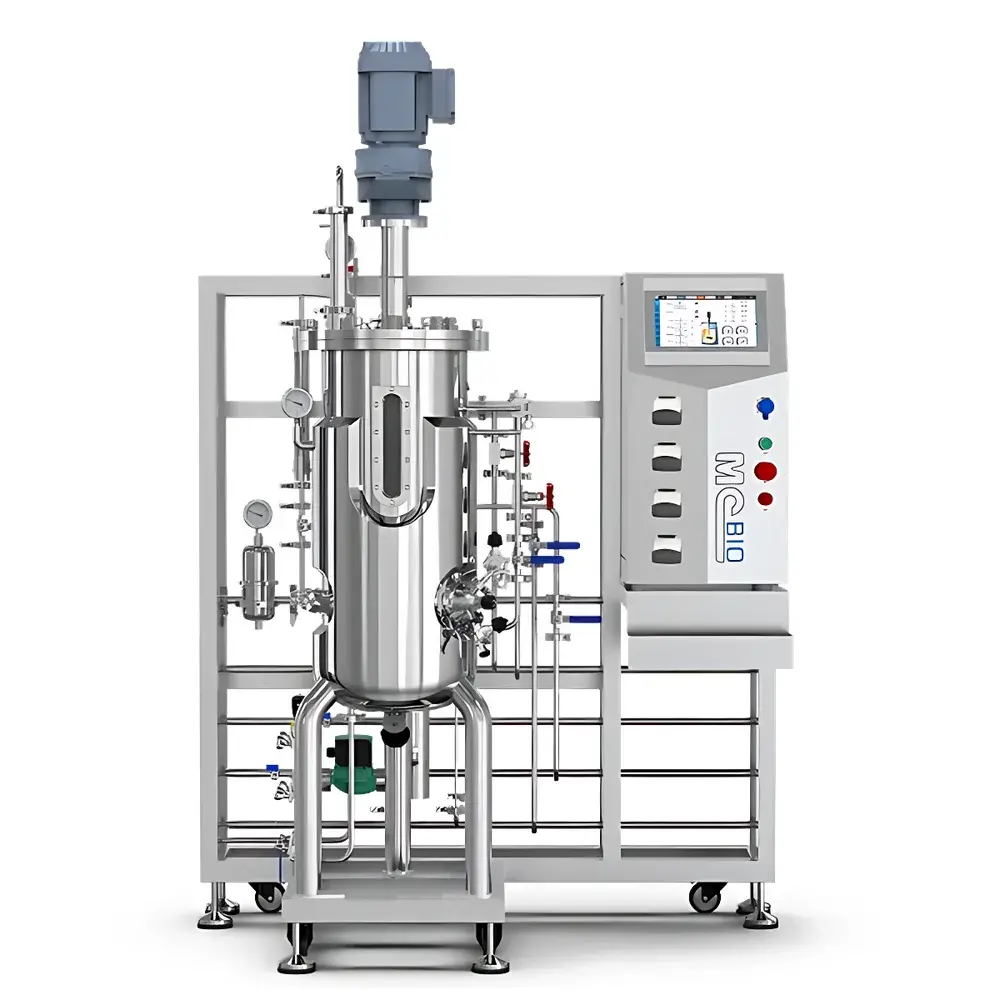
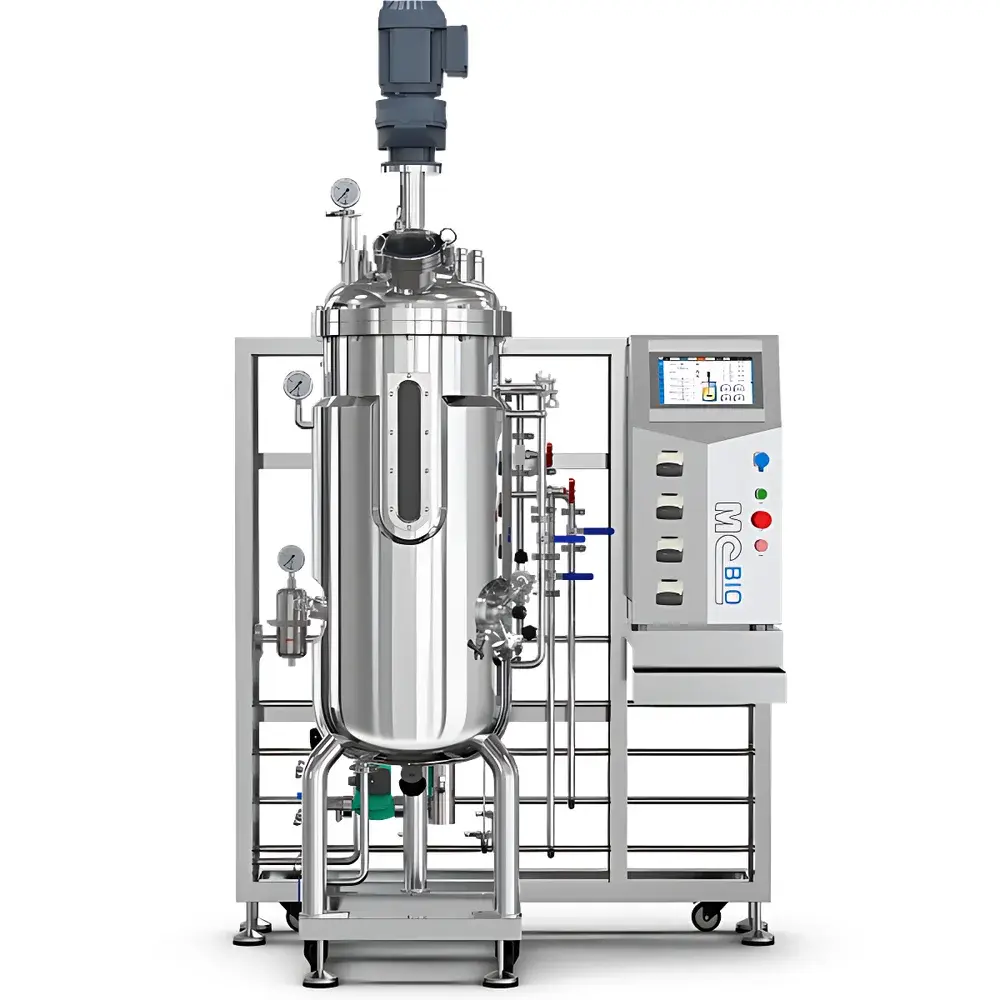
Mancang MC-JSF-50 Stainless Steel Laboratory Fermenter
| Brand | Mancang |
|---|---|
| Origin | Beijing, China |
| Manufacturer Type | Direct Producer |
| Country of Origin | China |
| Model | MC-JSF-50 |
| Vessel Volume | 0.5–500 L (Standard Config: 50 L) |
| Aeration System | Integrated Deep-Flow Sterile Air Supply |
| pH Control Range | 2.0–12.0 |
| Dissolved Oxygen (DO) Control Range | 0–100% (or 0–200%) |
| Temperature Control Range | 0–100 °C |
| Design Pressure | 0.3 MPa |
| Operating Pressure | 0.15 MPa |
| Material | SUS316L/SUS304 Stainless Steel |
| Internal Surface Finish | Ra ≤ 0.4 µm |
| External Finish | Bead-Blasted or Polished |
| Stirring Speed | 50–600 rpm (±1% accuracy, 1 rpm resolution) |
| Sterilization | In-situ Steam Sterilization (SIP), 121 °C for 30 min |
| Compliance | Meets ISO 8573-1 (compressed air purity), ASME BPE-2021 (bioprocessing equipment), and GLP/GMP design principles |
Overview
The Mancang MC-JSF-50 is a fully instrumented, jacketed stainless steel laboratory fermenter engineered for precise, reproducible microbial cultivation under controlled physiological conditions. Based on the Couette-type mechanical agitation principle and integrated with sterile gas mass transfer dynamics, this 50 L system supports aerobic, microaerobic, and facultative fermentation processes across academic research, bioprocess development, and pilot-scale validation. Its modular architecture enables seamless integration into GxP-compliant workflows—particularly where traceability, process consistency, and regulatory readiness are critical. Designed for in-situ steam sterilization (SIP) at 121 °C for 30 minutes, the vessel meets fundamental requirements of ISO 13408-1 (sterility assurance), ASME BPE-2021 (biopharmaceutical equipment design), and FDA 21 CFR Part 11-ready data integrity frameworks when paired with optional audit-trail software modules.
Key Features
- High-integrity vessel construction using electropolished SUS316L stainless steel (internal Ra ≤ 0.4 µm; external Ra ≤ 0.6 µm), conforming to ASME BPE surface finish standards.
- Double-jacketed temperature control system with Pt-100 RTD sensors, PID-regulated electric heating and external chilled water cooling—achieving ±0.2 °C stability over 0–100 °C range.
- Dual-probe online monitoring: Mettler Toledo (Hamilton) pH electrode (autoclavable, 121 °C/30 min) and optical DO sensor (0–100% or 0–200% range, ±0.1% resolution), both housed in 316L sanitary probe sleeves with dual-shielded cabling.
- Top-entry mechanical agitation with precision-balanced shaft and configurable impeller stack (standard: two-tier flat-blade + axial-flow turbine; optional: Rushton, pitched-blade, or hydrofoil designs).
- Sterile air delivery via dual-stage filtration: 0.1 µm pre-filter + 0.01 µm PTFE membrane final filter (99.9999% retention efficiency), validated per ISO 8573-1 Class 2:2:2 for oil, water, and particulate content.
- MC-BIO6000 embedded control platform: Siemens S7-1200 PLC core, 7″ color touchscreen HMI, real-time PID tuning, manual/auto mode switching with bumpless transfer, and USB data export for offline analysis.
- Comprehensive safety architecture: dry-run protection for heaters, over-pressure relief valves, foam-triggered alarm & pump activation, and fail-safe interlocks between SIP, agitation, and gas flow sequences.
Sample Compatibility & Compliance
The MC-JSF-50 accommodates diverse biological systems—including bacterial (e.g., E. coli, Bacillus spp.), yeast (S. cerevisiae, P. pastoris), filamentous fungi (Aspergillus, Trichoderma), and mammalian suspension cultures—within defined physicochemical envelopes. Its 70% fill ratio optimization ensures adequate headspace for foam management and oxygen transfer without compromising mixing homogeneity. All wetted materials comply with USP Class VI biocompatibility testing and EU 1935/2004 food-contact regulations. The system supports ASTM E2875-13 (verification of sterilization cycle efficacy) and aligns with ICH Q5A(R2) guidance for cell substrate characterization. Optional AUTO-SIP functionality enables fully automated, validated sterilization cycles compliant with Annex 1 (EU GMP) and WHO TRS 986 Annex 5.
Software & Data Management
The MC-BIO6000 firmware provides native support for time-stamped, password-protected data logging—including temperature, pH, DO, agitation speed, airflow, pressure, and cumulative feed volumes—with configurable sampling intervals (1–60 sec). Raw data exports as CSV or Excel-compatible files via USB port. Optional MC-CCK remote monitoring module adds TLS-encrypted web-based access (HTTPS) and mobile push notifications for parameter deviation alerts. When deployed with validated third-party SCADA platforms (e.g., Ignition, WinCC OA), the system satisfies 21 CFR Part 11 requirements through electronic signatures, audit trails, and role-based user permissions. All control algorithms utilize adaptive fuzzy-PID logic with auto-tuning capability—ensuring stable response during dynamic transitions such as fed-batch glucose shifts or pH-mediated induction events.
Applications
This fermenter serves as a primary tool for strain selection, media optimization, kinetic modeling, and scale-up correlation studies. Typical use cases include: (1) high-cell-density E. coli expression of recombinant proteins under pH-stat and DO-stat regimes; (2) aerobic yeast fermentation for ethanol or organic acid production with cascade-controlled aeration; (3) fungal morphology modulation via shear-sensitive agitation profiling; (4) validation of single-use bioreactor performance against stainless-steel benchmarks; and (5) regulatory submission batches requiring full traceability from inoculum expansion through harvest. Its standardized interface set (ISO-KF, DIN 11851, SMS 1144) allows direct coupling with off-gas analyzers (O2/CO2), inline NIR probes, or gravimetric feeding stations.
FAQ
Is the MC-JSF-50 suitable for GMP manufacturing environments?
Yes—when configured with AUTO-SIP, electronic batch records, and 21 CFR Part 11-compliant software options, it fulfills core equipment qualification (IQ/OQ/PQ) requirements for clinical-phase bioproduction.
Can the system be integrated with existing plant DCS or MES platforms?
Absolutely—the MC-BIO6000 supports Modbus TCP/IP and OPC UA protocols; custom driver development is available upon request.
What validation documentation is provided with the system?
Each unit ships with Factory Acceptance Test (FAT) reports, material certifications (EN 10204 3.1), weld logs, surface roughness verification, and calibration certificates for all primary sensors.
Does Mancang offer installation and operational qualification (IQ/OQ) support?
Yes—on-site commissioning, protocol development, and witnessed execution by certified bioprocess engineers are available as value-added services.
Are spare parts and sensor replacements readily available internationally?
All critical consumables—including Hamilton pH/DO electrodes, 0.01 µm filters, and 316L diaphragm valves—are stocked in regional distribution centers across North America, Europe, and APAC.
Related Products