
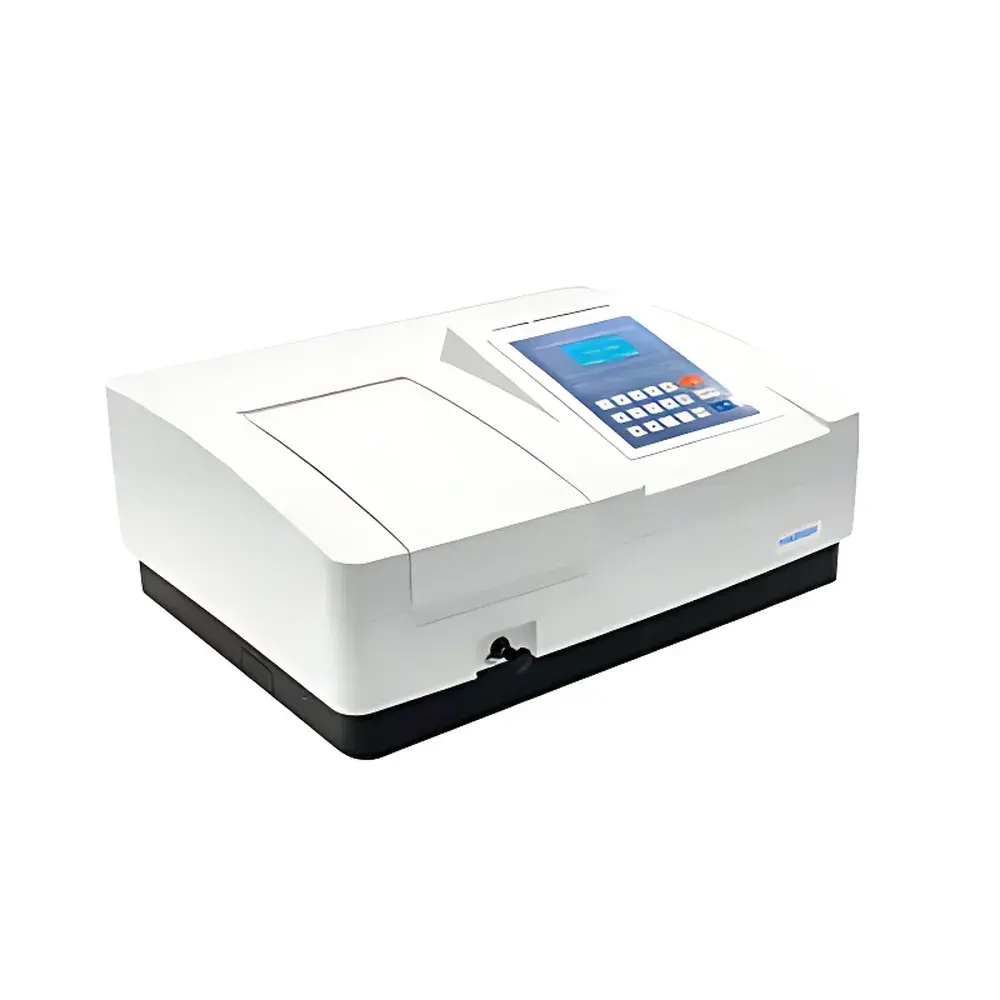
Mapada V-1800PC UV-Vis Spectrophotometer
| Brand | Mapada |
|---|---|
| Origin | Shanghai, China |
| Manufacturer Type | Original Equipment Manufacturer (OEM) |
| Product Category | Domestic |
| Model | V-1800PC |
| Price Range | USD 1,400–2,800 |
| Optical Design | Pseudo-Double-Beam |
| Detector | Silicon Photodiode |
| Wavelength Range | 320–1100 nm |
| Wavelength Accuracy | ±0.5 nm |
| Spectral Bandwidth | 2 nm |
| Stray Light | ≤0.5% T at 220 nm and 360 nm |
| Display | 128×64 Dot-Matrix LCD |
| Measurement Modes | Transmittance (T), Absorbance (A), Concentration (C), Energy (E) |
| Data Output | USB Interface |
| Print Output | Parallel Port |
| Power Supply | AC 220 V/50 Hz or AC 110 V/60 Hz |
| Dimensions (W×D×H) | 470 × 370 × 180 mm |
| Net Weight | 12 kg |
Overview
The Mapada V-1800PC UV-Vis Spectrophotometer is a precision optical instrument engineered for routine and research-grade quantitative and qualitative analysis in chemistry, biochemistry, pharmaceutical quality control, environmental monitoring, and materials science laboratories. Based on the fundamental principle of Beer-Lambert law absorption spectroscopy, it measures the intensity of light transmitted through a sample relative to a reference beam across the ultraviolet and visible spectral region (320–1100 nm). Its pseudo-double-beam architecture—comprising a fixed reference channel and a dynamically modulated sample channel—minimizes baseline drift and enhances photometric stability during extended measurements. The system integrates a high-efficiency 1200 lines/mm holographic grating, imported long-life tungsten-halogen lamp (for visible range), and socket-mounted deuterium lamp (for UV range), enabling seamless automatic source switching without manual intervention or optical realignment.
Key Features
- Precision wavelength scanning with ±0.5 nm accuracy and 2 nm spectral bandwidth, optimized for resolution-sensitive applications such as dye characterization and enzyme kinetics.
- Real-time lamp life monitoring and auto-switching between deuterium and tungsten sources—ensuring optimal signal-to-noise ratio across full spectral range.
- Large 128×64 dot-matrix LCD display supporting simultaneous visualization of absorbance spectra, calibration curves, kinetic time-series plots, and numeric data tables (up to 200 entries).
- Internal memory stores up to 100 user-defined calibration curves and 200 measurement datasets—enabling offline analysis and method recall without PC connectivity.
- Spacious sample compartment accommodating cuvettes from 5 mm to 100 mm pathlength, compatible with standard quartz, glass, and plastic cells.
- Plug-and-play lamp design: socket-mounted deuterium and tungsten lamps require no collimation or alignment after replacement—reducing maintenance downtime.
- Film-type tactile keypad with dedicated function keys for rapid access to photometric modes (T/A/C/E), wavelength setting, and scan initiation.
- USB 2.0 interface compliant with Windows-based host systems; supports direct data export to CSV, TXT, or proprietary .spc formats for traceability and audit readiness.
Sample Compatibility & Compliance
The V-1800PC accommodates liquid, solution-phase samples in standard rectangular cuvettes (10 mm default, optional 5/20/50/100 mm pathlengths) and supports semi-solid suspensions when used with appropriate dispersion protocols. It complies with core international performance standards including ISO 9001:2015 (quality management), ASTM E275-22 (standard practices for UV-Vis spectrophotometer verification), and USP (Spectrophotometry and Light-Scattering). While not inherently 21 CFR Part 11 compliant out-of-the-box, its firmware and Mapada professional software support electronic signature logging, user access levels, and audit trail generation when deployed within validated GxP environments under documented SOPs.
Software & Data Management
Bundled Mapada ScanPro software provides full PC-based instrument control and advanced data processing. Capabilities include multi-wavelength quantitation with linear/nonlinear curve fitting (including polynomial and quadratic models), time-scan kinetics with adjustable interval and duration, full-range spectral acquisition (320–1100 nm) with smoothing and derivative functions, and customizable report templates compliant with GLP documentation requirements. Raw spectral data are timestamped and tagged with operator ID, method name, and instrument serial number—facilitating traceability in regulated labs. Export options include Excel-compatible spreadsheets, image exports (PNG/TIFF), and spectral libraries for cross-instrument comparison.
Applications
- Pharmaceutical assay validation per USP monographs (e.g., paracetamol, aspirin, riboflavin content determination)
- Enzyme activity assays (e.g., NADH/NADPH oxidation kinetics at 340 nm)
- Water quality analysis: nitrate (220 nm), phosphate (880 nm via molybdenum blue), and COD estimation
- Food & beverage QC: color index measurement (L*a*b* derived from reflectance spectra), caffeine quantification
- Nanoparticle characterization: surface plasmon resonance peak tracking for Au/Ag colloids
- Educational use: undergraduate spectroscopy labs covering Beer’s law verification, λmax determination, and mixture analysis via multicomponent regression
FAQ
What is the difference between “pseudo-double-beam” and true double-beam design?
The V-1800PC uses a single detector with time-shared reference and sample beam paths via a rotating mirror—offering improved stability over single-beam systems but without the hardware complexity and cost of dual-detector configurations.
Is the instrument suitable for GLP-compliant laboratories?
Yes—when paired with Mapada ScanPro software configured with user authentication, audit trails, and electronic signatures, it meets essential GLP data integrity requirements for non-clinical safety studies.
Can I perform kinetic measurements over several hours?
Yes—the instrument supports time-scan mode with programmable intervals from 0.1 s to 600 s and total duration up to 24 hours, with automatic data logging to internal memory or USB drive.
Does the software support compliance with FDA 21 CFR Part 11?
The base software does not include Part 11 features by default, but Mapada offers a validated version with role-based access control, electronic signatures, and immutable audit logs upon request for regulated users.
What maintenance is required for long-term reliability?
Annual lamp replacement (typical deuterium lamp life: ~1,000 h; tungsten: ~2,000 h), periodic cleaning of cuvette holder and optical windows with lint-free wipes and spectroscopic-grade methanol, and biannual wavelength calibration verification using holmium oxide or didymium filters.
Related Products






