
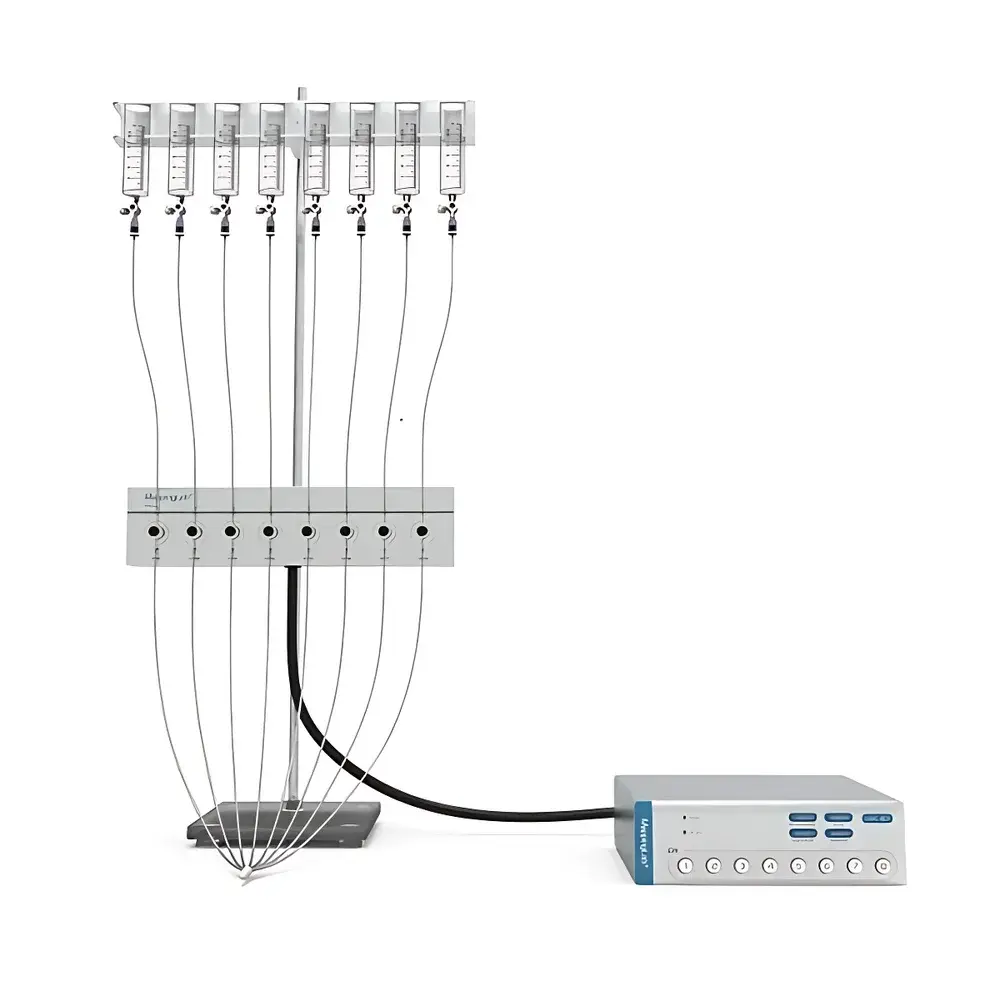
MappingLab MVC-801 Eight-Channel Perfusion and Drug Application System
| Brand | MappingLab |
|---|---|
| Origin | Beijing, China |
| Manufacturer Type | Authorized Distributor |
| Product Category | Domestic |
| Model | MVC-801 |
| Instrument Type | Semi-Automatic |
| Control Interface | Analog (0–5 V / 0–10 V) & Digital (TTL/BNC) |
| Valve Count | 8 Independent Solenoid Valves |
| Valve Specifications | 12 V DC, Max 4 W per valve, Min 24 Ω resistance |
| Cascade Capability | 11 Isolated BNC Trigger Inputs/Outputs |
| Memory Function | Yes (Last Valid Configuration Retained) |
| Overflow Protection | Integrated Flow Monitoring with Audible/Visual Alert |
| Software Compatibility | Native Integration with pCLAMP (Axon), PatchMaster (HEKA), and Custom LabVIEW/Python Scripts |
| Regulatory Context | Designed for GLP-compliant electrophysiology laboratories |
Overview
The MappingLab MVC-801 Eight-Channel Perfusion and Drug Application System is a semi-automatic, precision-engineered fluid delivery platform designed specifically for demanding electrophysiological recording environments. It operates on the principle of gravity-driven or pressure-assisted laminar perfusion, enabling rapid, reproducible exchange of extracellular solutions across multiple discrete channels—critical for time-resolved pharmacological interrogation in patch-clamp, calcium imaging, and acute brain slice electrophysiology. Unlike single-channel or manually switched systems, the MVC-801 provides synchronized, independent control over eight parallel perfusion lines, minimizing solution cross-contamination and reducing temporal jitter during agonist/antagonist application. Its architecture prioritizes signal integrity: low-dead-volume tubing paths, chemically inert fluidic components (PTFE, PEEK, borosilicate glass), and electrically isolated valve actuation ensure minimal electrical noise coupling into high-gain recording circuits.
Key Features
- Eight independently addressable solenoid valves, each rated for continuous-duty operation at 12 V DC, with thermal protection and impedance-matched drive circuitry (24 Ω minimum load, 4 W max per valve).
- Dual-mode control flexibility: manual push-button operation for rapid prototyping; TTL/BNC-triggered sequencing for hardware-synchronized drug delivery; analog voltage input (0–5 V or 0–10 V) for graded flow modulation or integration with DAQ-generated waveforms.
- Eleven galvanically isolated BNC ports—eight dedicated to valve triggering, three configurable as inputs or outputs—enabling bidirectional synchronization with amplifiers (e.g., Axon Digidata), stimulators, or fluorescence acquisition systems without ground-loop interference.
- Non-volatile configuration memory retains the last validated operational mode (valve mapping, timing sequence, analog scaling), eliminating reconfiguration between sessions and supporting standardized SOP execution.
- Integrated overflow detection system monitors real-time flow continuity via optical or pressure-based sensing; triggers audible alert and automatic valve shutoff to prevent chamber flooding and protect expensive recording rigs (e.g., upright microscopes, Faraday cages, headstages).
- Modular mechanical design accommodates both gravity-fed reservoirs (with height-adjustable stands) and regulated pressure sources (up to 100 kPa), supporting viscosity ranges typical of physiological saline, sucrose-based cutting solutions, and viscous pharmacological agents (e.g., peptide cocktails, lipid suspensions).
Sample Compatibility & Compliance
The MVC-801 is validated for use with primary neuronal cultures, acutely isolated cardiomyocytes, hippocampal/cortical brain slices (200–400 µm), retinal explants, and organotypic tissue preparations. Its fluid path materials comply with USP Class VI biocompatibility standards and exhibit negligible leachables under prolonged exposure to common electrophysiology buffers (aCSF, HBSS, Tyrode’s). The system supports ISO/IEC 17025-aligned calibration traceability when used with certified flow meters, and its deterministic timing behavior (sub-millisecond valve response latency, ±10 ms timing accuracy across all channels) meets ASTM E2919-13 requirements for stimulus delivery fidelity in functional assay validation. When operated within validated software workflows (e.g., pCLAMP 11+ with Audit Trail enabled), it contributes to FDA 21 CFR Part 11 compliance for regulated neuropharmacology studies.
Software & Data Management
The MVC-801 does not include proprietary software but delivers full interoperability through open communication protocols. It natively accepts TTL pulses from Axon pCLAMP’s “Stimulus” module and HEKA PatchMaster’s “Protocol Editor,” allowing direct embedding of drug application events into electrophysiology acquisition timelines. For custom automation, Python (PySerial, PyVISA) and LabVIEW drivers are provided, supporting dynamic sequence generation—including nested loops, conditional branching based on recorded membrane potential thresholds, and real-time feedback from auxiliary sensors. All trigger timestamps, valve states, and user-modified parameters are logged in HDF5 or CSV format alongside raw electrophysiology data, ensuring full experimental provenance for GLP/GMP audits.
Applications
- Concentration-response characterization of ligand-gated ion channels (e.g., NMDA, GABAA, nAChR) using rapid solution exchange (<50 ms solution turnover in standard recording chambers).
- Sequential multi-drug challenge paradigms in synaptic plasticity studies (e.g., LTP/LTD induction followed by kinase inhibitor wash-in).
- Combined optogenetic stimulation and pharmacological blockade in dual-modality experiments (e.g., ChR2 activation + TTX application).
- High-content screening of compound libraries on automated patch-clamp platforms where channel-specific perfusion routing minimizes carryover between test wells.
- Long-duration (>6 h) stable recordings requiring periodic replenishment of metabolic substrates or antioxidants without mechanical disturbance.
FAQ
What is the maximum recommended tubing inner diameter for optimal temporal resolution?
For sub-100 ms solution exchange in standard 0.5 mL recording chambers, we recommend ≤0.5 mm ID PTFE tubing; larger diameters increase dead volume and dispersion.
Can the MVC-801 be integrated with pressure-driven perfusion systems?
Yes—its valve manifold accepts inlet pressures up to 100 kPa; optional pressure regulators and flow restrictors are available for precise laminar flow control.
Is firmware update capability supported?
Firmware is field-upgradable via USB-C interface using manufacturer-provided utilities; version history and release notes are published on the official MappingLab technical portal.
Does the system meet electromagnetic compatibility (EMC) requirements for use inside shielded electrophysiology rooms?
The MVC-801 complies with IEC 61326-1:2013 Class A emission limits and includes ferrite-cored cables and internal filtering to minimize RF emissions below 10 µV/m at 3 m distance.
How is valve lifetime verified under continuous cycling conditions?
Each solenoid valve is rated for ≥1 million cycles at 1 Hz; accelerated life testing data (per ISO 13485 Annex C) is available upon request for quality assurance documentation.





