
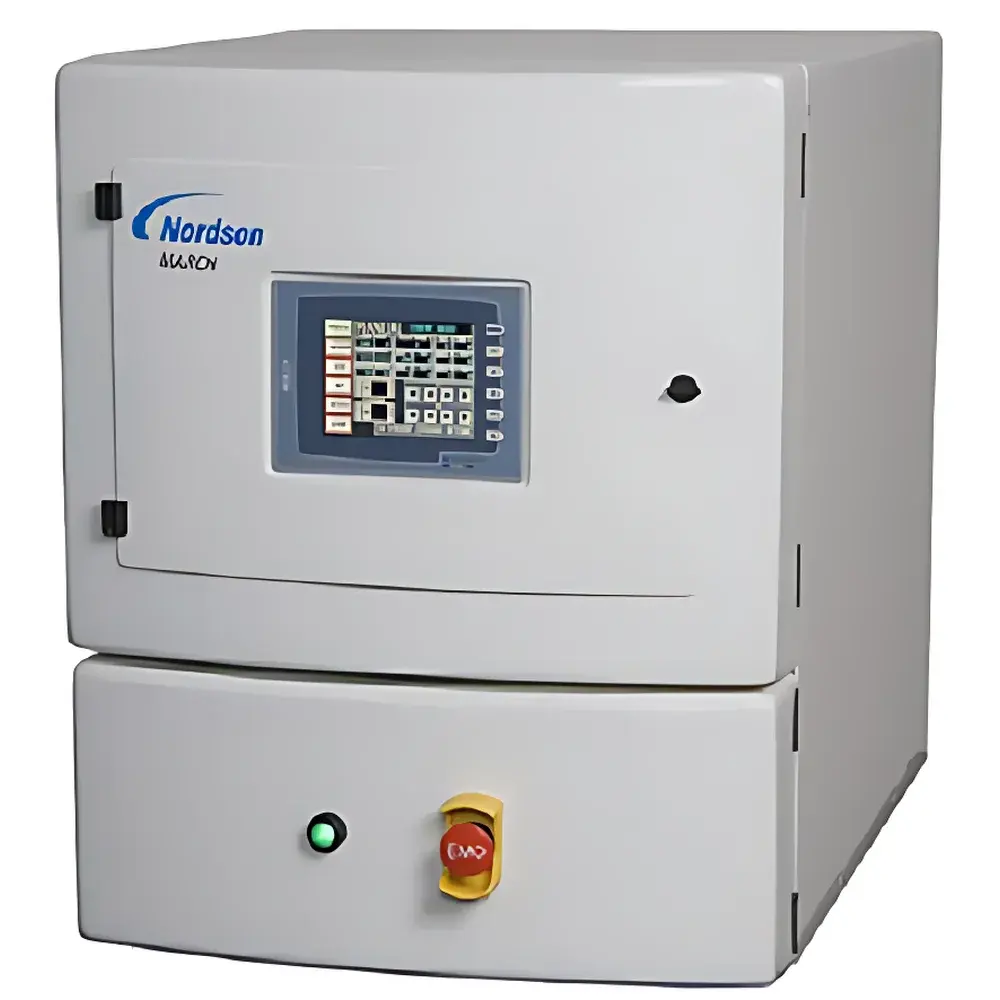
MARCH AP-1000 Plasma Cleaning System
| Origin | Netherlands |
|---|---|
| Manufacturer Type | Authorized Distributor |
| Origin Category | Imported Instrument |
| Model | MARCH AP-1000 |
| RF Frequency | 13.56 MHz (RF Generator with Auto-Impedance Matching) |
| Power Output | 2 kW |
| Chamber Material | Anodized Aluminum Alloy |
| Chamber Volume | Configurable (Standard & HTP Options Available) |
| Process Gases | O₂, Ar, H₂, He (via 4 Mass Flow Controllers) |
| Control System | PLC-Based Closed-Loop Control with Integrated Mechanical Height Sensor |
| Dimensions (Standard Unit) | 567 × 764 × 664 mm (W × D × H) |
| Dimensions (HTP Configuration) | 680 × 1127 × 1536–1890 mm (W × D × H) |
| Net Weight | 485 kg |
| Compliance | Designed for ISO Class 5–7 cleanroom integration |
| Software | Proprietary SPC-Enabled Process Management Suite with Audit Trail Capability |
Overview
The MARCH AP-1000 Plasma Cleaning System is a fully integrated, high-reliability RF plasma processing platform engineered for precision surface activation, organic residue removal, and native oxide reduction in microelectronics manufacturing and advanced materials R&D. Operating at the industrial standard 13.56 MHz radio frequency, the system employs capacitive-coupled (CCP) plasma generation within a vacuum chamber to produce highly reactive oxygen, argon, hydrogen, or helium species—enabling controlled, non-destructive modification of surfaces at the nanometer scale. Unlike atmospheric plasma tools, the AP-1000 operates under low-pressure conditions (typically 0.1–10 Torr), ensuring uniform plasma density, reproducible etch rates, and minimal thermal load on temperature-sensitive substrates such as bare silicon wafers, GaN-on-Si heterostructures, MEMS cantilevers, and flexible polymer-based sensors. Its monolithic architecture—housing the RF generator, vacuum pump (mounted on service-accessible casters), process chamber, and control electronics within a single enclosure—eliminates inter-unit cabling, reduces footprint, and supports 24/7 operation in production environments compliant with ISO 14644-1 Class 5–7 cleanroom specifications.
Key Features
- Self-contained design with integrated 2 kW RF generator, vacuum pumping system, and anodized aluminum process chamber—no external rack or auxiliary cabinets required
- Real-time closed-loop process control via PLC, incorporating mechanical height sensing for precise electrode gap stabilization during dynamic load changes
- Auto-tuning impedance matching network ensures consistent plasma coupling across variable chamber loads and gas compositions
- Touchscreen HMI with graphical process visualization, recipe management, and real-time parameter logging (pressure, power, forward/reflected RF, gas flow)
- Proprietary software suite supporting statistical process control (SPC), electronic batch records, and FDA 21 CFR Part 11–compliant audit trails for GLP/GMP environments
- Modular hardware configuration: Standard platform supports manual loading; High Throughput (HTP) variant includes vertically oriented M/G fixtures capable of holding up to 12 carriers, each accommodating ≥20 individual frames
Sample Compatibility & Compliance
The AP-1000 accommodates a broad range of substrate geometries—including 2″ to 8″ wafers, diced die stacks, PCB assemblies, ceramic packages, glass substrates, and MEMS sensor arrays—without requiring custom tooling. Chamber interior geometry and electrode spacing are optimized for laminar gas flow and uniform plasma distribution, validated per ASTM F209-22 (Standard Practice for Determining Cleanliness Levels of Surfaces). The system meets IEC 61000-6-3 (EMC emission limits) and IEC 61000-6-4 (industrial immunity), and its safety interlocks conform to ISO 13857 and EN 60204-1. Gas delivery utilizes four independent mass flow controllers (MFCs) calibrated to ±1% full-scale accuracy, enabling repeatable multi-gas sequences (e.g., Ar/O₂ pre-clean followed by H₂ reduction). All wetted surfaces are electropolished aluminum or stainless steel, minimizing particle generation and outgassing in accordance with SEMI F21-0212.
Software & Data Management
Control firmware runs on a deterministic real-time OS, synchronized with hardware I/O at sub-millisecond resolution. The embedded software provides role-based user access (Operator, Technician, Administrator), recipe versioning with digital signature, and export of timestamped CSV/Excel logs containing all monitored parameters. Data integrity is maintained through cyclic redundancy checks (CRC), write-once storage for critical logs, and optional integration with enterprise MES systems via OPC UA or Modbus TCP. Process data—including endpoint detection signals from optical emission spectroscopy (OES) modules (optional add-on)—is structured for traceability in ISO 9001-certified quality systems and supports automated nonconformance reporting per ISO 13485 requirements for medical device manufacturing.
Applications
- Pre-wirebond cleaning of Al/Cu bond pads to remove hydrocarbon contamination and thin native oxides
- Surface activation of PDMS, PET, and PI films prior to metallization or adhesive bonding
- Residue-free deburring of laser-cut stents and microfluidic channel walls
- Removal of photoresist scum and post-etch polymers from GaAs and SiC power devices
- Hydrophilicity enhancement of micro-lens arrays and optical waveguide facets
- Pre-epoxy dispensing treatment of ceramic substrates in hybrid RF module assembly
FAQ
What vacuum level does the AP-1000 achieve during operation?
The system reaches base pressures ≤5 × 10⁻³ Torr using its integrated two-stage rotary vane pump; process pressure is actively regulated between 0.1–10 Torr via throttle valve feedback control.
Is remote monitoring supported?
Yes—Ethernet connectivity enables secure remote diagnostics, log retrieval, and limited supervisory control via authenticated HTTPS interface, compliant with NIST SP 800-53 Rev. 5 AC-17 controls.
Can the chamber be upgraded for reactive ion etching (RIE)?
The AP-1000 platform supports optional RIE configurations with bias RF supply (13.56 MHz or 2 MHz), but standard plasma cleaning mode operates in pure CCP mode without substrate bias.
What maintenance intervals are recommended?
Chamber cleaning every 200 hours; RF matching network calibration annually; MFC recalibration every 6 months; pump oil replacement every 3,000 operating hours or per manufacturer’s viscosity specification.
Does the system support automated cassette-to-cassette handling?
Not natively—but the HTP configuration’s front-access layout and standardized footprint allow seamless integration with third-party robotic load ports (SEMI E47.1 compliant) upon request.



