
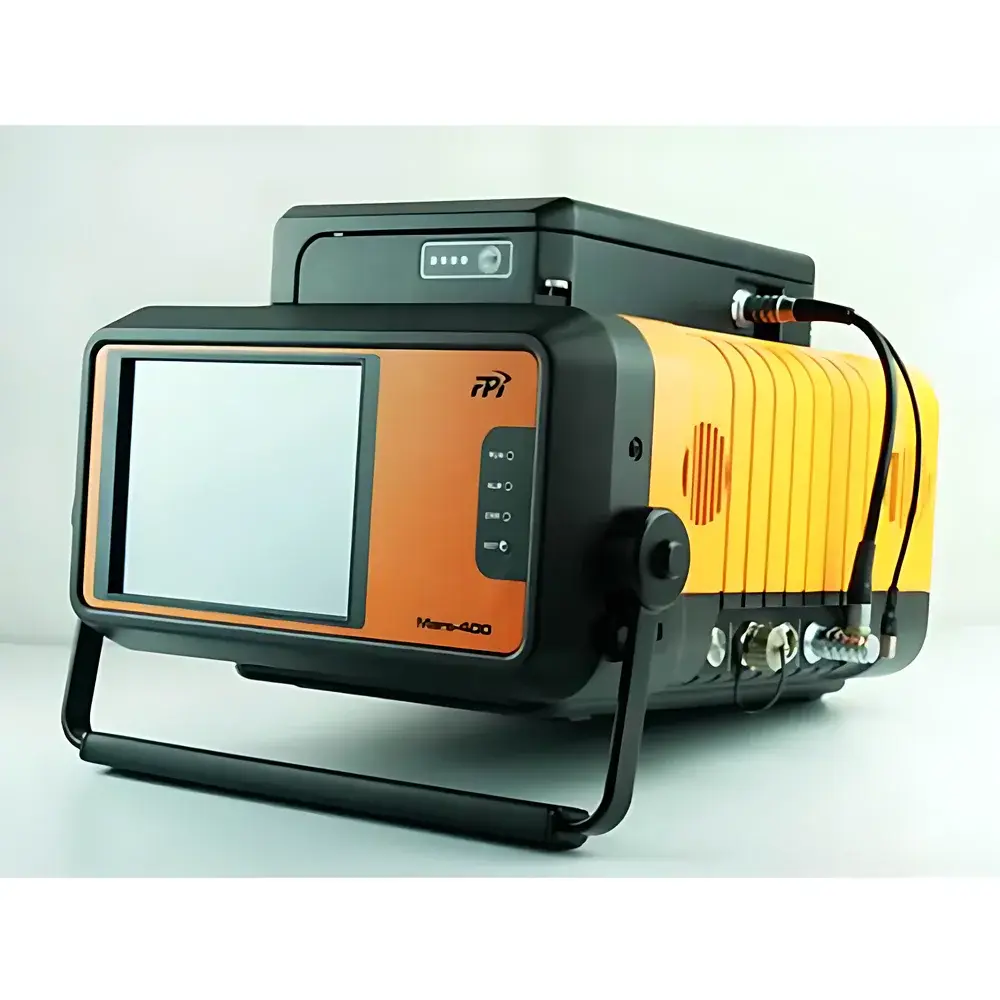
Mars-400 Plus Portable Gas Chromatography-Mass Spectrometry System
| Brand | FPI (Fortune Photonics Instrumentation) |
|---|---|
| Origin | Zhejiang, China |
| Manufacturer Type | OEM Manufacturer |
| Country of Origin | China |
| Model | Mars-400 Plus |
| Instrument Type | Portable GC-MS |
| Mass Range | 15–550 amu |
| Mass Resolution | Unit mass resolution |
| Detection Limit | < ppb (for selected VOCs/SVOCs) |
| Maximum Scan Rate | 10,000 amu/s |
| Sensitivity | Optimized for trace-level detection in field conditions |
| Weight | 17 kg |
| Power Supply | Integrated rechargeable battery pack |
| Carrier Gas | Built-in helium or hydrogen micro-gas cylinder (optional) |
Overview
The Mars-400 Plus Portable Gas Chromatography-Mass Spectrometry (GC-MS) System is an integrated, field-deployable analytical platform engineered for rapid, on-site identification and quantification of volatile and semi-volatile organic compounds (VOCs and SVOCs). It combines low thermal mass (LTM) gas chromatography with a compact 3D quadrupole ion trap mass spectrometer to deliver laboratory-grade analytical performance under non-laboratory conditions. Unlike benchtop GC-MS systems requiring fixed infrastructure, the Mars-400 Plus operates autonomously—powered by an internal rechargeable battery and supplied with carrier gas from an integrated micro-cylinder—enabling immediate deployment in emergency response, environmental incident assessment, and mobile monitoring scenarios. Its design adheres to core principles of field analytical chemistry: minimal sample preparation, high chromatographic peak capacity, real-time spectral acquisition, and robust spectral library matching (NIST/EPA/Custom) for unambiguous compound identification.
Key Features
- Rapid LTM-GC separation: Utilizes low thermal mass column heating (up to 600 °C/min ramp rate) to reduce analysis cycle time to ≤20% of conventional GC methods—enabling full chromatographic runs in under 5 minutes for common VOC panels.
- High-sensitivity ion trap MS: Features a patented pulsed internal ionization source optimized for electron ionization (EI) at reduced pressure, enhancing signal-to-noise ratio for sub-ppb level detection of target analytes including BTEX, chlorinated solvents, PAHs, and organophosphorus compounds.
- Multi-phase sample introduction: Supports direct gas sampling via handheld probe, static/dynamic headspace analysis for aqueous and solid matrices, split injection for SPME fiber desorption or liquid micro-injection (1–10 µL), and sealed-gas syringe injection for concentrated emission sources—eliminating need for off-site derivatization or extraction.
- Field-hardened mechanical architecture: Engineered with shock-absorbing chassis, conformal coating on PCBs, and vibration-damped optical path; certified to operate continuously at ambient temperatures from −10 °C to +50 °C and relative humidity up to 90% non-condensing.
- Intuitive touch-enabled software: Runs on embedded Linux with a 10.1-inch capacitive touchscreen; implements wizard-driven workflows for method setup, calibration, acquisition, and reporting—reducing operator training time and minimizing procedural errors in high-stress environments.
Sample Compatibility & Compliance
The Mars-400 Plus accommodates diverse environmental matrices without pre-concentration or solvent extraction in most cases. Certified for direct analysis of ambient air (via probe), water (headspace), soil slurries (dynamic headspace), and swab extracts (SPME). Method validation aligns with EPA Methods TO-14A, TO-15, and 8260D for VOCs, and ASTM D7717 for field-portable GC-MS verification. Data integrity meets GLP/GMP-aligned requirements: audit trail logging, user access control, electronic signatures, and exportable .cdf/.mzML files compatible with third-party processing tools. While not FDA 21 CFR Part 11–certified out-of-box, its firmware supports configurable audit trails and secure data archiving for regulated field programs.
Software & Data Management
Pre-installed FPI GC-MS Control Suite v4.x provides real-time total ion chromatogram (TIC) display, extracted ion chromatograms (XIC), spectral deconvolution, and automated NIST library search (with customizable match thresholds and retention index filtering). All raw and processed data are stored locally on encrypted SSD storage and can be exported via USB 3.0 or Wi-Fi (802.11ac) to networked servers or LIMS. Software includes built-in calibration curve generation (linear/log-linear), internal standard correction, and QC flagging per ICH Q2(R2) guidelines. Remote diagnostics and firmware updates are supported over secure TLS channels.
Applications
- Emergency response: Real-time identification of chemical spills, industrial leaks, or clandestine lab emissions.
- Environmental field screening: On-site VOC profiling in ambient air near landfills, refineries, or remediation sites.
- Occupational hygiene: Personal breathing zone monitoring and workplace vapor mapping.
- Forensic investigation: Rapid analysis of ignitable liquids, accelerants, or illicit drug precursors at crime scenes.
- CBRNE defense: Detection and identification of toxic industrial chemicals (TICs) and chemical warfare agent degradation products.
- Regulatory compliance: Field verification of cleanup endpoints per state and federal volatile organic compound action levels.
FAQ
What carrier gases are supported, and how long does a single cylinder last?
The system supports helium and hydrogen micro-cylinders (standard 50 mL, 10 MPa); typical runtime is 6–8 hours at 1 mL/min flow, depending on method parameters.
Is the instrument suitable for quantitative analysis without lab-based calibration?
Yes—built-in internal standard calibration (e.g., deuterated surrogates) enables semi-quantitative results in field mode; full quantitation requires initial calibration against NIST-traceable standards, which can be performed onsite using certified gas standards.
Can the Mars-400 Plus connect to enterprise LIMS or cloud platforms?
Raw data exports in open formats (.mzML, .cdf) and metadata in CSV/XML enable integration with major LIMS vendors and cloud analytics pipelines via API or SFTP.
Does the system meet MIL-STD-810G for transport ruggedness?
It complies with equivalent mechanical shock and drop specifications (1.5 m concrete drop, 3-axis random vibration 5–500 Hz), though formal MIL-STD-810G certification is not claimed.
What maintenance intervals are recommended for field operation?
Ion source cleaning every 50–100 samples; column trimming every 200 injections; battery health check every 6 months; annual factory recalibration recommended for metrological traceability.



