
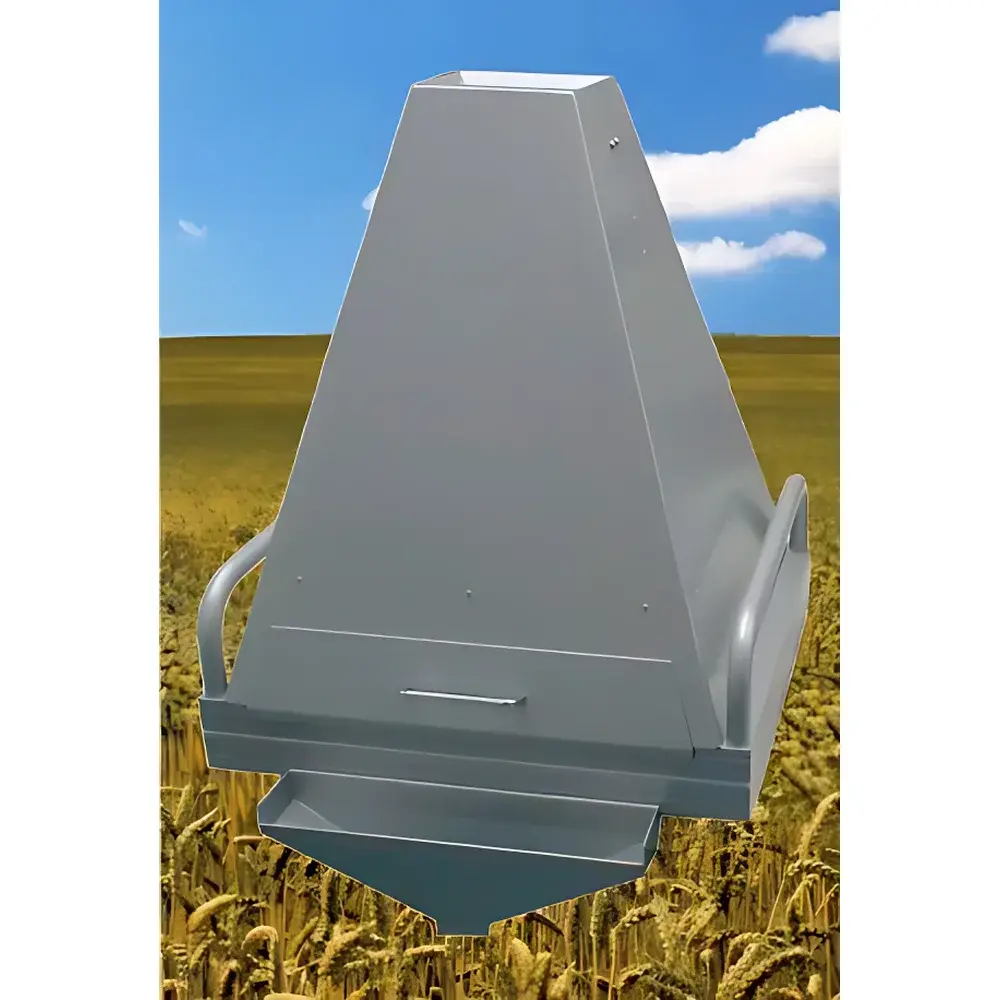
Marvin Seed Image Analyzer & Thousand-Grain Weight (TGW) System
| Brand | Anoxomat |
|---|---|
| Origin | Netherlands |
| Model | MARVIN |
| Instrument Type | Seed Image Analysis and TGW Determination System |
| Seed Diameter Range | ≥0.8 mm (Standard Version), ≥0.2 mm (High-Resolution Version) |
| Pixel Resolution | 0.15 mm (Standard), 0.10 mm (High-Resolution) |
| Imaging Area | 65 cm² (Standard), 325 cm² (High-Resolution) |
| Analysis Speed | 1–3 s per sample |
| Measurement Accuracy | <1% error |
| Measured Parameters | Seed Count, Thousand-Grain Weight (TGW), Hectoliter Weight (HLW), 2D Morphometrics (Length, Width, Aspect Ratio, Roundness, Convexity), Particle Size Distribution Classification |
| Sample Mass Capacity | 50 g |
| Minimum Weighing Increment | 0.005 g |
| Moisture Determination Range | ±3% (when integrated with optional moisture module) |
| Operating Ambient Temperature Range | 20 °C ±2 °C |
Overview
The Marvin Seed Image Analyzer & Thousand-Grain Weight (TGW) System is an automated, vision-based instrumentation platform engineered for high-throughput, non-destructive seed quality assessment in agricultural research laboratories, seed certification agencies, and breeding programs. It operates on the principle of digital image acquisition followed by algorithmic morphometric segmentation and statistical calibration against gravimetric reference standards. Unlike conventional manual counting or sieve-based sizing methods, Marvin employs calibrated monochrome CCD imaging under controlled illumination to capture high-contrast top-view silhouettes of bulk seed samples. Its dual-path architecture integrates real-time image processing with synchronized mass measurement—enabling traceable TGW derivation without manual intervention. Designed for ISO 9001-compliant workflows and aligned with ISTA (International Seed Testing Association) Rule 5 (Seed Counting) and Rule 7 (Weight Determination), the system supports objective, auditable seed evaluation across regulatory and R&D environments.
Key Features
- Automated dual-mode operation: simultaneous image capture and precision weighing (0.005 g resolution) for direct TGW calculation via mass/seed-count ratio.
- Configurable analysis profiles: user-defined thresholds for size, shape, contrast, and connectivity enable reliable discrimination of irregular, shriveled, cracked, or diseased seeds—including Brassica spp., Poaceae grains, legumes, sunflower, and forage species.
- Two hardware configurations: Standard version (≥0.8 mm min. diameter, 0.15 mm pixel resolution, 65 cm² field-of-view) and High-Resolution version (≥0.2 mm min. diameter, 0.10 mm pixel resolution, 325 cm² extended imaging area).
- Dual-instant verification: embedded redundancy logic cross-checks count and morphology metrics within <1 second, flagging outliers for operator review—enhancing data integrity without slowing throughput.
- Robust mechanical design: vibration-damped optical stage, corrosion-resistant sample tray, and sealed imaging chamber minimize environmental interference and eliminate routine optical recalibration.
- FDA 21 CFR Part 11–ready software architecture with full audit trail, electronic signatures, and role-based access control—validated for GLP/GMP seed testing compliance.
Sample Compatibility & Compliance
Marvin accommodates a broad spectrum of dicot and monocot seeds—including but not limited to wheat, barley, maize, soybean, canola, mustard, alfalfa, clover, and Helianthus annuus—without pre-sorting or manual orientation. Seeds must be dry (moisture content ≤14%) and free of surface debris or clumping to ensure optical separation during imaging. The system conforms to ISTA Rules 5, 7, and 10 (Purity Analysis), as well as EN ISO 20275 (Cereal Grains — Determination of Thousand-Kernel Weight) and ASTM D7081 (Standard Practice for Digital Image Analysis of Particulate Materials). All calibration protocols are documented per ISO/IEC 17025 requirements, and factory-certified traceability to NIST-traceable mass standards is provided.
Software & Data Management
The Marvin Control Suite runs on Windows OS and provides a validated, modular interface for method setup, batch processing, and report generation. Each analysis session logs raw images, binary masks, centroid coordinates, perimeter contours, and derived metrics—including length, width, circularity, convexity, elongation, and Feret diameters. Export formats include CSV, XML, and native .MARV binary files compatible with LIMS integration. Direct export to Microsoft Excel (with formula-locked worksheets) and SQL-compatible databases eliminates transcription errors. Audit trails record all user actions, parameter changes, and result modifications with timestamps and operator IDs—fully compliant with FDA 21 CFR Part 11 and EU Annex 11 requirements for electronic records.
Applications
- Regulatory seed certification: rapid, repeatable TGW and purity assessment for ISTA-accredited labs.
- Plant breeding programs: high-volume phenotyping of seed morphology traits (e.g., length-to-width ratio, shape indices) correlated with yield, dormancy, or stress tolerance.
- Quality assurance in seed production: real-time monitoring of lot homogeneity, grading consistency, and deviation detection (e.g., chaff contamination, insect damage).
- Academic agronomy research: quantitative analysis of seed development dynamics, varietal comparisons, and post-harvest treatment effects.
- Grain trading and storage management: hectoliter weight prediction from image-derived density proxies and volumetric packing models.
FAQ
Does Marvin require external balance integration for TGW calculation?
No. The system includes an integrated high-precision analytical balance (0.005 g readability) co-located within the imaging enclosure, ensuring synchronized mass and image capture without external cabling or alignment drift.
Can Marvin analyze seeds with high surface reflectivity or translucency (e.g., rice, millet)?
Yes—via adjustable LED illumination intensity and polarization filters; method templates for low-contrast species are included in the standard software library.
Is firmware and software update support available post-purchase?
Yes. Anoxomat provides biannual validated software releases with new species libraries, ISTA rule updates, and cybersecurity patches—accessible via secure customer portal with installation validation reports.
What is the typical throughput for a full TGW + morphology analysis?
Approximately 240–300 samples per 8-hour shift, depending on seed size distribution and whether HLW or multi-threshold classification is enabled.
Does Marvin support multi-language UI and reporting?
Yes. Interface and report templates are localizable into English, Spanish, French, German, Portuguese, and Chinese—configured per user profile without reinstallation.
Related Products






