
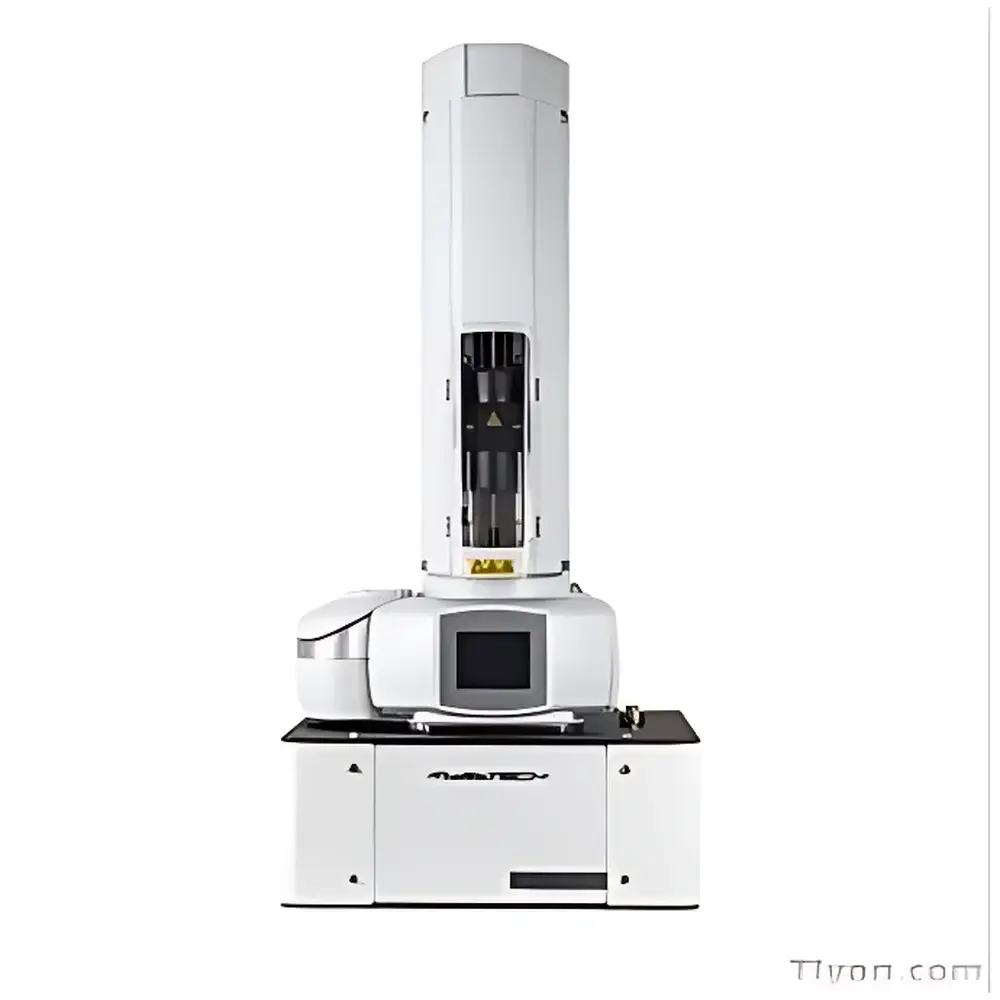
Masa MCCGC-AIMS PeakMachine Gas Chromatography–Ion Mobility Spectrometer
| Brand | Masa |
|---|---|
| Origin | Slovakia |
| Model | MCCGC-AIMS |
| Sample Introduction | Automated |
| Sensitivity | ppb to ppt |
| Library | VOCs, Explosives |
| Operating Pressure | 600–1200 mbar |
| Drift Gas Flow | 500–1200 mL/min |
| Sample Gas Flow | 2–500 mL/min |
| Drift Field Strength | 200–560 V/cm |
| Polarity | Positive/Negative |
| Ionization Source | Corona Discharge (Non-radioactive) |
| Pre-separation GC | Multi-Capillary Column Gas Chromatograph |
| IMS Temperature Range | 30–140 °C |
| Resolution (FWHM) | 90–100 (N₂/air) |
| Power Supply | 250 V / 24 V |
| Communication | TCP/IP, USB 2.0 |
| Dimensions (mm) | 490 × 390 × 150 |
Overview
The Masa MCCGC-AIMS PeakMachine is a high-performance two-dimensional (2D) analytical platform integrating multi-capillary column gas chromatography (MCCGC) with atmospheric- and sub-atmospheric-pressure ion mobility spectrometry (IMS). Engineered for precision separation and identification of volatile organic compounds (VOCs), semi-volatiles, and trace-level threat agents in complex matrices, the system operates on orthogonal separation principles: first-dimension retention time from MCCGC and second-dimension ion mobility drift time from IMS. This dual-separation architecture delivers enhanced peak capacity, reduced spectral overlap, and improved compound-specific resolution—particularly critical for applications involving flavor profiling, off-odor detection, pharmaceutical residual solvent analysis, and explosives screening. Unlike conventional IMS systems relying on radioactive 63Ni sources, the PeakMachine employs a robust corona discharge ionization source, eliminating regulatory handling constraints while maintaining stable ion generation across extended operation cycles. Its modular thermal management enables precise control of both GC column oven and IMS drift tube temperatures (30–140 °C), ensuring reproducible ion mobility behavior under variable matrix loadings.
Key Features
- Two-dimensional separation combining MCCGC retention and IMS drift time for unambiguous compound identification
- Non-radioactive corona discharge ionization source compliant with IEC 61010-1 and EU RoHS directives
- Configurable operating pressure range (600–1200 mbar) supporting both ambient-pressure and reduced-pressure IMS modes
- High-resolution IMS performance: ≥90 FWHM in N₂, up to 100 FWHM in synthetic air—optimized for structural isomer differentiation
- Dual-polarity capability (positive/negative mode) enabling comprehensive ionization coverage of polar and non-polar analytes
- Integrated dopant gas injection module for reaction ion chemistry modification—enhancing selectivity toward lactones, nitro-compounds, and sulfur-containing volatiles
- Automated sample introduction compatible with standard liquid/solid headspace autosamplers (e.g., CTC Analytics PAL, Gerstel MPS)
- Drift field strength tunable from 200 to 560 V/cm to balance resolution, sensitivity, and duty cycle
Sample Compatibility & Compliance
The PeakMachine accommodates headspace analysis of liquids (aqueous solutions, beverages, solvents), solids (powders, tablets, food matrices), and polymers without derivatization. Its low sample consumption (2–500 mL/min sample gas flow) and high sensitivity (sub-ppb to low-ppt detection limits for target VOCs and explosives) support routine QC testing per ISO 17025-accredited laboratory workflows. The instrument meets essential electromagnetic compatibility (EMC) requirements per EN 61326-1 and safety standards per EN 61010-1. Data acquisition and reporting modules support audit-trail functionality aligned with FDA 21 CFR Part 11 and EU Annex 11 expectations for regulated environments. Instrument qualification documentation—including IQ/OQ protocols—is available upon request for GMP/GLP-compliant deployment in pharmaceutical and food safety laboratories.
Software & Data Management
PeakMachine Control Suite provides real-time visualization of 2D chromatograms (retention time vs. drift time), automated peak detection, and library matching against embedded spectral libraries for VOCs and explosives. Raw data are stored in vendor-neutral HDF5 format, enabling interoperability with third-party chemometric tools (e.g., MATLAB, Python scikit-learn). Machine learning classifiers—including supervised random forest and PCA-LDA models—are pre-trained for rapid categorization of unknown samples into predefined classes (e.g., “fresh coffee”, “oxidized oil”, “TNT-contaminated surface”). All processing steps—including baseline correction, mobility calibration, and retention index alignment—are fully scriptable and version-controlled. Audit logs record user actions, parameter changes, and calibration events with timestamped digital signatures.
Applications
- Food & beverage quality control: Detection of spoilage markers (e.g., hexanal, 2-nonanone), authenticity verification (geographic origin, varietal classification), and packaging migration studies
- Pharmaceutical manufacturing: Residual solvent monitoring (ICH Q3C), cleaning validation, and headspace analysis of lyophilized products
- Environmental monitoring: Real-time detection of airborne VOCs in indoor/outdoor settings and landfill emissions tracking
- Security & defense: Field-deployable screening for explosives (RDX, PETN, TNT), chemical warfare agent simulants, and illicit drug precursors
- Research laboratories: Reaction monitoring, metabolite profiling in breath analysis, and fundamental studies of ion–molecule reactions under controlled drift conditions
FAQ
What types of samples can be analyzed directly without derivatization?
Liquid and solid samples amenable to headspace sampling—including aqueous solutions, beverages, powders, tablets, and polymer films—can be introduced directly using standard autosamplers.
Is the system compliant with FDA 21 CFR Part 11 requirements?
Yes—audit trails, electronic signatures, and role-based access controls are implemented in the software suite to support regulated data integrity requirements.
Can the IMS operate independently of the GC module?
Yes—the instrument supports standalone IMS mode for rapid screening or method development, with full parameter control via the same software interface.
What drift gases are supported, and is dopant gas delivery integrated?
Standard operation uses purified N₂ or synthetic air; optional dopant gases (e.g., acetone, chloroform) are delivered through a dedicated, mass-flow-controlled inlet module.
How is calibration maintained across temperature and pressure variations?
Internal reference ions (e.g., H⁺(H₂O)ₙ clusters) are continuously monitored; mobility calibration is automatically updated using built-in drift time standards and temperature-compensated field calculations.




