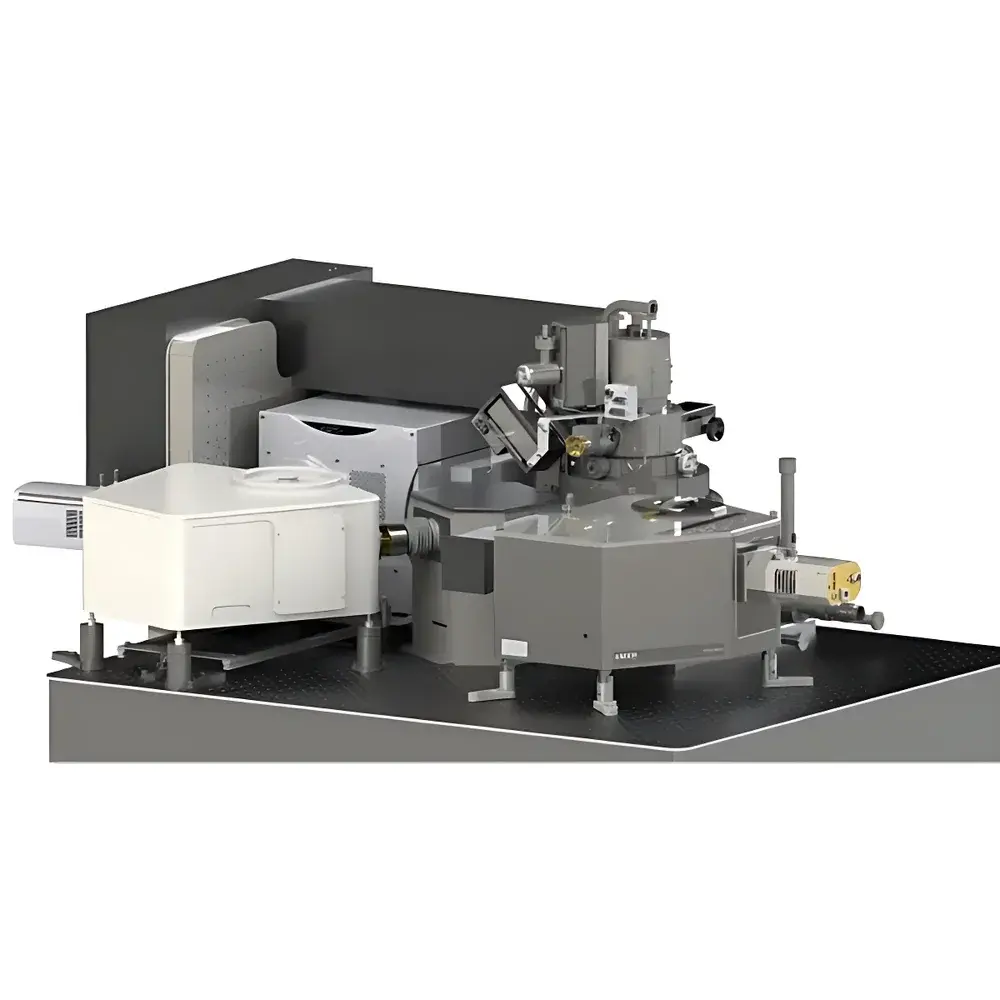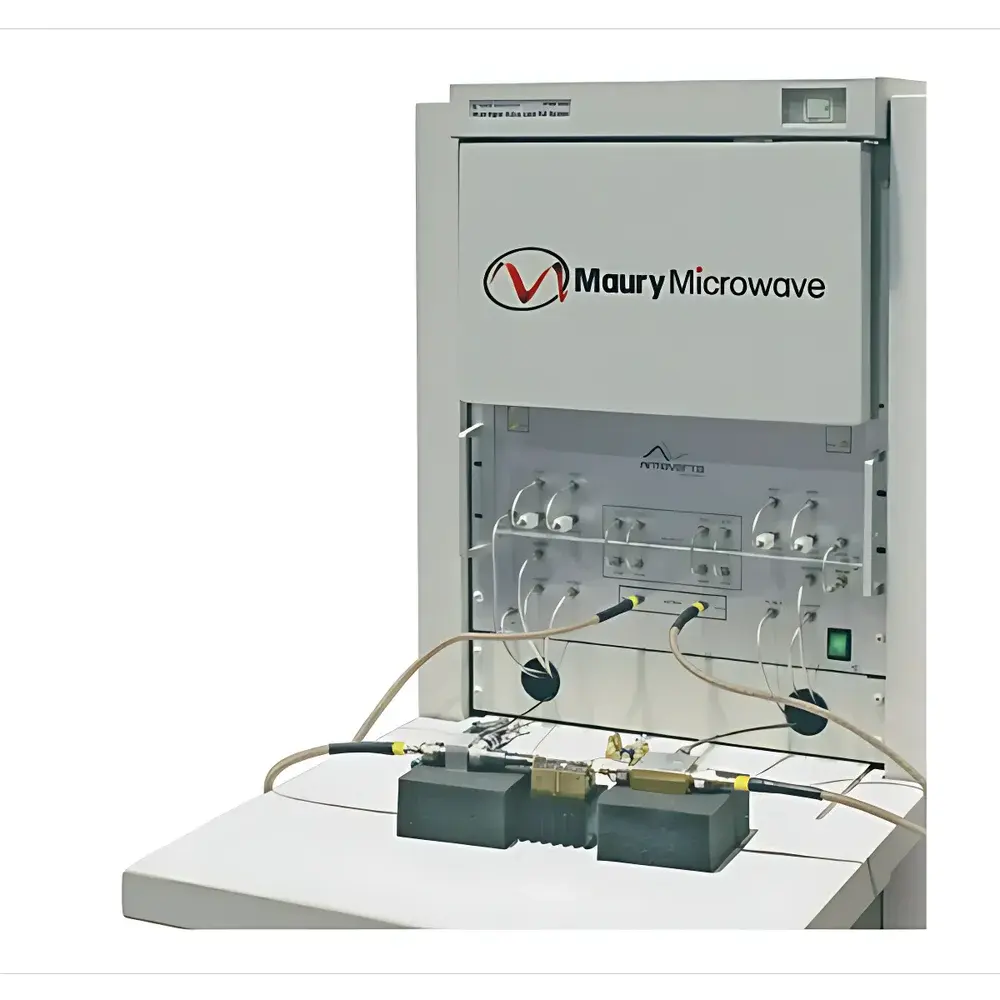
Maury MT1000 and MT2000 Series Mixed-Signal Active Load-Pull Systems
| Brand | Maury |
|---|---|
| Origin | USA |
| Model | MT1000 and MT2000 Series Mixed-Signal Active Load-Pull Systems |
| Frequency Range | 1 MHz to 67 GHz |
| Maximum Impedance Tuning Speed | 1000 impedance/power states per minute |
| Baseband/RF/Harmonic Bandwidth (MT2000) | up to 1000 MHz |
| Configurations | MT2000E6-500 (40 GHz, 6-loop, 500 MHz BW), MT2000F4-1000 (67 GHz, 4-loop, 1000 MHz BW) |
| Compliance | Designed for RFIC, MMIC, and GaN PA characterization under pulsed CW, modulated, and multi-tone conditions |
Overview
The Maury MT1000 and MT2000 Series Mixed-Signal Active Load-Pull Systems represent a fully integrated, turnkey architecture engineered for high-speed, wideband nonlinear characterization of RF and microwave power devices. Unlike passive mechanical tuner-based systems, these platforms implement real-time, closed-loop active impedance synthesis using synchronized vector signal generation and acquisition across RF, harmonic, and baseband domains. The core measurement principle relies on simultaneous control and monitoring of complex terminations at fundamental, harmonic, and modulation frequencies—enabling precise reconstruction of time-domain voltage and current waveforms at the device under test (DUT) reference plane. This capability supports rigorous validation of nonlinear behavioral models (e.g., X-parameters, Poly-Harmonic Distortion models), large-signal stability analysis, and load-line optimization under realistic operating conditions—including pulsed DC bias, modulated RF excitations (QAM, OFDM), and dynamic antenna mismatch scenarios. Operating from 1 MHz to 67 GHz, the systems are deployed in R&D labs, wafer-level test facilities, and production validation environments where throughput, repeatability, and broadband fidelity are critical.
Key Features
- Single-box integration eliminating discrete VNAs, NVNAs, vector signal generators, vector signal analyzers, oscilloscopes, and passive tuners
- Real-time active impedance synthesis with up to 1000 impedance/power state transitions per minute—unconstrained by Smith chart coverage limitations
- Simultaneous RF, harmonic, and baseband impedance control: MT2000 supports up to 1000 MHz instantaneous bandwidth at baseband terminals for ACPR/EVM-driven PA design
- Dual-mode operation: supports both continuous-wave (CW) and pulsed RF stimuli with synchronized DC/pulsed bias control
- Hardware-accelerated waveform capture: digitizes time-domain V/I waveforms at DUT plane with calibrated phase coherence across harmonics
- Modular loop architecture: MT2000E6-500 (40 GHz, 6-loop configuration, 500 MHz baseband BW); MT2000F4-1000 (67 GHz, 4-loop configuration, 1000 MHz baseband BW)
- Factory-calibrated uncertainty budgets traceable to NIST standards; compliant with ISO/IEC 17025 laboratory accreditation requirements
Sample Compatibility & Compliance
The MT1000 and MT2000 systems accommodate a broad range of semiconductor technologies including GaN HEMTs, Si LDMOS, GaAs pHEMTs, and CMOS RFICs—configured as bare die, packaged devices, or on-wafer probes. All hardware interfaces meet IEEE 1687 (IJTAG) and MIL-STD-1553B timing specifications for deterministic synchronization. Software drivers support SCPI command sets aligned with IVI-COM and VXIplug&play standards. System calibration procedures follow IEEE Std 145-2013 for antenna and microwave measurements and are compatible with GLP/GMP audit trails per FDA 21 CFR Part 11 when used in regulated product development workflows. Harmonic termination accuracy is validated per IEC 62037-5 for nonlinear device characterization.
Software & Data Management
The integrated Maury WinPLOT™ software provides a unified GUI for measurement sequencing, real-time impedance mapping, waveform visualization, and model extraction. It supports automated script execution via Python API (PyWinPLOT), enabling integration into CI/CD pipelines for design-for-test (DFT) validation. Raw time-domain data is stored in HDF5 format with embedded metadata (frequency plan, bias conditions, calibration date, operator ID). Audit logs record all parameter changes, calibration events, and user actions with timestamped digital signatures. Export options include Touchstone (S-, Y-, Z-, and X-parameter formats), CSV, MATLAB .mat, and industry-standard IC-CAP and ADS-compatible datasets. Data integrity is enforced through SHA-256 hashing and optional AES-256 encryption for secure transfer to remote analysis servers.
Applications
- Nonlinear model extraction and verification for EM-SPICE co-simulation and behavioral modeling tools
- Wideband power amplifier design optimization under realistic modulated signal conditions (e.g., 5G NR FR1/FR2, Wi-Fi 6E/7)
- Dynamic load-pull analysis for envelope tracking (ET) and digital pre-distortion (DPD) algorithm development
- On-wafer characterization of mmWave phased-array front-end modules with active impedance tuning at harmonic frequencies
- Thermal-aware load-pull using synchronized IR imaging triggers and pulsed-bias thermal stabilization protocols
- Production test correlation studies between wafer-probe and module-level performance under varying antenna VSWR conditions
FAQ
What distinguishes active load-pull from passive mechanical tuner systems?
Active systems synthesize terminations electronically in real time, enabling arbitrary impedance trajectories across frequency and harmonic domains without mechanical latency or limited Smith chart coverage.
Can the MT2000 perform harmonic load-pull at 67 GHz?
Yes—the MT2000F4-1000 configuration supports active harmonic termination control up to the 5th harmonic at 67 GHz fundamental frequency, with calibrated phase accuracy better than ±3°.
Is third-party software integration supported?
Yes—native APIs for Keysight PathWave ADS, Cadence AWR, and Synopsys Sentaurus Device enable bidirectional data exchange and automated test flow orchestration.
Does the system support pulsed-RF measurements with nanosecond-level timing resolution?
Yes—integrated trigger distribution network achieves sub-10 ns jitter between RF pulse edges, DC gate/base pulses, and digitizer acquisition windows.
How is calibration traceability maintained across frequency bands?
Each system ships with NIST-traceable SOLT and TRL calibration kits; factory-performed full 2-port + harmonic calibration is documented in ISO/IEC 17025-compliant certificates.