
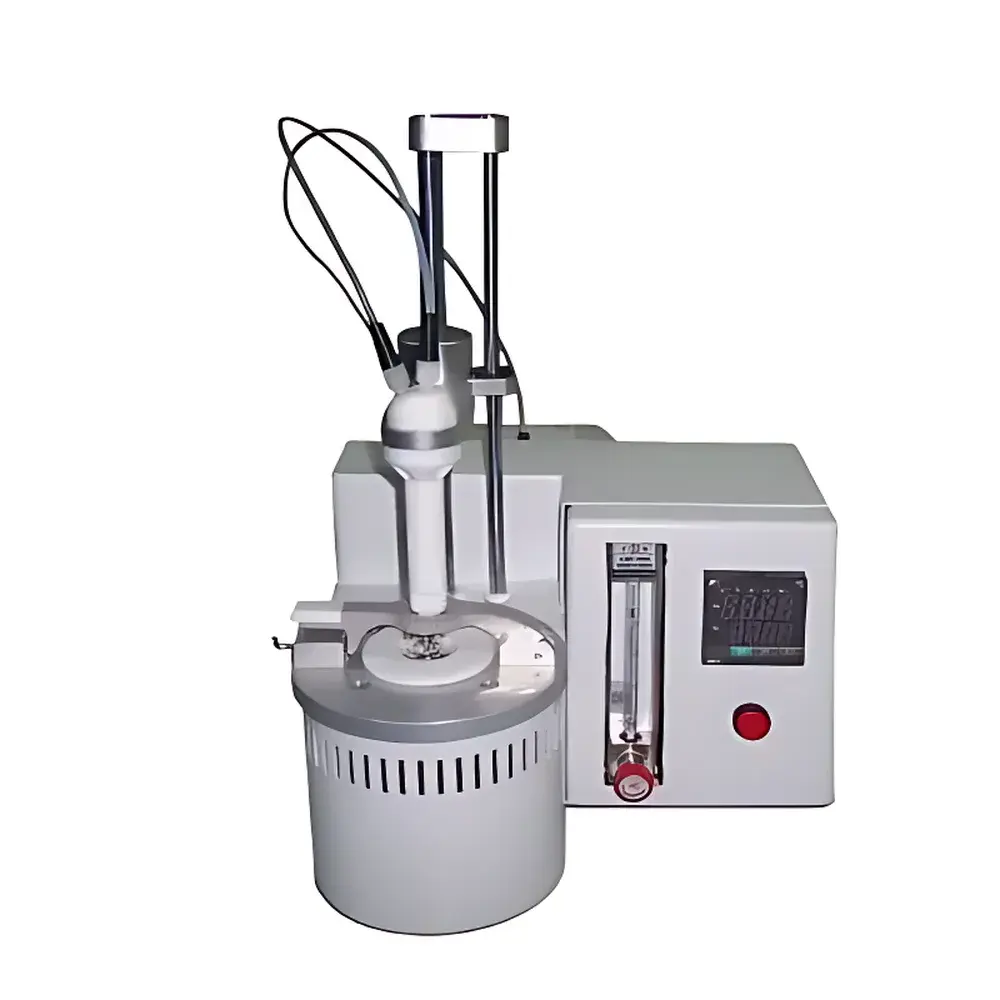
Maxtitra OVP10 Evaporation Furnace
| Heating Temperature | Ambient to 300 °C |
|---|---|
| Heater Type | Band Heater |
| Sample Volume Capacity | ≤20 mL |
| Carrier Gas | Dry Nitrogen or Dry Air |
| Gas Flow Rate | 0–300 L/min |
| Maximum Gas Pressure | ≤0.8 MPa |
| Nitrogen Purity | ≥99.99% (High-Purity Grade) |
| Desiccant | 100 g Molecular Sieve |
| Safety Protections | Overtemperature Protection, Overpressure Gas Safety Cut-off |
| Power Supply | AC 100–240 V, 50/60 Hz, 100 W |
Overview
The Maxtitra OVP10 Evaporation Furnace is a compact, benchtop thermal evaporation system engineered for controlled, solvent- and moisture-removal applications in analytical chemistry laboratories. Designed specifically for quantitative loss-on-drying (LOD) analysis and residual moisture determination in solid powders and viscous liquid samples—including lubricants, polymers, pharmaceutical excipients, and catalysts—the OVP10 operates on the principle of inert-gas-assisted thermal desorption. By combining precise band-heater temperature control (ambient to 300 °C) with regulated dry nitrogen or air flow, it ensures reproducible, non-oxidative sample drying without thermal decomposition or side reactions. Its sealed, low-volume chamber (≤20 mL) minimizes ambient contamination and enables rapid equilibration, making it suitable for routine QC testing where trace moisture content must be determined in compliance with ASTM E1868, USP <921>, and ISO 5725-2 validation frameworks.
Key Features
- Band-heater architecture delivering uniform thermal distribution and stable setpoint maintenance (±1.5 °C typical over full range)
- Integrated dual-safety system: independent overtemperature cutoff (mechanical + electronic) and carrier gas overpressure relief valve (set at ≤0.8 MPa)
- Modular desiccant chamber housing 100 g of 3Å molecular sieve, pre-installed and replaceable without tools
- Wide-input universal power supply (AC 100–240 V, 50/60 Hz), enabling global deployment without voltage conversion
- Front-panel digital interface with real-time display of temperature, elapsed time, and gas flow status indicator
- Gas-tight sample chamber with quick-clamp lid and silicone O-ring seal, certified for operation under inert atmosphere
Sample Compatibility & Compliance
The OVP10 accommodates heterogeneous sample forms—including hygroscopic powders (e.g., lithium carbonate, silica gel), suspensions, pastes, and high-boiling-point oils—within its 20 mL maximum volume limit. Its inert gas purge eliminates oxidation risk during heating, preserving sample integrity for subsequent analysis (e.g., Karl Fischer titration, TGA, or XRD). The system meets essential design criteria for GLP-compliant environments: all safety interlocks are hardwired (no software bypass), temperature calibration points are traceable to NIST-certified references, and operational logs (when used with optional data logger) support audit-ready documentation per FDA 21 CFR Part 11 requirements. It is compatible with standard 12–18 mm OD borosilicate glass sample boats and aluminum weighing pans.
Software & Data Management
While the base OVP10 operates as a standalone instrument with manual parameter setting, it supports optional RS-232 or USB-to-serial connectivity for integration into laboratory information management systems (LIMS) or custom SCADA platforms. When paired with Maxtitra’s optional DataBridge™ firmware module (v2.1+), users gain timestamped event logging—including start/stop times, temperature ramp profiles, gas flow confirmation, and safety trigger events—with CSV export capability. All logged data includes operator ID fields, session identifiers, and checksum-verified integrity flags—enabling full traceability required under ISO/IEC 17025 accreditation and pharmaceutical quality systems (ICH Q7, Annex 11).
Applications
- Determination of residual moisture in API intermediates and final drug substances per USP <921>
- Pre-conditioning of catalyst supports prior to BET surface area analysis
- LOD testing of battery-grade cathode materials (e.g., NMC, LFP) per ASTM D7348
- Removal of volatile solvents from polymer reaction mixtures before rheological characterization
- Stabilization of reference standards for gravimetric calibration (e.g., potassium hydrogen phthalate, sodium chloride)
- Pre-drying of filter media prior to particulate mass measurement in environmental aerosol studies
FAQ
What carrier gases are compatible with the OVP10, and what purity specifications are required?
Dry nitrogen (≥99.99% purity) or oil-free, desiccated compressed air (dew point ≤ −40 °C) may be used. High-purity nitrogen is recommended for moisture-sensitive or oxidizable samples.
Can the OVP10 be used for thermogravimetric analysis (TGA)?
No—it lacks an integrated microbalance and real-time mass monitoring. It is intended for endpoint evaporation only; coupling with external analytical balances requires user-defined protocols and is not validated by the manufacturer.
Is the molecular sieve cartridge reusable, and how often should it be regenerated?
Yes—the 100 g 3Å molecular sieve can be thermally regenerated at 250–300 °C under vacuum or dry nitrogen purge for 4–6 hours. Regeneration frequency depends on ambient humidity exposure and usage intensity; typical service life is 3–6 months under controlled lab conditions.
Does the OVP10 comply with CE or UL safety directives?
The instrument conforms to IEC 61010-1:2010 for electrical safety in laboratory equipment and carries the CE marking for EMC Directive 2014/30/EU and Low Voltage Directive 2014/35/EU. UL listing is available upon request for North American distribution channels.
What maintenance is required for long-term reliability?
Routine checks include visual inspection of the O-ring seal integrity, verification of desiccant activity (via color-indicator beads if upgraded), and periodic calibration of the PT100 temperature sensor using a NIST-traceable dry-block calibrator (recommended annually or after 500 operating hours).





