
MAYZUM MAY-2001NC Online Sodium Hypochlorite Concentration Meter
| Brand | MAYZUM |
|---|---|
| Model | MAY-2001NC |
| Measurement Principle | Vibrational Density-based Electrochemical Correlation |
| Measured Parameters | Density (g/cm³), Temperature (°C), NaOCl Concentration (% w/w), Baumé (°Bé) |
| Density Range | 0–2.2 g/cm³ |
| Concentration Range | 0.1–114.62% |
| Resolution | 0.001 g/cm³ / 0.1 °C / 0.1% / 0.1 °Bé (standard) |
| Accuracy | ±0.002 g/cm³ / ±0.5% / ±0.5 °Bé (standard) |
| Temp. Compensation | Automatic, 0–80 °C integrated Pt100 sensor |
| Operating Temp. | −20 to +120 °C (process), −20 to +80 °C (ambient) |
| Pressure Rating | ≤20 MPa |
| Enclosure Rating | IP67 |
| Electrical Interface | M12×1.5 (probe), M16×1.5 (controller) |
| Output Options | 4–20 mA analog, RS485/RS232 digital, dual-channel relay alarms |
| Power Supply | 24 V DC |
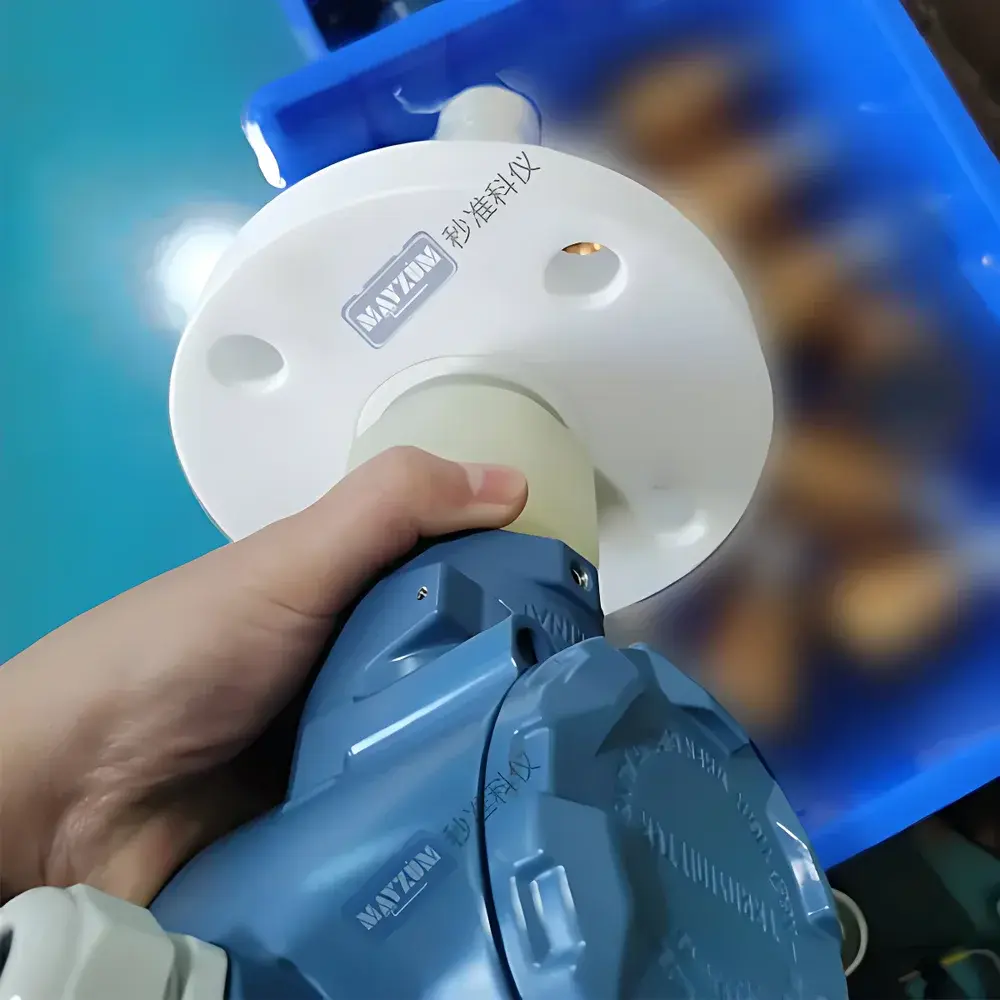
| Wetted Materials | PTFE flange, Hastelloy C-276 with PTFE lining |
| Explosion Protection | Ex ia IIB T6 Ga (optional) |
| Data Storage | SQLite database, up to 16 GB |
Overview
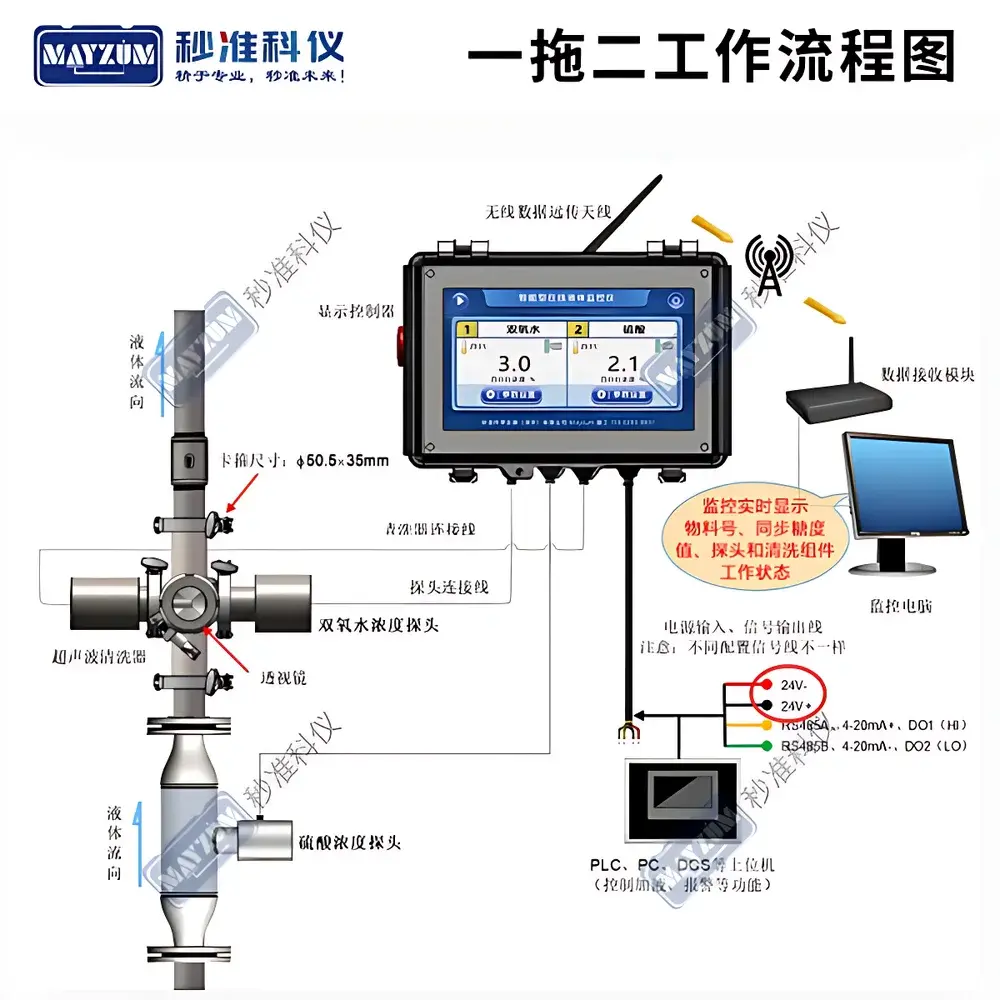
The MAYZUM MAY-2001NC is an industrial-grade online concentration meter engineered for continuous, real-time monitoring of sodium hypochlorite (NaOCl) solutions in water treatment, disinfection, electroplating, and chemical dosing applications. Unlike optical or conductometric methods—whose accuracy degrades with turbidity, oxidation byproducts, or electrode fouling—the MAY-2001NC employs a high-stability vibrational density sensing principle. It measures the fundamental physical property of solution density (g/cm³) at the process stream, then correlates it to NaOCl concentration (%) via a rigorously validated, temperature-compensated calibration model. This approach ensures long-term stability, immunity to color change, suspended solids, or redox interference, and eliminates drift associated with electrode aging. The instrument is equally applicable to other dense aqueous electrolytes—including sulfuric acid (including fuming H₂SO₄ formulations), ammonium sulfate, aluminum sulfate, and nitric acid—where density-concentration relationships are well characterized per ISO 279, ASTM D1298, and USP <841>.
Key Features
- Vibrational density transducer with integrated Pt100 temperature sensor—mounted directly in contact with process media for immediate thermal equilibration and precise automatic compensation across 0–80 °C.
- Corrosion-resistant wetted materials: PTFE-sealed flange interface and Hastelloy C-276 probe body with internal PTFE lining—validated for continuous exposure to ≥15% NaOCl, 98% H₂SO₄, and fuming sulfuric acid (oleum) up to 65% SO₃.
- Self-contained, maintenance-free operation: factory-calibrated with NIST-traceable certificate; no field recalibration required under stable process conditions per ISO/IEC 17025-compliant validation protocols.
- 4.3-inch capacitive touchscreen HMI with color-coded status indicators, intuitive menu navigation, and customizable alarm thresholds—supports multi-language UI (English, Spanish, German, Chinese) via firmware update.
- Dual-mode output architecture: simultaneous 4–20 mA analog (linearized to % NaOCl or density), isolated RS485 Modbus RTU, and two programmable relay outputs for high/low concentration alarms or automated reagent dosing control.
- Embedded SQLite database engine supporting 16 GB onboard storage; time-stamped records include density, temperature, calculated concentration, system diagnostics, and operator events—with automatic backup to USB flash drive.
- Optional wireless telemetry module (MAY-LOT) enables secure MQTT or OPC UA transmission to PLCs, DCS, SCADA, or cloud-based MES platforms—fully compliant with IEC 62443-3-3 security profiles.
Sample Compatibility & Compliance
The MAY-2001NC is designed for direct in-line installation in pressurized piping (≤20 MPa) or side-stream bypass loops. Its density-based measurement methodology remains unaffected by solution opacity, particle load (<50 µm), or oxidative degradation products common in aged NaOCl stock solutions. It meets EN 61326-1 (EMC), EN 61000-6-2/6-4, and RoHS 2011/65/EU. For hazardous area deployment, the optional Ex ia IIB T6 Ga intrinsically safe version complies with ATEX 2014/34/EU and IECEx standards. All firmware and data logging functions adhere to ALCOA+ principles—supporting audit trails, electronic signatures, and 21 CFR Part 11-compliant user access control when paired with MAY-LST extended logging firmware.
Software & Data Management
Data integrity is ensured through cyclic redundancy checking (CRC-32) on all stored records and write-protected archival partitions. Historical datasets (retained for 12 months minimum) are exportable as CSV or Excel-compatible XLSX files with embedded metadata (timestamp, operator ID, calibration ID). PC-based configuration utility (Windows/Linux/macOS) provides full parameter setup, trend visualization, statistical summaries (min/max/avg/std dev), and deviation alerts based on configurable moving windows. Remote access via Ethernet or optional LTE module allows real-time dashboard viewing, alarm acknowledgment, and firmware updates—without compromising network segmentation requirements in regulated environments.
Applications
- Continuous monitoring of NaOCl dosage in municipal drinking water and wastewater disinfection systems—ensuring residual chlorine compliance per EPA Method 334.0 and EU Directive 98/83/EC.
- In-process concentration control during electroplating bath replenishment—maintaining optimal oxidant levels for passivation and etching consistency.
- Fuming sulfuric acid (oleum) blending verification in specialty chemical synthesis—correlating measured density to SO₃ content per ASTM D2982.
- Quality assurance of ammonium sulfate fertilizer solutions and aluminum sulfate coagulant dosing in potable water plants.
- Automated feedback control in closed-loop chemical dosing skids—integrating seamlessly with Allen-Bradley, Siemens S7, or Yokogawa CENTUM VP DCS systems.
FAQ
Does the MAY-2001NC require periodic recalibration?
No—factory calibration is traceable to NIST standards and remains valid under stable process conditions. Recalibration is only recommended after mechanical shock, replacement of the density sensor, or if long-term drift exceeds ±0.002 g/cm³ per ISO 5725-2 verification protocol.
Can it measure fuming sulfuric acid (oleum)?
Yes—its Hastelloy C-276/PTFE construction and density correlation algorithm support oleum concentrations up to 65% SO₃, with density ranges mapped per DIN 51757 Annex B.
Is wireless data transmission secure and auditable?
Yes—MAY-LOT module implements TLS 1.2 encryption, device authentication, and immutable log entries synchronized with UTC timestamps—fully supporting GxP and FDA 21 CFR Part 11 data integrity requirements.
What happens during power interruption?
Non-volatile memory preserves all configuration parameters and last 72 hours of high-frequency process data; upon reboot, the system resumes measurement without manual intervention.
How is temperature compensation implemented?
A co-located Pt100 sensor delivers real-time temperature readings directly to the density transducer’s microcontroller, enabling dynamic polynomial correction per IAPWS formulation—eliminating lag-induced errors from remote temperature probes.





