MAYZUM MAY-3002 Online Refractometer
| Brand | MAYZUM |
|---|---|
| Origin | Guangdong, China |
| Manufacturer Type | OEM/ODM Manufacturer |
| Country of Origin | China |
| Model | MAY-3002 |
| Price | USD 1,380 (FOB Guangdong) |
| Measurement Principle | Critical Angle Refraction |
| Measured Parameters | Refractive Index (nD), Temperature (°C), Brix (% w/w), and Custom Concentration Scales |
| Brix Range | 0.0–30.0% |
| Refractive Index Range | 1.3200–1.3810 |
| Resolution | 0.1% Brix, 0.0002 nD, 0.1°C |
| Accuracy | ±0.2% Brix, ±0.0003 nD, ±0.2°C |
| Temperature Compensation | Automatic, 0–60°C |
| Process Temperature | 0–80°C |
| Pressure Rating | ≤1 MPa |
| Wetted Materials | 316L Stainless Steel + Optical-Grade Sapphire Prism |
| Enclosure Material | Anodized Aluminum |
| Electrical Supply | DC 24 V / AC 220 V |
| Output Signals | 4–20 mA, RS485/Modbus RTU, Dual Switch Outputs (High/Low Alarm), Optional Wireless Data Transmission Module |
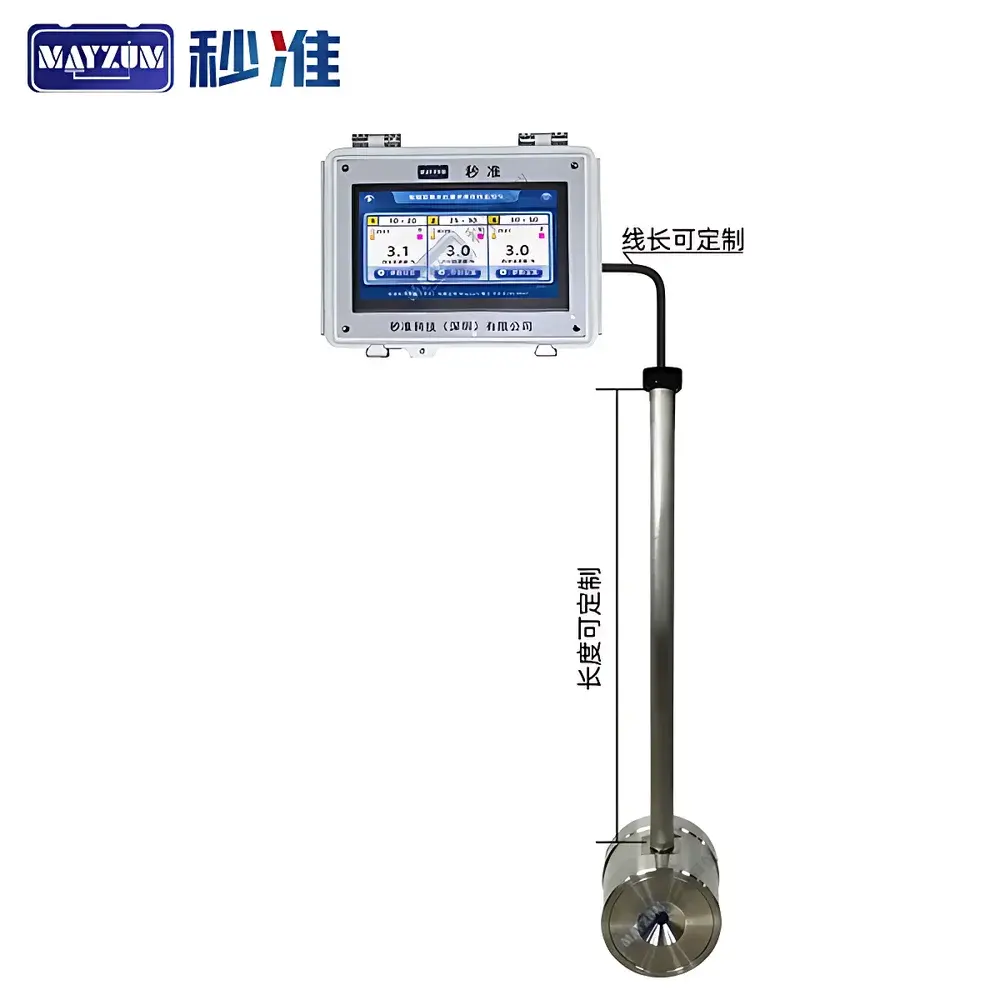
| Display | Integrated 4.3-inch TFT Touch Controller |
| Cable Length | Up to 100 m (customizable) |
| IP Rating | IP67 |
| Weight | ≈2.25 kg |
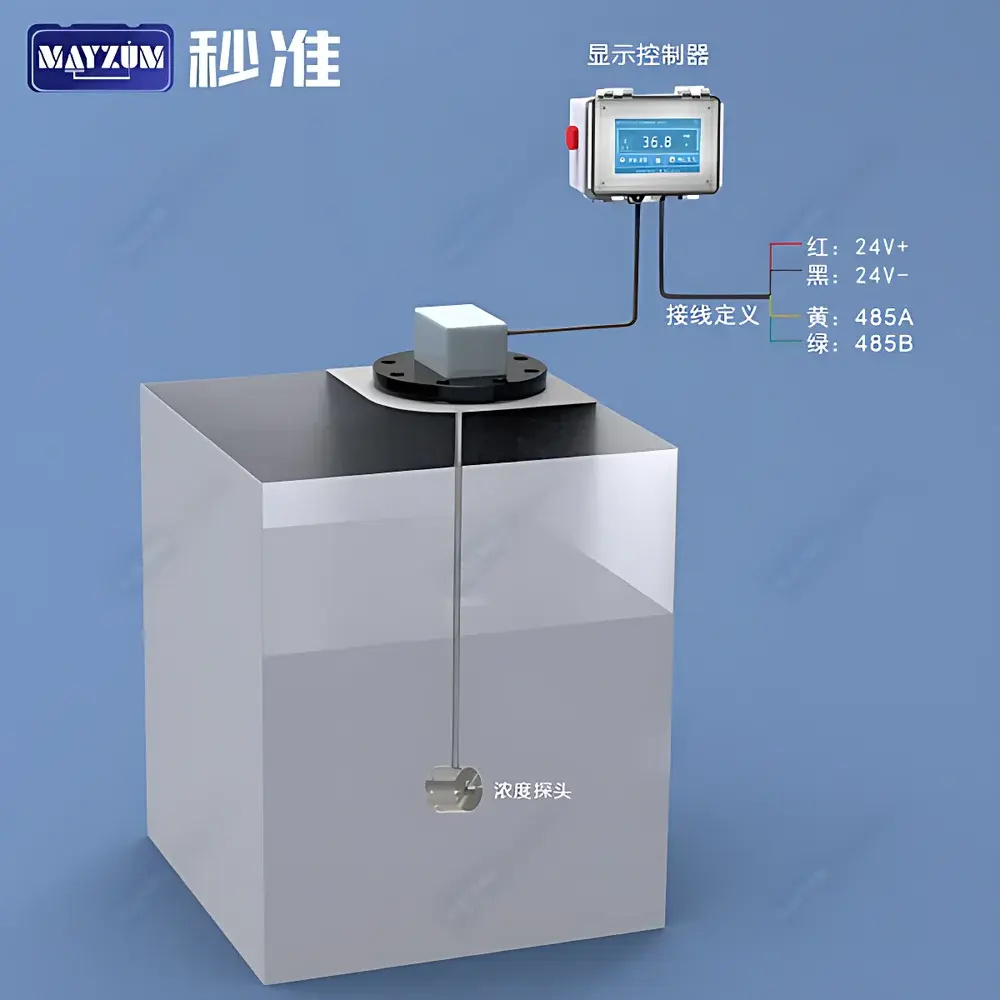
| Mounting Options | Top-Insert Flange, Wall-Mount Clamp, or Extended Bracket |
Overview
The MAYZUM MAY-3002 Online Refractometer is an industrial-grade, in-line process analyzer engineered for continuous, real-time measurement of refractive index, temperature, and derived concentration values—including Brix (% w/w), total dissolved solids (TDS), and custom-defined solute concentration scales. It operates on the physical principle of critical-angle refraction: a collimated light beam is directed onto the sapphire prism surface in direct contact with the process fluid; the angle at which total internal reflection occurs varies precisely with the fluid’s refractive index, which correlates stoichiometrically with solute concentration. This optical method eliminates reliance on chemical reagents, moving parts, or sample extraction—ensuring maintenance-free, drift-free operation under dynamic flow conditions. Designed for integration into sanitary, hygienic, and aggressive chemical environments, the MAY-3002 delivers high reproducibility (<±0.2% Brix) across wide temperature gradients (0–80°C process, 0–60°C compensation range) and is certified to IP67 for dust- and water-immersion resistance. Its all-solid-state architecture—featuring a monolithic optical-grade sapphire measuring surface and corrosion-resistant 316L wetted path—meets material compatibility requirements common in food-grade, pharmaceutical, and fine chemical manufacturing.
Key Features
- Optical-grade sapphire prism with full-planar contact geometry—resistant to scratching, erosion, crystallization, and fouling from suspended solids, bubbles, or viscous media
- True in-situ measurement: unaffected by liquid color, turbidity, viscosity, flow turbulence, pressure transients, or particulate load
- Factory-calibrated with NIST-traceable certificate; no field calibration required—enabled by built-in automatic temperature compensation (ATC) and stable optical alignment
- Integrated 4.3-inch capacitive touch display controller with intuitive UI for local configuration, alarm threshold setting (dual high/low limits), and real-time trend visualization
- No consumables, zero reagent usage, and ultra-low power consumption (DC 24 V typical)—suitable for long-term unattended operation
- Multiple mounting options: top-insertion flange (DIN/ISO standard), wall-mount clamp, or extended bracket for elevated tanks up to 100 m cable reach
- Dual switch outputs for alarm signaling (e.g., relay-connected warning lights or PLC interlocks); optional wireless data transmission module (MAY-LOT) for IIoT integration
- Compliant with CE electromagnetic compatibility (EMC) directives and RoHS material restrictions
Sample Compatibility & Compliance
The MAY-3002 is validated for continuous monitoring of aqueous and organic solutions across diverse industrial sectors. It supports transparent, translucent, and mildly turbid liquids—including wort, fruit juice concentrates, syrup blends, pharmaceutical excipient solutions, cleaning-in-place (CIP) rinse water, die-release agents, metalworking fluids, and detergent formulations. Its sapphire/316L construction complies with FDA 21 CFR Part 11 (when paired with MAY-LST multi-sensor acquisition system and audit-trail-enabled software), EHEDG Guideline Doc. 8 (hygienic design), and ISO 22000 prerequisite programs. While not intrinsically safe certified, it may be deployed in Zone 2/Class I Div 2 areas when installed per IEC 60079-14 guidelines. The device meets GLP/GMP documentation requirements through traceable factory calibration and configurable data logging (via RS485 Modbus RTU to SCADA or MES systems).
Software & Data Management
Data output is native to industry-standard protocols: analog 4–20 mA (linearly scaled to Brix or nD), digital RS485/Modbus RTU (register-mapped for refractive index, temperature, Brix, status flags), and two discrete switch outputs (programmable as high/low alarms or maintenance alerts). The integrated touch controller stores up to 30 days of local historical data (1-min intervals) with timestamped export via USB-C. For centralized control, the MAY-LOT wireless telemetry module enables encrypted MQTT or HTTP(S) transmission to cloud platforms (e.g., AWS IoT Core, Siemens MindSphere) or on-premise historian servers. When used with the MAY-LST multi-channel acquisition system, the MAY-3002 supports synchronized multi-point concentration profiling and automated model retraining using user-supplied reference lab data—enabling dynamic recalibration without manual intervention.
Applications
- Real-time Brix monitoring during wort boiling, fermentation, and post-fermentation dilution in craft and macro-breweries
- In-line concentration verification of fruit juice, nectars, and dairy-based beverages during blending, evaporation, and homogenization
- CIP validation: quantifying residual caustic or acid concentration in final rinse cycles to ensure microbial control compliance (e.g., ISO 15161)
- Continuous dosing control of mold release agents, cutting fluids, and quenching oils in precision machining lines
- Batch consistency assurance in pharmaceutical syrup preparation and active pharmaceutical ingredient (API) crystallization processes
- Monitoring sugar recovery efficiency in beet and cane sugar refining evaporators and pan stations
- Process endpoint detection in solvent extraction, leaching, and polymer emulsion synthesis where refractive index correlates linearly with solute mass fraction
FAQ
Does the MAY-3002 require periodic recalibration?
No. It is factory calibrated with NIST-traceable standards and employs automatic temperature compensation and optical stability engineering to maintain accuracy over time—eliminating scheduled recalibration per ISO/IEC 17025 Annex A.3 recommendations.
Can it measure opaque or highly viscous fluids?
Yes. Unlike transmission-based analyzers, its critical-angle principle relies solely on the interface between sapphire and the adjacent fluid—making it insensitive to opacity, suspended solids, or viscosity up to 10,000 cP.
Is the sapphire prism susceptible to etching by strong acids or alkalis?
Optical sapphire (Al₂O₃) exhibits exceptional resistance to pH 0–14 exposure at temperatures ≤80°C; however, prolonged contact with hydrofluoric acid or hot concentrated phosphoric acid (>85%) is not recommended.
What is the maximum allowable process pressure?
The probe is rated for continuous operation at ≤1 MPa (10 bar) static pressure; pressure spikes must remain within ±10% of rated value to preserve seal integrity.
How is compliance with FDA 21 CFR Part 11 achieved?
When integrated with the MAY-LST acquisition system and configured with electronic signature, audit trail, and role-based access control (RBAC), full Part 11 compliance is attainable—subject to site-specific validation protocol execution.
Related Products