
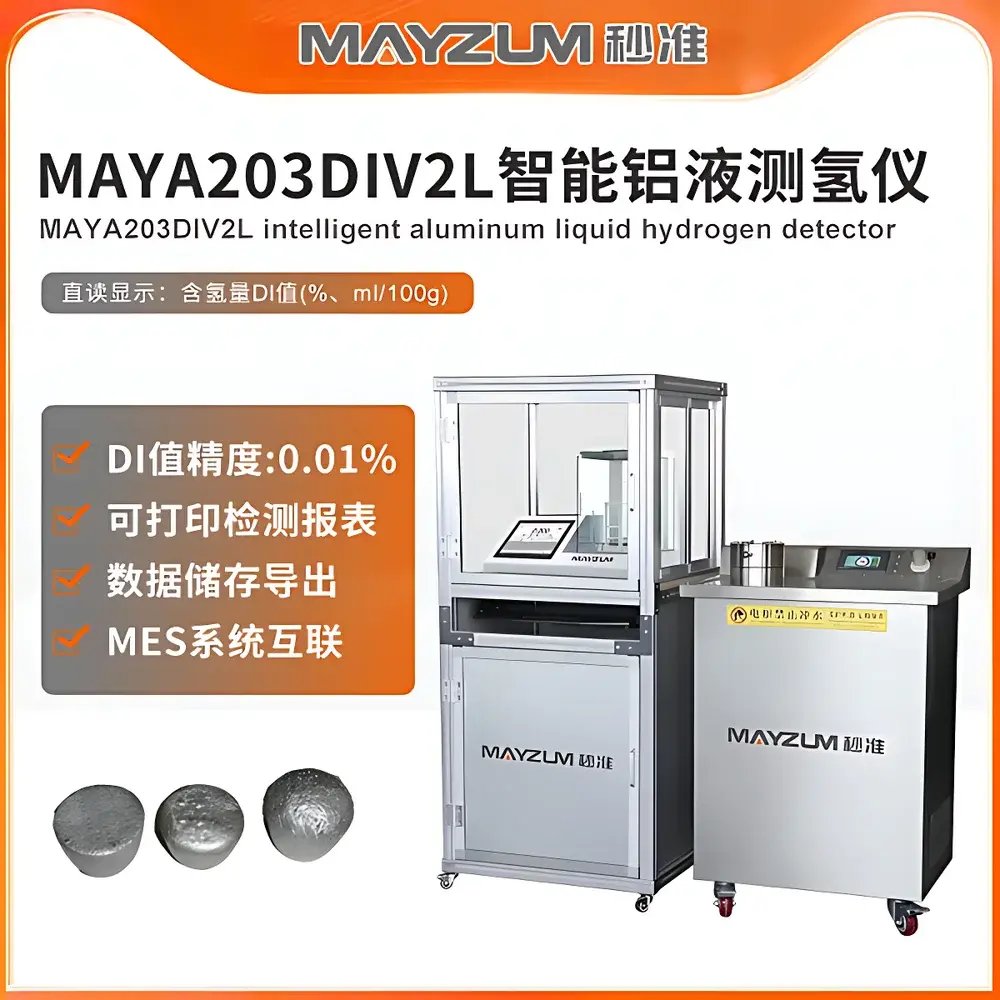
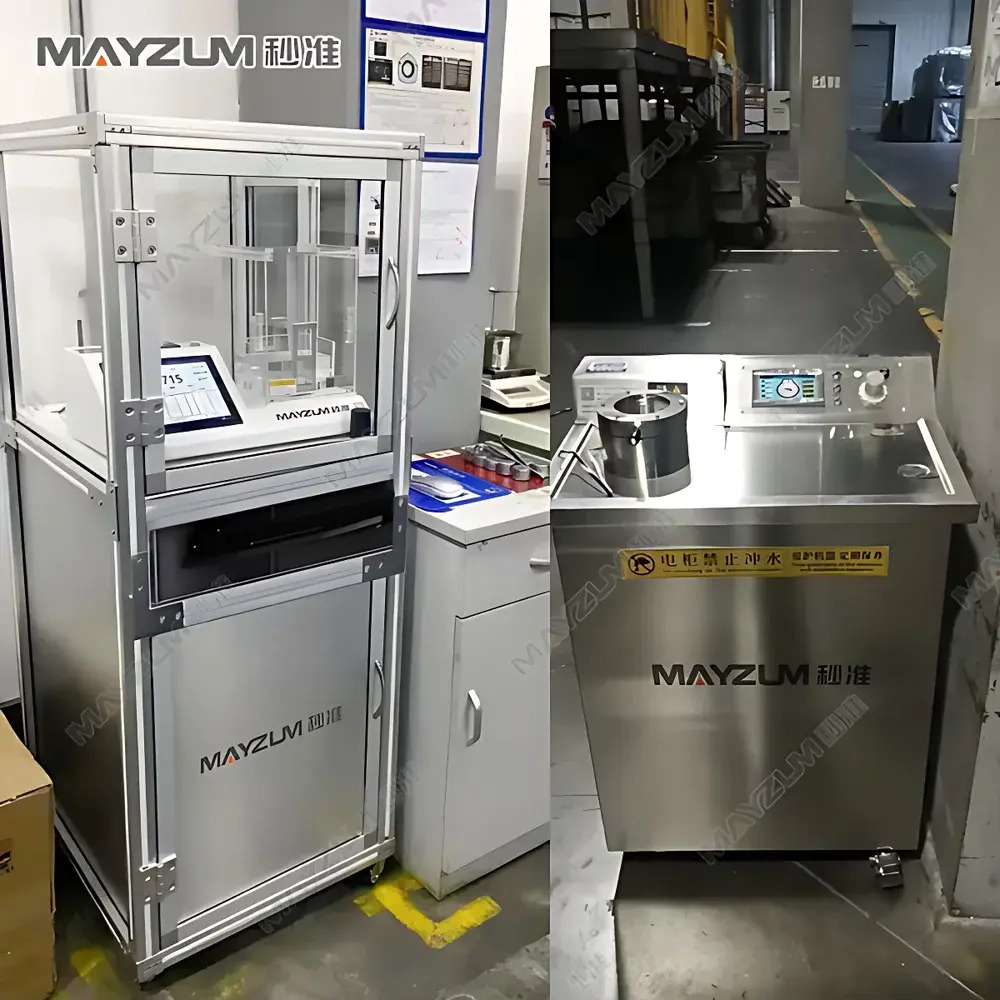
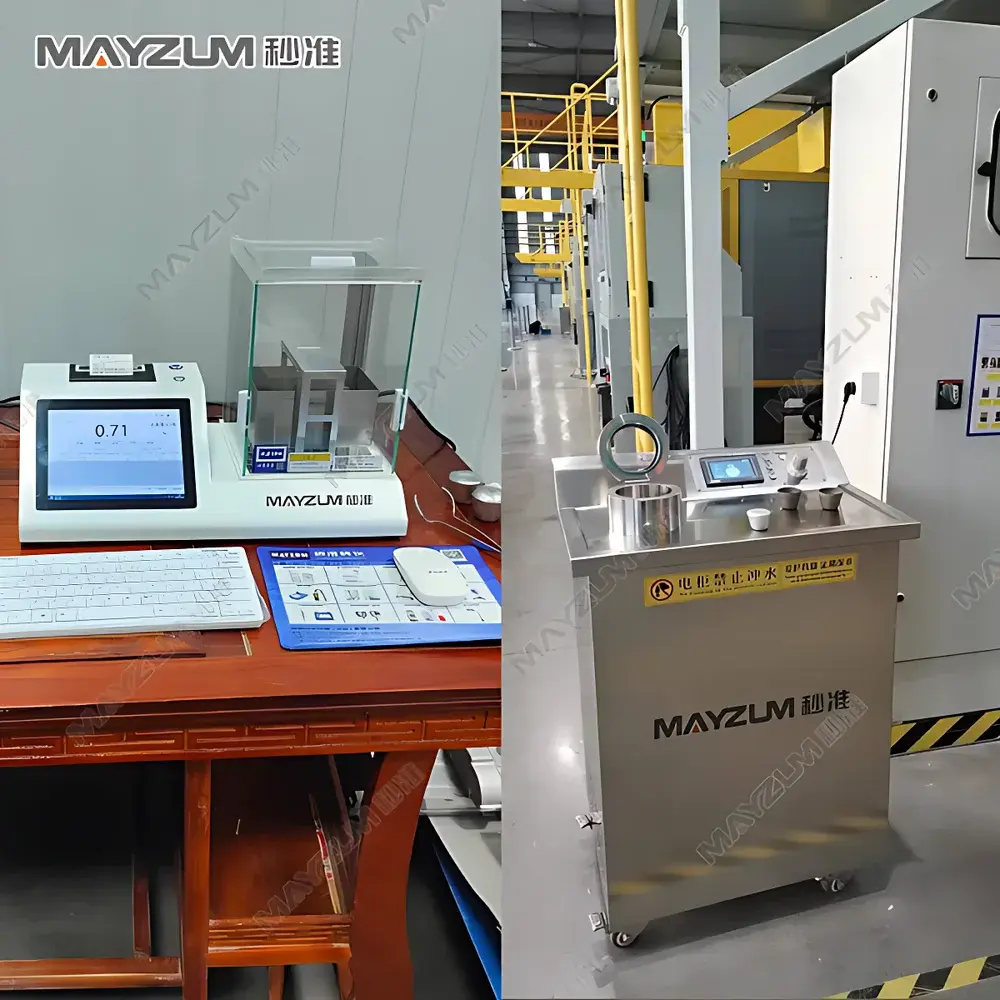
MAYZUM MAYA203DIV2L ASTM/ISO-Compliant Aluminum Melt Hydrogen Analyzer via Vacuum Solidification Density Equivalence Method
| Brand | MAYZUM |
|---|---|
| Model | MAYA203DIV2L |
| Type | Benchtop Solid Density Analyzer for Hydrogen Quantification in Aluminum Melts |
| Density Resolution | 0.0001 g/cm³ |
| Temperature Range | −30 °C to +60 °C |
| Display | Digital LCD |
| Origin | Guangdong, China |
| Manufacturer | MAYZUM (OEM/ODM Capable) |
| Compliance | GB/T 43139–2023, GB/T 5611–2017, ASTM E807 (adapted), ISO 11922 (principles) |
Overview
The MAYZUM MAYA203DIV2L is a benchtop density analyzer engineered specifically for the quantitative determination of dissolved hydrogen content in molten aluminum and its alloys via the vacuum solidification density equivalence method. It operates on the fundamental physical principle that hydrogen gas trapped during solidification induces micro-porosity, resulting in a measurable reduction in the apparent density of the solidified sample relative to theoretical density. By precisely measuring the density of standardized test specimens prepared under controlled vacuum solidification conditions—per GB/T 43139–2023 and GB/T 5611–2017—the instrument calculates hydrogen concentration using empirically validated density–hydrogen calibration curves. This method is widely accepted in foundry quality control environments where rapid, non-destructive, and repeatable assessment of melt cleanliness is critical prior to casting. The system integrates high-stability weighing mechanics, temperature-compensated density computation, and programmable thermal conditioning to ensure measurement reproducibility across ambient and sub-zero sample stabilization conditions.
Key Features
- Benchtop architecture with integrated vacuum solidification sample holder and thermal chamber (−30 °C to +60 °C), enabling precise density measurement of solidified aluminum test bars under standardized cooling profiles
- Density resolution of 0.0001 g/cm³ achieved via high-precision electromagnetic force compensation balance with automatic internal calibration and drift compensation
- Compliance-ready firmware supporting audit trails, user-level access control (admin/operator), and timestamped measurement logs aligned with GLP/GMP documentation requirements
- Dedicated algorithm module for hydrogen quantification: converts measured density deviation from theoretical Al–Si–Cu alloy reference densities into ppm H₂ equivalents using material-specific calibration matrices
- Robust mechanical design with anti-vibration isolation base and ESD-safe enclosure, suitable for foundry lab environments with elevated particulate and thermal load
- Modular software interface compatible with USB and RS-232 output; supports export of raw density values, calculated hydrogen concentrations, and process metadata in CSV and PDF formats
Sample Compatibility & Compliance
The MAYA203DIV2L is validated for use with standard cylindrical or prismatic test specimens (Ø12 mm × 100 mm typical) produced by vacuum solidification of aluminum melts per GB/T 43139–2023 Annex A. It accommodates alloys across the 1xx.x, 3xx.x, and 6xx.x series—including A380, A383, A390, and 6061-based compositions—with automatic density correction for nominal Si, Cu, Mg, and Fe content entered prior to analysis. Instrument validation includes traceable calibration against NIST-traceable density standards (e.g., stainless steel, fused quartz), and full compliance documentation is provided for internal QA audits. While not certified to ISO/IEC 17025, the system meets technical prerequisites for inclusion in accredited laboratory scope under Clause 6.4 (Equipment) when operated within defined environmental and procedural controls.
Software & Data Management
The MAYA203DIV2L runs proprietary MAYZUM DensityLink v3.2 software, designed for metrological integrity in regulated manufacturing settings. All measurements are time-stamped, user-identified, and stored with full parameter history—including sample ID, alloy composition input, thermal stabilization duration, ambient humidity, and balance diagnostic flags. Software supports FDA 21 CFR Part 11-compliant electronic signatures when deployed with domain-authenticated Windows OS and encrypted local database storage. Audit trail functionality records all configuration changes, calibration events, and data exports with immutable timestamps. Optional integration with LIMS platforms is available via HL7 or RESTful API extension (custom development required).
Applications
- Pre-casting quality assurance in high-pressure die-casting (HPDC) and gravity die-casting facilities
- Hydrogen monitoring during fluxing, degassing, and grain refinement processes in aluminum remelting lines
- Validation of rotary degasser efficiency and inert gas purge protocols
- Root-cause analysis of porosity-related scrap in automotive structural castings (e.g., engine blocks, transmission cases)
- R&D evaluation of new alloy formulations and melt treatment technologies
- Third-party certification testing for aerospace-grade aluminum castings requiring ≤0.10 mL/100g H₂ limits
FAQ
What standard methods does the MAYA203DIV2L implement?
It implements GB/T 43139–2023 and GB/T 5611–2017 as primary references, with operational alignment to ASTM E807 (Standard Practice for Determining Hydrogen Content of Aluminum Alloys by Vacuum Solidification) and ISO 11922 principles for density-based gas quantification.
Can it measure hydrogen in alloys other than aluminum?
No—it is calibrated and validated exclusively for aluminum and aluminum-silicon-copper-magnesium systems. Density–hydrogen relationships differ significantly in magnesium or zinc alloys, requiring separate instrumentation.
Is external vacuum pumping required?
Yes. The instrument includes a dedicated vacuum port (KF16 flange) and requires connection to a two-stage rotary vane pump capable of ≤10 Pa ultimate pressure, as specified in GB/T 43139–2023 Section 6.2.
How often must the balance be recalibrated?
Internal calibration is performed automatically at power-on and every 2 hours during operation; external verification with certified weights is recommended before each daily shift or after transport.
Does the system support multi-user environments with role-based permissions?
Yes—administrator, technician, and viewer roles are configurable, with password protection and activity logging enabled by default.



