
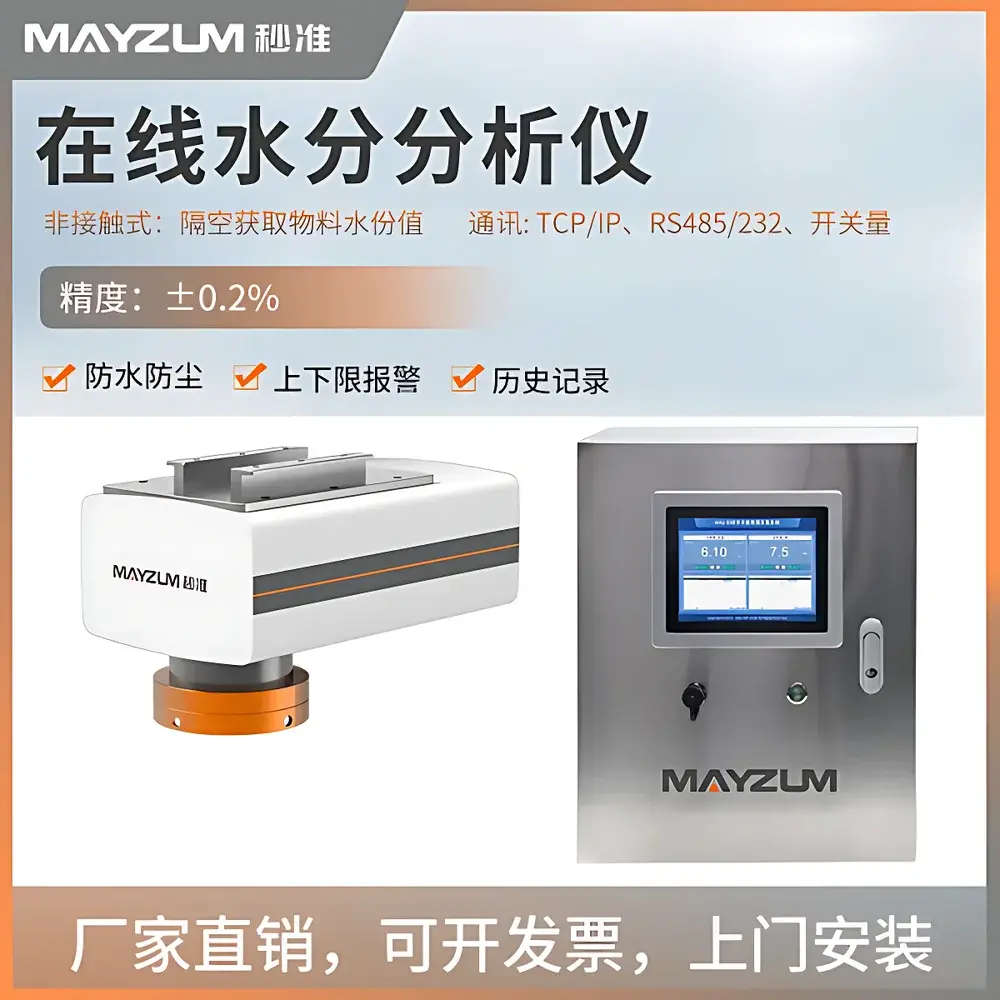
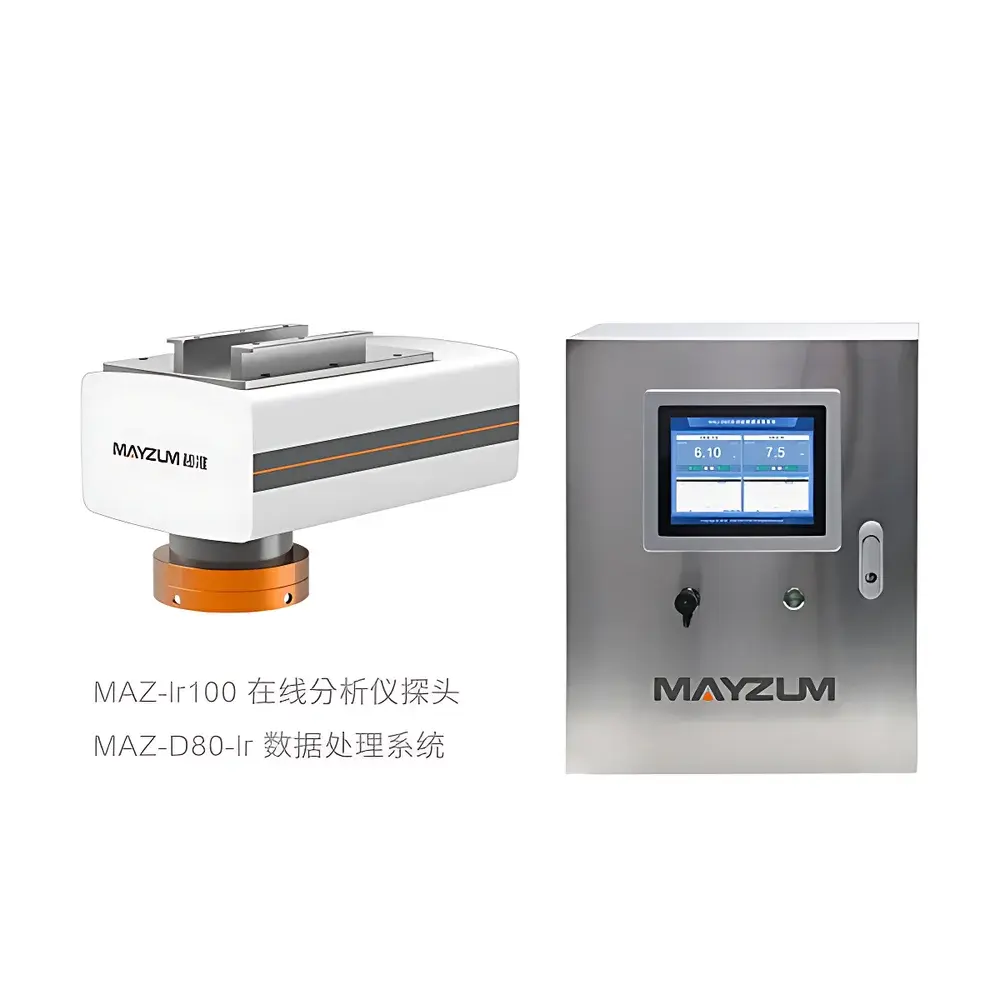
MAYZUM MAZ-Ir100-AC Online Near-Infrared Moisture Analyzer for Pesticide Formulations
| Brand | MAYZUM |
|---|---|
| Model | MAZ-Ir100-AC |
| Type | Online NIR Analyzer |
| Wavelength Range | 4-channel NIR |
| Scan Speed | 30 ms |
| Moisture Range | 0.1–70% w/w |
| Resolution | 0.01% |
| Accuracy | ±0.2% (matrix-dependent) |
| Housing Material | SS316L |
| IP Rating | IP65 |
| Operating Temperature | −10 to 50 °C |
| Humidity Range | 10–90% RH |
| Power Supply | DC 24 V, 2 A |
| Output Interfaces | TCP/IP, RS485/RS232, Digital Alarm Outputs (2 channels) |
| Probe Cable Length | Standard 5 m (extendable to 100 m) |
| Installation Distance | 250 ± 100 mm (non-contact transmission mode) |
| Weight | ≈9.8 kg |
| Dimensions | 130 × 360 × 160 mm |
Overview
The MAYZUM MAZ-Ir100-AC Online Near-Infrared Moisture Analyzer is a non-contact, real-time process analytical instrument engineered for continuous moisture quantification in pesticide formulations and related agrochemical intermediates. It operates on the principle of near-infrared (NIR) absorption spectroscopy—specifically leveraging four discrete, optimized NIR wavelength channels (typically within the 1100–2500 nm range) to detect overtone and combination vibrations of O–H bonds in water molecules. Unlike traditional loss-on-drying or Karl Fischer titration methods, this system enables true in-line, at-line, or cross-belt measurement without sample contact, physical extraction, or reagent consumption. Its optical architecture integrates an InGaAs linear photodiode array detector with a fixed-grating spectrometer, enabling parallel spectral acquisition and high-speed signal processing (30 ms per scan). The system’s optical path is rigorously stabilized against thermal drift and mechanical vibration, ensuring long-term baseline stability essential for unattended industrial deployment.
Key Features
- Non-contact transmission-mode measurement: eliminates sensor fouling, wear, and calibration drift associated with probe-based systems.
- Four-channel NIR detection with factory-calibrated wavelength bands optimized for water-specific absorbance in complex organic matrices (e.g., emulsifiable concentrates, wettable powders, suspension concentrates).
- Robust stainless-steel (SS316L) housing rated IP65, suitable for humid, dusty, or mildly corrosive environments common in formulation plants and packaging lines.
- Integrated diagnostics: real-time LED source health monitoring, automatic lamp lifetime estimation, and fault-triggered alarms.
- Dual-limit moisture threshold alerting with configurable digital outputs (2 independent relay channels) for integration into PLC-controlled drying, blending, or filling systems.
- Onboard data logging: stores up to three years of timestamped moisture values, statistical summaries (min/max/avg/std dev), and trend curves; exportable via USB or network interface in CSV format.
- Soft-start power circuitry minimizes inrush current, extending the operational life of the NIR light source beyond 10,000 hours.
Sample Compatibility & Compliance
The MAZ-Ir100-AC is validated for homogeneous or semi-homogeneous flowing streams—including liquid suspensions, viscous pastes, granular blends, and thin-layer coatings—common in pesticide manufacturing (e.g., EC, SC, WP, CS formulations). It accommodates materials with particle sizes from sub-micron colloids to ~5 mm granules, provided optical path consistency is maintained across the measurement zone. While not a regulatory-grade reference method, the analyzer supports method equivalence verification per ISO 12099:2017 (Animal feeding stuffs — Guidelines for instrumental methods of analysis) and ASTM E1655-22 (Standard Practices for Infrared Multivariate Quantitative Analysis). Its digital output architecture complies with IEC 61131-3 for industrial automation interoperability. Data integrity features—including user-access logs, audit-trail-enabled configuration changes, and password-protected calibration management—align with GLP and GMP documentation expectations for QC laboratories supporting registration dossiers (e.g., EPA, EU PPP Regulation No 1107/2009).
Software & Data Management
The embedded firmware supports both standalone operation and networked integration via TCP/IP (Modbus TCP or custom JSON API) and serial protocols (Modbus RTU over RS485/RS232). A Windows-based configuration utility enables spectral model development using partial least squares (PLS) regression, with support for external reference datasets generated from validated offline methods (e.g., AOAC 950.46). All calibration models are digitally signed and version-controlled. Raw spectra (4-channel intensity vectors) and processed moisture values are time-stamped with millisecond precision and synchronized to external PLC clocks via NTP or hardware trigger inputs. Audit trails record every parameter modification, model upload, or alarm event—including operator ID, timestamp, and pre-/post-change values—meeting FDA 21 CFR Part 11 requirements when deployed with appropriate system validation documentation.
Applications
This analyzer is deployed in continuous quality assurance workflows across pesticide formulation facilities: real-time moisture feedback control during solvent evaporation in EC production; endpoint detection in fluidized-bed drying of WP batches; consistency monitoring of SC homogenization tanks; and final product release verification prior to packaging. It also serves R&D labs evaluating hygroscopic stability of new active ingredient carriers, co-formulants, or encapsulation matrices. Beyond pesticides, its validated spectral models extend to feed premixes, botanical extracts, and polymer-based controlled-release granules where water content directly impacts chemical stability, flowability, and dissolution kinetics. Field deployments confirm stable performance under variable ambient lighting, moderate vibration, and transient condensation—critical for integration above mixing vessels or downstream of spray dryers.
FAQ
Is the MAZ-Ir100-AC suitable for measuring moisture in highly pigmented or opaque pesticide suspensions?
Yes—its transmission geometry and 4-channel NIR design mitigate scattering effects better than single-wavelength reflectance systems; optimal pathlength selection (via adjustable probe distance) further enhances signal-to-noise ratio.
Can the unit be recalibrated in-house without sending it to the manufacturer?
Yes—users may load and validate new PLS models using reference data from certified lab methods; full calibration traceability requires documented reference standards and uncertainty budgets.
Does the system support integration with MES or LIMS platforms?
Yes—via TCP/IP with configurable polling intervals and structured JSON payloads containing moisture values, confidence metrics, and diagnostic flags.
What maintenance is required beyond routine optical window cleaning?
None—solid-state optics, sealed detector array, and fanless thermal management eliminate scheduled maintenance; annual verification against NIST-traceable moisture standards is recommended.
How does ambient temperature fluctuation affect measurement stability?
Internal thermal compensation algorithms and reference-channel normalization correct for drift; performance remains within ±0.2% accuracy across −10 to 50 °C when installed per mounting specifications.





