
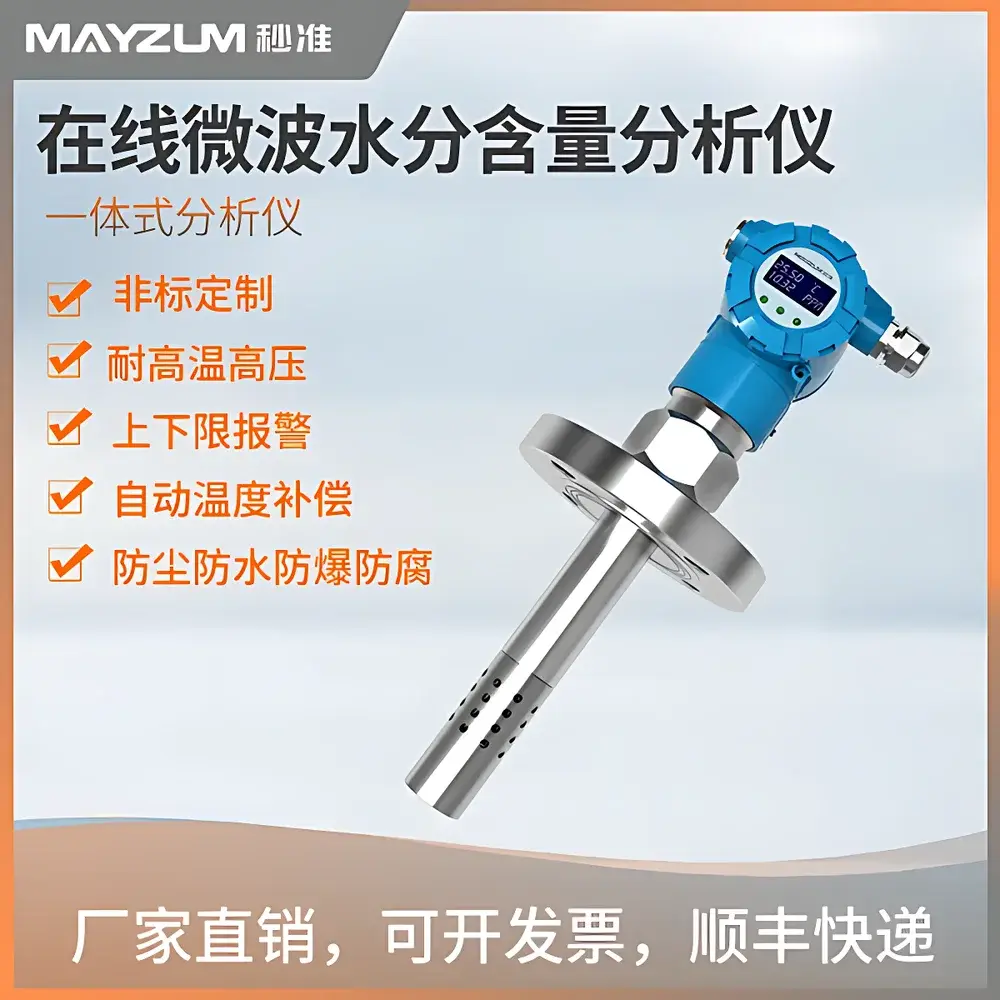
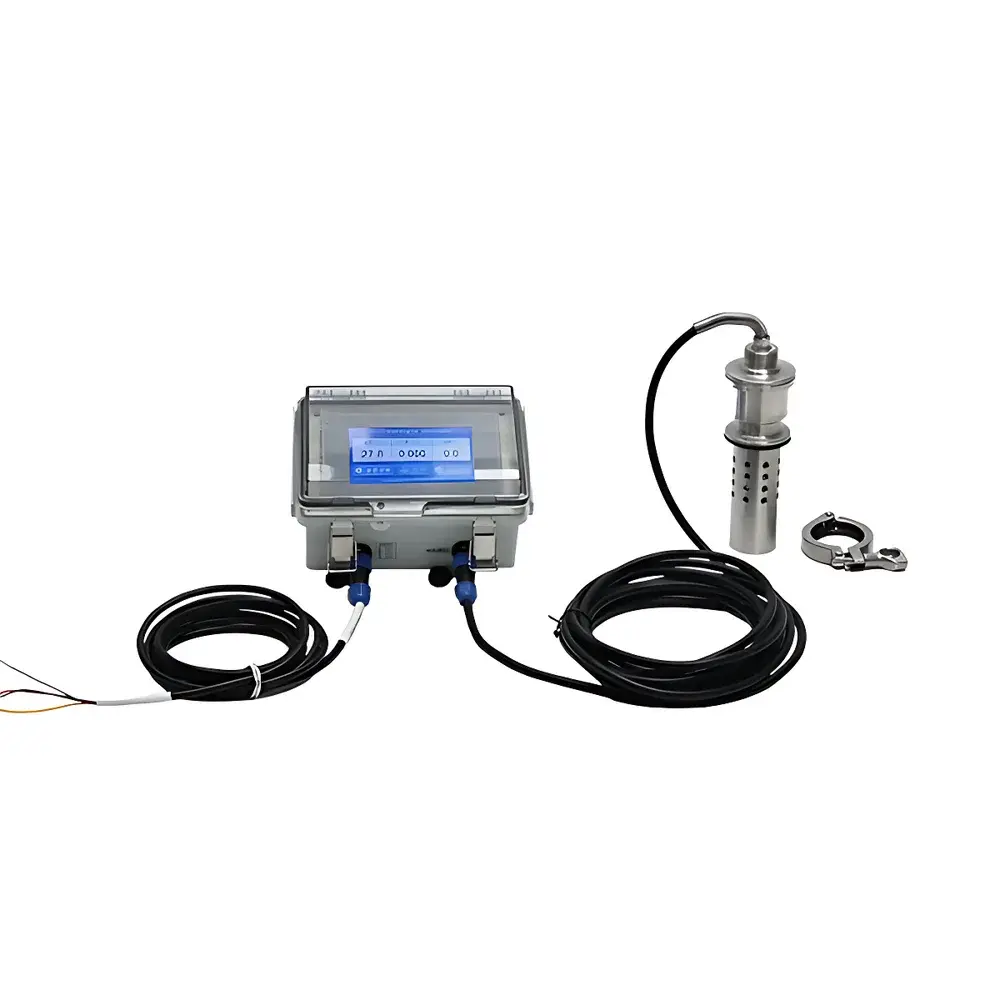
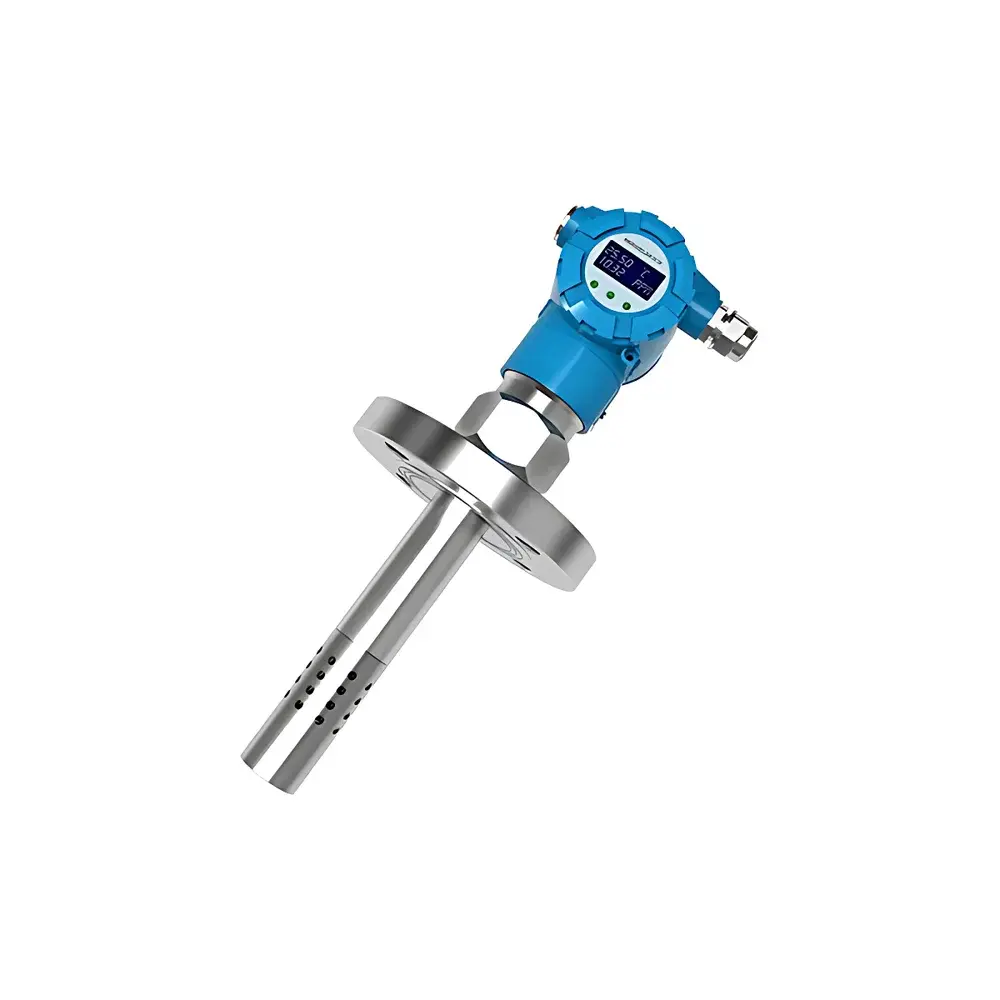
MAYZUM MAZ-Mw100-AJ Online Microwave Moisture Analyzer for Gelatin and High-Viscosity Biological Materials
| Brand | MAYZUM |
|---|---|
| Model | MAZ-Mw100-AJ |
| Measurement Principle | Microwave Attenuation & Resonance Frequency Shift |
| Moisture Range | 100 ppm – 99.99% (w/w) |
| Resolution | 50 ppm |
| Probe Length | 150 mm / 1 m (customizable) |
| Cable Length | Standard 5 m (up to 100 m) |
| Operating Temp. | −10 °C to +90 °C (wetted parts rated to 100 °C) |
| Pressure Rating | ≤ 4.0 MPa |
| Wetted Materials | SS316L, Hastelloy C, PTFE, Monel 400 |
| Process Connections | Flanged, threaded, sanitary clamp, non-contact through-glass |
| Output Signals | TCP/IP, RS485/232, dual relay alarms (HI/LO) |
| Enclosure Rating | IP68 |
| Explosion Protection | Ex db IIC T6 Gb |
| Power Supply | 220 V AC, <100 mA |
| Dimensions | 280 × 485 × 590 mm |
| Weight | ≈ 5 kg |
Overview
The MAYZUM MAZ-Mw100-AJ is an industrial-grade online microwave moisture analyzer engineered specifically for continuous, real-time quantification of water content in high-value biological and viscous materials—including gelatin, collagen hydrolysates, traditional Chinese medicine (TCM) extracts, marine biopolymers (e.g., sea cucumber, fish maw), and fermented substrates such as jiupi (wine lees). Unlike conventional loss-on-drying or Karl Fischer titration methods, this system operates on the physical principle of microwave energy attenuation: a tunable microwave probe emits electromagnetic waves (typically in the 1–10 GHz band) that propagate through the sample medium. Water molecules—due to their permanent dipole moment—exhibit strong and frequency-dependent absorption characteristics. As microwave energy traverses the material, its amplitude decay, phase shift, and resonant frequency perturbation are captured by integrated high-stability RF circuitry. These raw signal variations are processed in real time by an embedded AI-accelerated algorithm incorporating multi-parameter temperature compensation, enabling robust correlation between dielectric response and gravimetric water concentration. Crucially, because microwaves penetrate bulk matter uniformly—regardless of surface texture, color, opacity, or particulate distribution—the MAZ-Mw100-AJ delivers true volumetric moisture assessment without sampling bias or operator intervention.
Key Features
- Non-invasive measurement capability: supports both contact immersion and non-contact transmission modes—enabling moisture analysis through quartz, borosilicate glass, or polymer windows without process interruption.
- High-resolution detection: 50 ppm resolution across the full dynamic range (100 ppm – 99.99%), validated per ASTM D4006 and ISO 15512 for trace-level aqueous quantification in complex matrices.
- Process-hardened construction: wetted components fabricated from electropolished SS316L, optional Hastelloy C or Monel 400 for aggressive chemical environments; PTFE-insulated internal cabling rated to 100 °C.
- Ruggedized enclosure: IP68-rated housing with explosion-proof certification (Ex db IIC T6 Gb), suitable for Zone 1 hazardous locations per IEC 60079-0/11.
- Flexible integration: configurable analog/digital outputs (RS485 Modbus RTU, TCP/IP Ethernet, dual SPDT relays) compliant with PLC/DCS architectures and Industry 4.0 data pipelines.
- Onboard data governance: local touchscreen HMI with embedded historian supporting ≥3 years of timestamped measurements; exportable CSV logs with metadata (temperature, pressure, signal SNR, calibration epoch).
Sample Compatibility & Compliance
The MAZ-Mw100-AJ is validated for use with heterogeneous, temperature-sensitive, and thermally labile materials where conventional oven-drying induces decomposition or volatilization artifacts—particularly critical for gelatin-based pharmaceutical excipients, TCM decoctions, and marine-derived nutraceuticals. Its measurement integrity remains unaffected by suspended solids, viscosity changes (>10,000 cP), or emulsion phase separation. Regulatory alignment includes design conformity with FDA 21 CFR Part 11 (audit trail, electronic signature support via optional software module), GLP-compliant calibration logging, and traceability to NIST-traceable reference standards. It meets the functional requirements of USP <921> for instrumental moisture determination and supports IQ/OQ documentation packages for GMP manufacturing environments.
Software & Data Management
The device ships with MAYZUM’s proprietary MWSuite™ v3.2 firmware, featuring adaptive baseline correction, multi-point matrix calibration workflows, and drift-compensated long-term stability algorithms. Remote configuration and diagnostics are accessible via secure HTTPS web interface or native Windows/Linux client. All measurement data are time-synchronized using NTP and tagged with environmental context (process temperature, ambient humidity, signal quality index). Historical datasets support statistical process control (SPC) charting—including X-bar/R charts—and automated deviation alerts triggered by user-defined moisture thresholds. Raw RF spectral data can be exported for third-party multivariate modeling (e.g., PLS regression) in MATLAB or Python-based chemometric platforms.
Applications
- Pharmaceutical manufacturing: inline monitoring of gelatin capsule shell drying, lyophilized intermediate moisture, and TCM granule blending uniformity.
- Food & nutraceutical processing: real-time control of collagen hydrolysate spray-drying, fermented beverage mash consistency, and seafood protein concentrate dehydration.
- Biopolymer synthesis: closed-loop feedback for enzymatic hydrolysis endpoint detection and solvent recovery optimization in chitosan or alginate production.
- Waste valorization: continuous sludge dewatering efficiency tracking in anaerobic digestion effluent streams.
- Chemical intermediates: water-in-oil emulsion stability assessment and solvent hydration level verification in API crystallization steps.
FAQ
Does the MAZ-Mw100-AJ require periodic recalibration?
Yes—initial factory calibration is traceable to NIST SRM 2890 (water-in-toluene standards). Field recalibration intervals are determined by process criticality and regulatory requirements; typical recommendation is every 6 months under GMP conditions, supported by onboard standard verification routines.
Can it measure moisture in opaque, high-viscosity slurries like hot gelatin melt?
Yes—microwave penetration depth exceeds 150 mm in low-conductivity biological gels at operating frequencies; no optical transparency or homogeneity is required.
Is the system compatible with SIL2 safety instrumented systems?
Not natively—but relay outputs and Modbus TCP interfaces support integration into SIS via certified gateways meeting IEC 61511 requirements.
What validation documentation is provided?
Factory test reports, EU Declaration of Conformity (ATEX/IECEx), RoHS/REACH compliance statements, and optional IQ/OQ protocol templates aligned with Annex 11 and GAMP5 guidelines.
How is temperature compensation implemented?
Dual-sensor architecture: integrated Pt100 RTD adjacent to the microwave probe captures localized thermal drift; compensation coefficients are dynamically updated using a physics-based dielectric relaxation model trained on >12,000 reference measurements across 42 material classes.




