
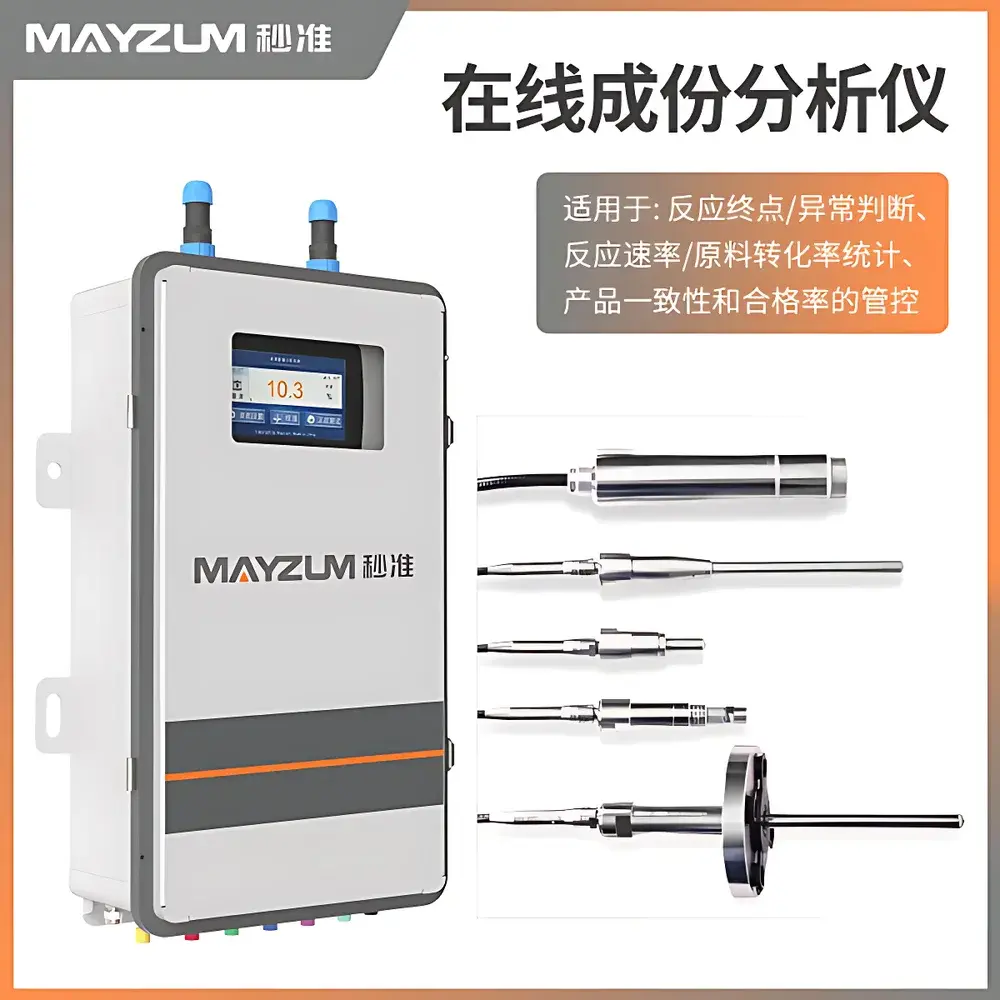
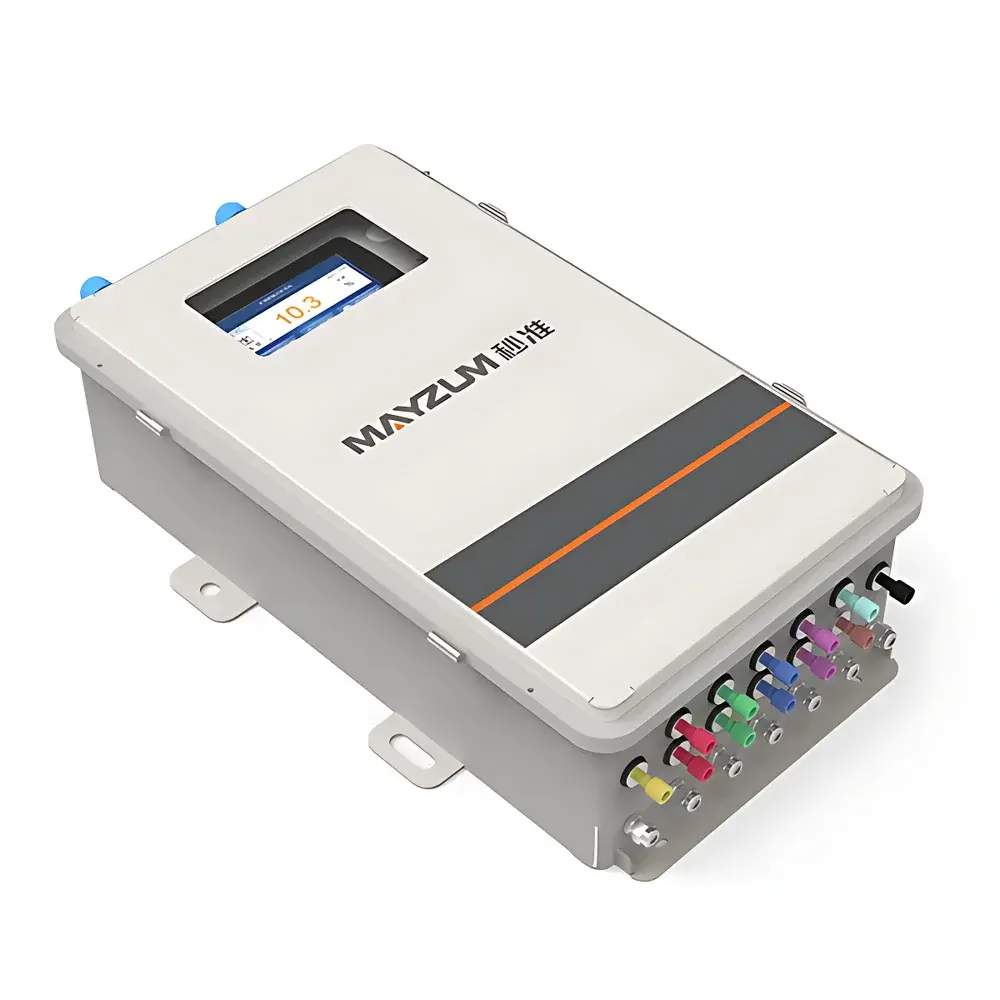
MAYZUM MAZ-Ra300-Acr Online Acrylonitrile Concentration Analyzer
| Brand | MAYZUM |
|---|---|
| Origin | Guangdong, China |
| Manufacturer Type | Authorized Distributor |
| Regional Classification | Domestic (PRC) |
| Model | MAZ-Ra300-Acr |
| Instrument Type | Online Raman Spectrometer |
| Spectral Resolution | 6 cm⁻¹ |
| Concentration Range | 0.1–99.9% |
| Resolution | 0.01% |
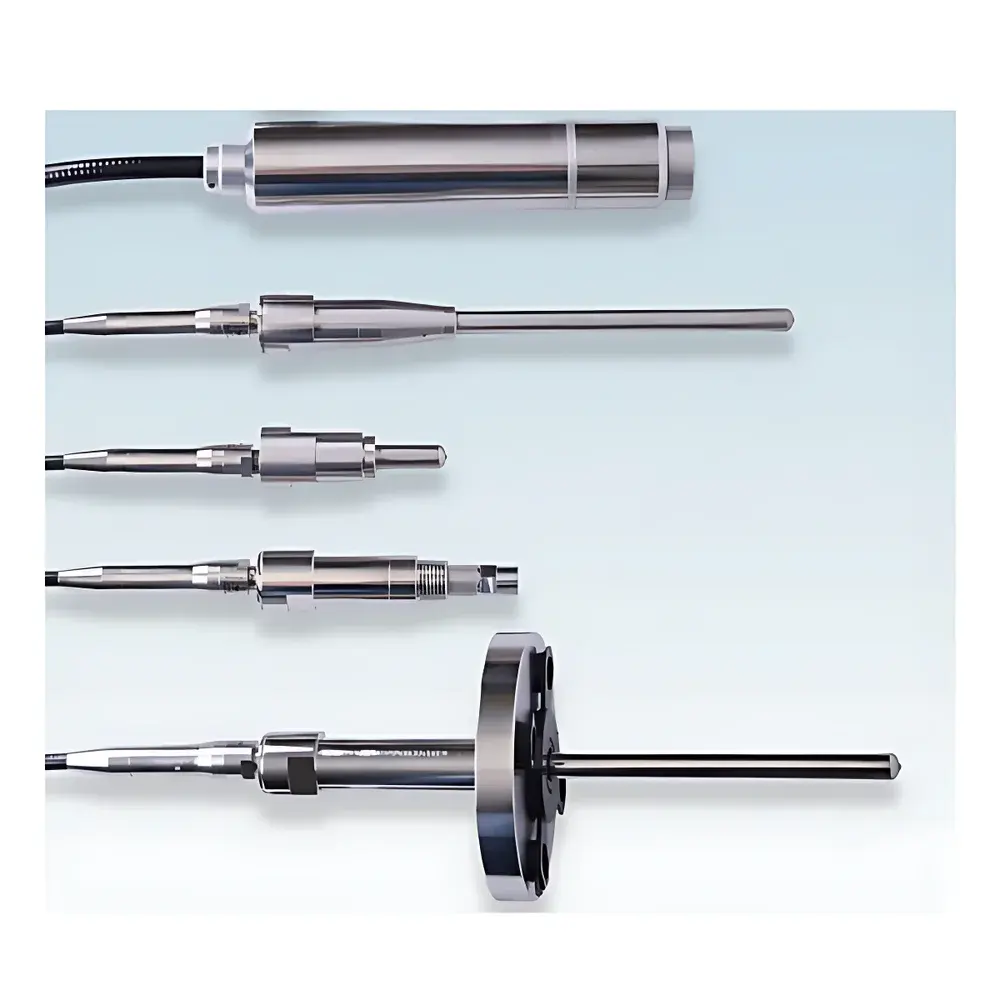
| Probe Length | 150 mm / 1 m (customizable) |
| Cable Length | Standard 5 m (extendable to 100 m) |
| Operating Temperature | −10 to 130 °C |
| Wetted Materials | Hastelloy C / PTFE / M400 / Non-contact optical path |
| Process Connection Options | Non-contact direct irradiation, immersion flange, sanitary clamp, NPT thread, flow cell |
| Power Supply | 220 V AC, <0.2 A |
| Output Interfaces | TCP/IP, RS-485/232 (digital), dual-channel relay (alarm & limit control) |
| IP Rating (wetted parts) | IP67 |
| Max Pressure Rating | ≤1 MPa |
| Net Weight | ≈5 kg |
| Dimensions | 280 × 485 × 590 mm (L×W×H) |
Overview
The MAYZUM MAZ-Ra300-Acr Online Acrylonitrile Concentration Analyzer is an industrial-grade, process-integrated Raman spectrometer engineered for real-time, non-invasive quantification of acrylonitrile and related nitrile compounds in liquid-phase chemical processes. Based on high-stability 785 nm laser excitation and backscattered Raman signal acquisition, the system delivers chemometrically calibrated concentration outputs without sample extraction or reagent consumption. Its design targets continuous monitoring applications where rapid reaction kinetics, thermal aggressiveness, or corrosion sensitivity preclude conventional offline methods such as titration, GC, or HPLC. The analyzer operates under ASTM E1840-compliant spectral acquisition protocols and supports traceable calibration transfer across multiple production lines via embedded reference standards and wavelength-stabilized optics.
Key Features
- Real-time analysis with ≤3-second spectral acquisition and model inference cycle — enabling closed-loop feedback for reactor control systems.
- Multi-mount probe architecture: supports non-contact transmission through quartz/glass vessels, immersion-style flanged installation, sanitary clamp coupling, NPT-threaded insertion, and inline flow-cell integration.
- Chemically inert wetted materials: configurable probe housings in Hastelloy C-276, PTFE-lined stainless steel, or M400 nickel alloy for compatibility with strong acids, oxidizers, and halogenated solvents.
- Embedded chemometric engine with auto-model selection: preloaded quantitative models for acrylonitrile, hydrogen cyanide, methyl methacrylate, and common nitro/nitrile intermediates; supports user-defined PLS or PCR model deployment via secure firmware update.
- Scalable multi-probe topology: single host unit interfaces up to six independent probes via time-multiplexed fiber-optic channels — reducing capital cost per measurement point in distributed process units.
- Comprehensive data integrity architecture: audit-trail-enabled logging compliant with FDA 21 CFR Part 11 requirements; timestamped spectra, raw intensity values, and model metadata retained for ≥3 years with SHA-256 hash verification.
Sample Compatibility & Compliance
The MAZ-Ra300-Acr demonstrates robust performance across diverse sample matrices including aqueous and organic-phase reaction mixtures, polymerization slurries, fermentation broths, and highly corrosive nitration media. It is validated for use with compounds containing C≡N triple bonds (e.g., acrylonitrile, propionitrile), polar functional groups (–OH, –COOH, –NH₂), and thermally labile species (e.g., diazonium salts, nitroso intermediates). The system meets IEC 61000-6-2/6-4 electromagnetic immunity standards and carries CE marking for industrial environments. All optical components comply with ISO 10110 surface quality specifications, and probe assemblies conform to ASME B16.5 Class 150 flange dimensions where applicable. For GMP-regulated pharmaceutical manufacturing, the instrument supports 21 CFR Part 11 electronic signature workflows and GLP-aligned calibration documentation.
Software & Data Management
The embedded HMI runs a deterministic Linux-based OS with a 10.1-inch capacitive touchscreen interface supporting both local operation and remote access via TLS-secured web browser or OPC UA server (IEC 62541). Spectral preprocessing includes cosmic ray removal, dark current subtraction, and Savitzky-Golay smoothing. Quantitative results are exported in CSV or HDF5 format with embedded metadata (sample ID, operator, timestamp, instrument serial, model version). Historical trend visualization includes overlayable concentration curves, statistical process control (SPC) charts (X-bar/R), and deviation alerts tied to configurable upper/lower action limits. Data export supports SFTP push to LIMS or MES platforms, and alarm events trigger SNMP traps or MQTT messages for integration into DCS/SCADA architectures.
Applications
- Acrylonitrile-butadiene-styrene (ABS) and polyacrylonitrile (PAN) polymerization endpoint detection and monomer conversion tracking.
- In-line monitoring of acrylonitrile hydrolysis to acrylic acid or glycolonitrile in continuous stirred-tank reactors (CSTRs).
- Nitration process safety: real-time detection of unstable nitro intermediates during aromatic nitration or aliphatic nitration sequences.
- Biocatalytic nitrile hydration: enzyme activity assessment and substrate depletion profiling in immobilized nitrile hydratase reactors.
- Pharmaceutical API synthesis: crystallization endpoint determination for nitrile-containing drug substances (e.g., letrozole, citalopram intermediates).
- Hazardous material screening in waste streams: identification and semi-quantitative estimation of residual acrylonitrile in scrubber effluents or solvent recovery distillates.
FAQ
What spectral resolution does the MAZ-Ra300-Acr achieve, and how is it maintained under thermal drift?
The system delivers a nominal spectral resolution of 6 cm⁻¹ (FWHM) across the 200–3200 cm⁻¹ Raman shift range. Resolution stability is ensured by passive thermal management of the spectrograph module and real-time grating position correction using internal neon emission line referencing.
Can the analyzer quantify acrylonitrile in the presence of high water content or volatile organic solvents?
Yes — the chemometric models are trained on multivariate calibration sets spanning 0–95% water and common solvents (acetone, THF, DMF, acetonitrile). Water’s broad Raman band is deconvoluted using constrained least-squares fitting prior to analyte quantification.
Is third-party validation support available for regulatory submissions?
MAYZUM provides IQ/OQ documentation templates aligned with ASTM E2656 and USP <857>, including instrument qualification protocols, uncertainty budgeting worksheets, and method verification reports for specific client matrices.
How is calibration model transfer handled across different probe units or production sites?
Models are stored in encrypted, version-controlled containers with embedded spectral response fingerprints. Transfer requires only probe-specific gain normalization — no full recalibration — verified via NIST-traceable polystyrene standard spectra.
Does the system support hazardous area installation (e.g., Zone 1/Div 1)?
The base configuration is rated for Class I, Division 2 / Zone 2 environments. Explosion-proof variants (ATEX II 2G Ex db IIB T4 Gb / UL 1203 Class I Div 1) are available with custom probe housings and intrinsically safe barrier kits.




