
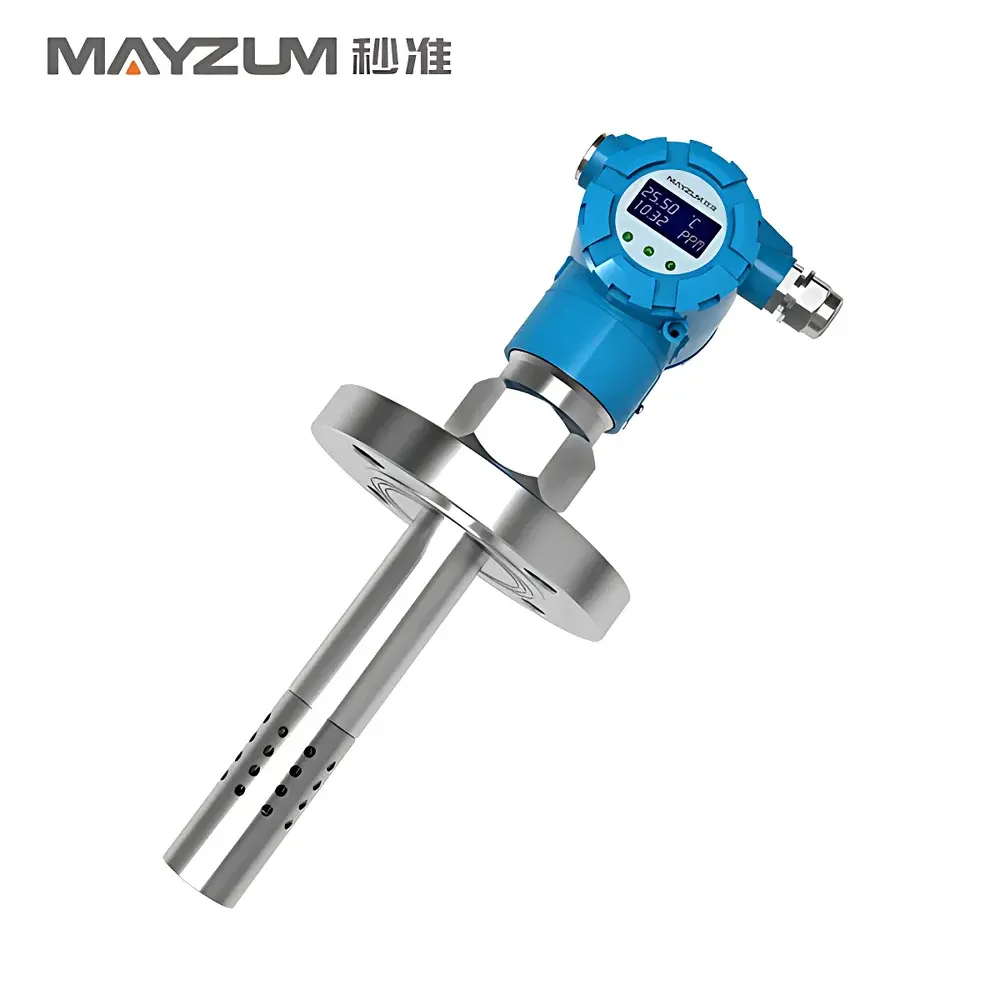
MAYZUM MAZ-Sc201 Online Solid Content Analyzer
| Brand | MAYZUM |
|---|---|
| Model | MAZ-Sc201 |
| Measurement Principle | Microwave Dielectric Absorption |
| Accuracy | ±0.3% (typical, dependent on matrix) |
| Resolution | 0.1% |
| Operating Temperature (wetted probe) | up to 120 °C |
| Pressure Rating (wetted probe) | up to 4.0 MPa |
| Output Interfaces | RS485 (Modbus RTU), 4–20 mA analog, TCP/IP Ethernet |
| Installation Options | Flanged contact probe or non-contact over-the-pipe configuration |
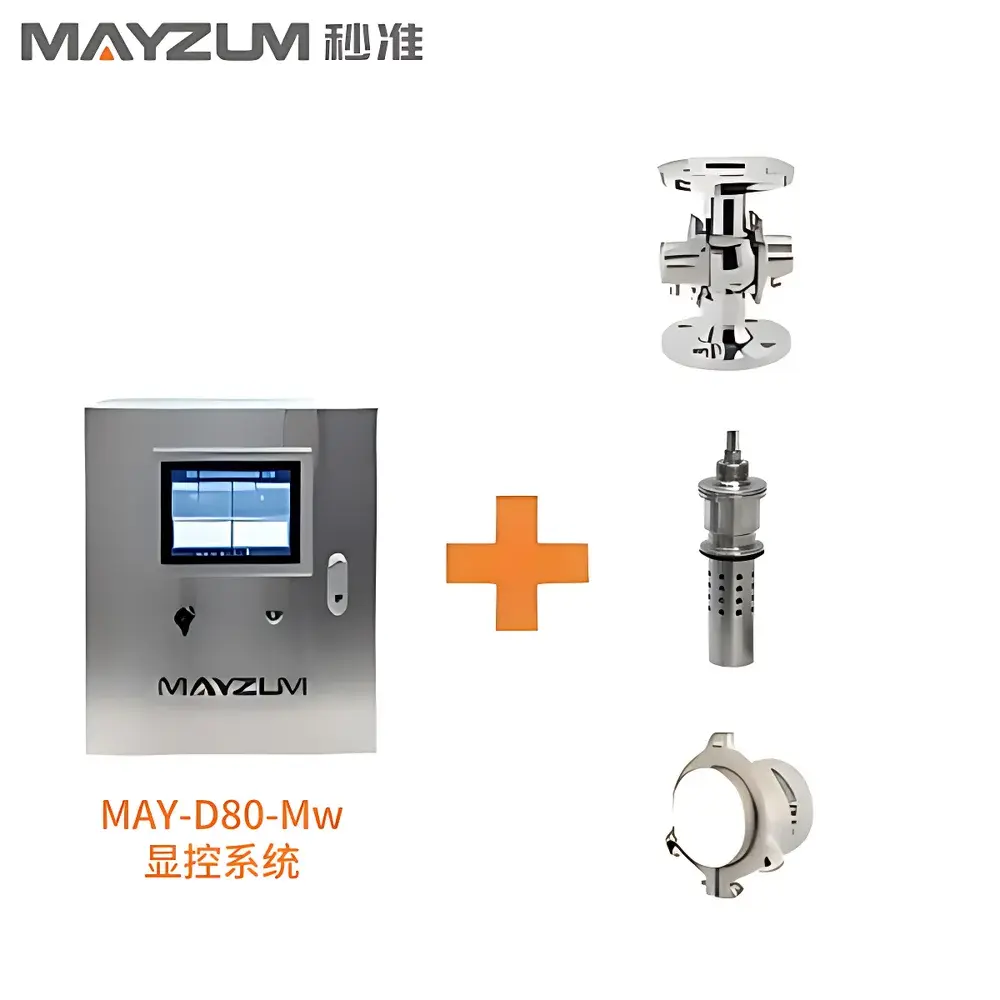
| Multi-channel Capability | Supports “one master → multiple slave” topology for cost-effective multi-point monitoring |
Overview
The MAYZUM MAZ-Sc201 Online Solid Content Analyzer is an industrial-grade microwave dielectric absorption instrument engineered for continuous, real-time quantification of solid content (or inverse moisture content) in flowing or static liquid, slurry, paste, and semi-solid process streams. Unlike conventional offline oven-drying or Karl Fischer titration methods—which introduce sampling bias, time lag, and operator dependency—the MAZ-Sc201 employs calibrated microwave transmission and reflection measurements at fixed frequencies (typically 2.45 GHz or 9.3 GHz, depending on probe configuration) to determine the dielectric constant and loss factor of the material. These electromagnetic properties correlate directly with water concentration due to water’s high relative permittivity (~80 at 20 °C) compared to most organic solvents (<10) and dry solids (<5). The analyzer computes solid content (%) as a derived parameter using factory- and field-adjustable calibration models, supporting both single-point linear and multi-point polynomial regression against reference laboratory data (e.g., ASTM D2231, ISO 712, or internal SOPs). Designed for integration into continuous manufacturing environments, it delivers stable, drift-compensated readings under dynamic flow conditions, temperature fluctuations, and variable particle loading—without requiring sample extraction, dilution, or chemical reagents.
Key Features
- Robust microwave sensing architecture with temperature- and pressure-compensated probe electronics (rated to 120 °C and 4.0 MPa)
- High-resolution output (0.1% solid content increment) with typical repeatability better than ±0.2% across homogeneous matrices
- Flexible installation: standard DN50–DN150 flanged wetted probes for pipe/tank immersion; optional non-invasive clamp-on variant for stainless-steel or non-metallic pipelines
- Dual-mode operation: supports both direct-contact measurement (for slurries, pastes, emulsions) and through-wall detection (for sealed vessels or hazardous zones)
- Multi-point monitoring capability via modular architecture—single master controller can interface with up to six remote slave sensors, reducing hardware footprint and total cost of ownership
- Industrial-grade I/O suite: isolated 4–20 mA analog output (HART-compatible), RS485 Modbus RTU, and TCP/IP Ethernet for SCADA/DCS integration
- Onboard data logging (≥30 days at 1-second intervals) with timestamped event markers and alarm-triggered snapshot capture
Sample Compatibility & Compliance
The MAZ-Sc201 is validated for use with conductive and non-conductive media including aqueous slurries, solvent-based dispersions, viscous pastes, and heterogeneous suspensions. It performs reliably in applications where traditional near-infrared (NIR) or capacitance sensors suffer from coating interference, air entrainment, or density variation artifacts. The system complies with CE marking requirements (EMC Directive 2014/30/EU, Low Voltage Directive 2014/35/EU) and meets IP66 ingress protection for panel-mounted electronics. Wetted components conform to FDA-compliant materials (316L SS probe body, PTFE-sealed ceramic windows) suitable for food-grade and pharmaceutical intermediate handling. While not intrinsically safe certified out-of-box, explosion-proof enclosures (ATEX II 2G Ex db IIB T4 Gb / UL Class I Div 1) are available as OEM options. Calibration traceability aligns with ISO/IEC 17025-accredited laboratory practices when paired with gravimetric reference standards.
Software & Data Management
The embedded firmware supports secure web-based configuration via HTTPS-enabled HTML5 interface, eliminating dependency on proprietary desktop software. Configuration parameters—including calibration coefficients, temperature compensation curves, alarm thresholds (high/low deviation, rate-of-change), and communication protocol settings—are stored in non-volatile memory with write-protection and audit trail logging. All data exports comply with CSV and XML formats compatible with LIMS, MES, and PAT (Process Analytical Technology) frameworks. Optional cloud gateway modules enable encrypted MQTT/TLS telemetry to AWS IoT Core or Azure IoT Hub, supporting time-series analytics and predictive maintenance modeling. Audit logs record user login/logout events, parameter changes, and calibration updates—fully compliant with FDA 21 CFR Part 11 requirements when deployed with electronic signature validation and role-based access control (RBAC).
Applications
- Chemical & Petrochemical: Real-time monitoring of water-in-oil emulsions, water-coal slurry consistency, polymer latex solids, and catalyst slurry concentration in continuous reactors
- Pulp & Paper: In-line control of stock consistency pre-press, black liquor solids, and coating slip formulation
- Food & Beverage: Fermentation broth dry matter tracking (e.g., soy sauce mash, wine lees, koji rice), dough hydration profiling, and coffee extract concentration
- Environmental Engineering: Sludge dewatering optimization, landfill leachate solids load estimation, and thermal drying endpoint detection
- Pharmaceutical & Biotech: Monitoring of wet granulation endpoints, lyophilization cycle validation support, and API suspension stability assessment
- Metallurgy & Mining: Sinter mix moisture control, flotation pulp density verification, and tailings thickener feed optimization
FAQ
How does the MAZ-Sc201 differ from traditional oven-dry methods for solid content determination?
It eliminates manual sampling, drying delays, and inter-laboratory variability by providing continuous, in-situ measurement with sub-minute response time—enabling closed-loop process control rather than post-hoc quality verification.
Can the analyzer be calibrated using customer-specific reference methods?
Yes. The device accepts user-defined calibration tables generated from gravimetric (ASTM D2231), NIR, or other reference techniques, with support for up to 10-point multi-linear or quadratic curve fitting.
Is compensation for temperature and pressure drift implemented automatically?
Yes. Integrated Pt100 RTD and piezoresistive pressure sensors feed real-time corrections to the microwave signal processing algorithm, maintaining accuracy across operational transients.
What maintenance is required for long-term reliability?
No consumables or routine recalibration are needed. Recommended annual verification against traceable standards; probe window cleaning only if fouling occurs—typically every 3–6 months depending on process abrasivity.
Does the system support integration into Siemens PCS7 or Emerson DeltaV DCS platforms?
Yes. Native Modbus TCP and 4–20 mA HART integration is documented and tested with major DCS vendors; FDT/DTM drivers available upon request.





