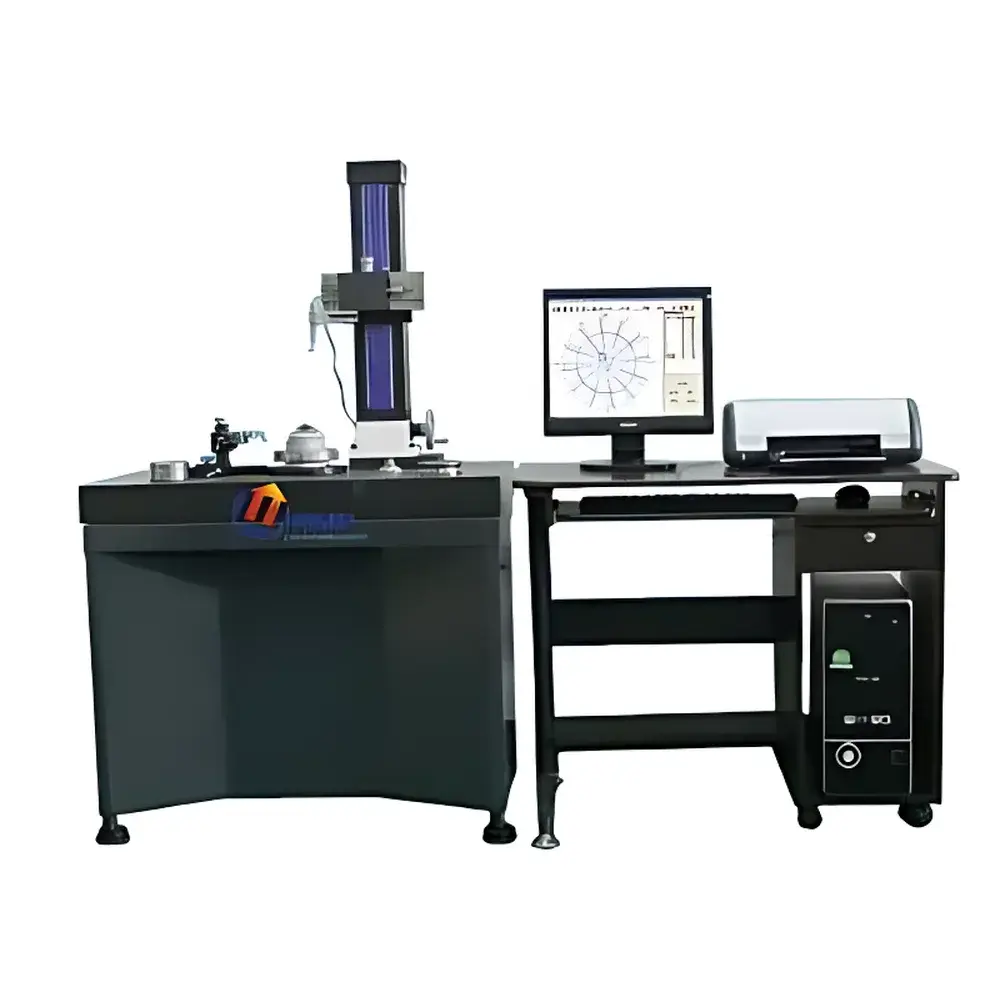
MC012-Y9025B Roundness and Waviness Measuring Instrument
| Origin | China |
|---|---|
| Manufacturer Type | Authorized Distributor |
| Model | MC012-Y9025B |
| Spindle Accuracy | ±0.0125 µm |
| System Accuracy | 0.03 µm |
| Data Acquisition | Hall-effect Sensor |
| Max. External Diameter | Ø140 mm (expandable) |
| Min. Internal Diameter | Ø3 mm |
| Max. Measurement Height | 300 mm (extendable) |
| Radial Range | ≤30 µm |
| Sensor Resolution | 0.01 µm |
| Max. Load Capacity | 15 kg |
| Rotational Speed | 115 rpm |
| Power Supply | 220 V, 50 Hz, 250 W |
| Air Supply Pressure | ≥0.45 MPa |
Overview
The MC012-Y9025B Roundness and Waviness Measuring Instrument is a high-precision geometric metrology system engineered for deterministic evaluation of rotational symmetry and surface texture irregularities in annular and cylindrical components. Based on the principle of rotating part measurement using an ultra-stable air-bearing spindle, the instrument captures radial deviations as the workpiece rotates at a controlled angular velocity (115 rpm), enabling separation of form errors—including roundness, waviness, coaxiality, perpendicularity, parallelism, and flatness—through harmonic decomposition and multi-zone filtering. Its core architecture supports both ISO 1101 (Geometrical Product Specifications) and ANSI/ASME Y14.5 standards for form tolerance assessment, making it suitable for first-article inspection, in-process verification, and final acceptance testing in bearing manufacturing, precision machining, and aerospace component production.
Key Features
- Air-bearing main spindle with ±0.0125 µm radial motion error and integrated air filtration—ensuring zero mechanical wear, long-term stability, and sub-micron repeatability over extended operational cycles.
- Real-time Windows-based measurement software featuring intuitive GUI, dual-input support (mouse and keyboard shortcuts), and on-screen dynamic waveform display synchronized with polar and Cartesian plots.
- Modular sensor configuration: two interchangeable probe types included—contact-type stylus sensors optimized for small-bore (Ø3 mm minimum) and large-diameter (up to Ø140 mm) geometries—enabling comprehensive coverage across bearing rings, rollers, balls, and precision shafts.
- High-resolution data acquisition via Hall-effect transducers with 0.01 µm resolution and ≤30 µm radial range, supporting harmonic analysis up to 50th order for detailed waviness profiling.
- Robust mechanical design rated for 15 kg maximum load and 300 mm vertical travel (extendable), allowing full-height evaluation of tall cylindrical parts without repositioning.
- Integrated statistical database compliant with GLP/GMP documentation requirements—supports audit-ready export of measurement reports (PDF, CSV), traceable timestamps, operator ID logging, and networked data sharing via Ethernet or USB 3.0.
Sample Compatibility & Compliance
The MC012-Y9025B accommodates a broad spectrum of rotationally symmetric parts, including but not limited to: inner/outer raceways of ball and roller bearings; steel balls and cylindrical rollers; piston rings; fuel injector nozzles; optical lens mounts; and turbine blade root sections. All measurements adhere to ISO 12181 (Roundness), ISO 12780 (Straightness), ISO 12781 (Flatness), and ISO 12782 (Waviness) specifications. The system’s hardware and software architecture are designed to support FDA 21 CFR Part 11–compliant electronic records when configured with user authentication, audit trail activation, and digital signature modules—facilitating regulatory submissions in medical device and pharmaceutical manufacturing environments.
Software & Data Management
The embedded measurement platform provides comprehensive post-processing capabilities: automated parameter calculation (eccentricity magnitude and phase angle, harmonic amplitude spectra, RMS roughness within defined wavelength bands), customizable report templates, and batch-mode analysis for serial part evaluation. Raw point-cloud data is stored in vendor-neutral ASCII format for third-party interoperability. Database management includes query-by-part-number, date-range filtering, statistical process control (SPC) chart generation (X̄-R, Cp/Cpk), and trend analysis across multiple shifts or production lots. Remote diagnostics and firmware updates are supported via secure HTTPS interface.
Applications
- Quality assurance of bearing raceway geometry during grinding and superfinishing operations.
- Root cause analysis of vibration-induced failure modes through spectral decomposition of waviness harmonics.
- Machine tool calibration verification—e.g., lathe chuck runout, grinding wheel truing accuracy, and CNC rotary table positioning fidelity.
- Process capability studies (Cp, Cpk) for high-volume production of automotive transmission components.
- Research-grade surface texture characterization in tribology laboratories evaluating lubricant film formation and contact mechanics.
- Compliance testing for aerospace fasteners per NASM1312-7 and MIL-STD-1553B mechanical interface specifications.
FAQ
What standards does the MC012-Y9025B comply with for roundness measurement?
It conforms to ISO 12181-1:2011 and ISO 12181-2:2011 for roundness deviation assessment, as well as ISO 12782:2016 for waviness evaluation.
Can the system perform harmonic analysis beyond the 50th order?
Standard configuration supports up to 50th-order harmonic decomposition; higher-order analysis (up to 200th) is available via optional firmware upgrade and enhanced sampling rate licensing.
Is environmental conditioning required for stable operation?
No dedicated temperature-controlled room is needed; the instrument operates reliably in ambient conditions from 15–30 °C with ≤60% RH, meeting ISO 230-2 machine tool testing environmental guidelines.
How is measurement traceability ensured?
Each system ships with a NIST-traceable calibration certificate for spindle motion and sensor linearity, valid for 12 months; annual recalibration services include full mechanical verification and software validation per ISO/IEC 17025 requirements.
Does the software support automated pass/fail decision logic based on GD&T tolerances?
Yes—the measurement engine allows direct import of GD&T callouts from CAD models (via STEP AP214 or QIF schema), enabling real-time conformance checking against user-defined tolerance zones and automatic flagging of nonconforming features.