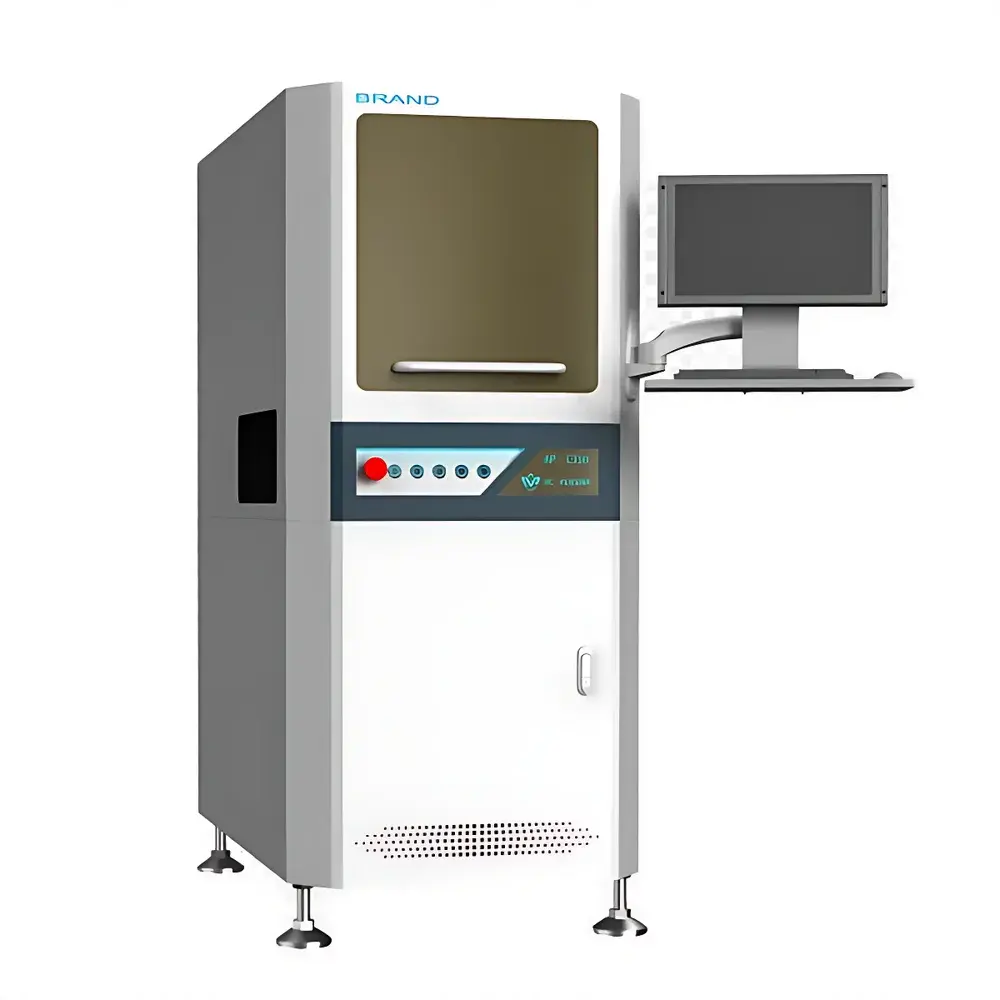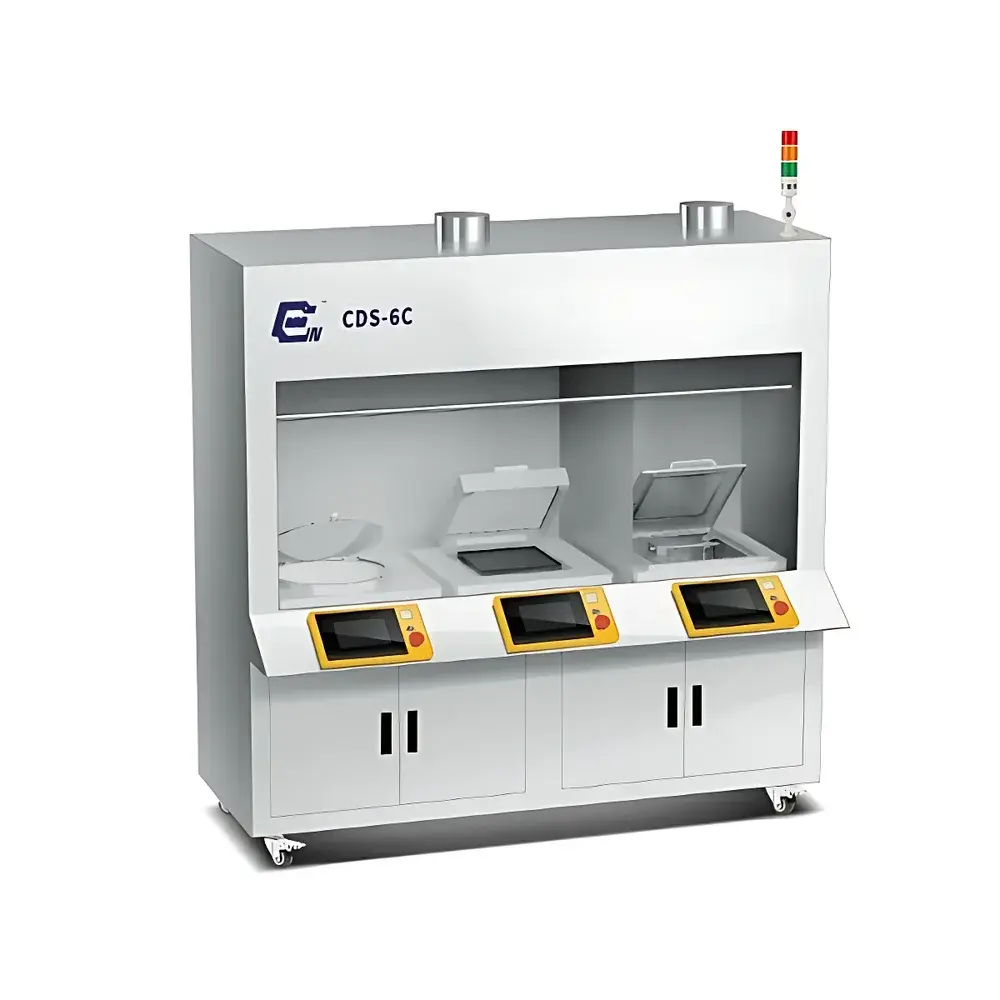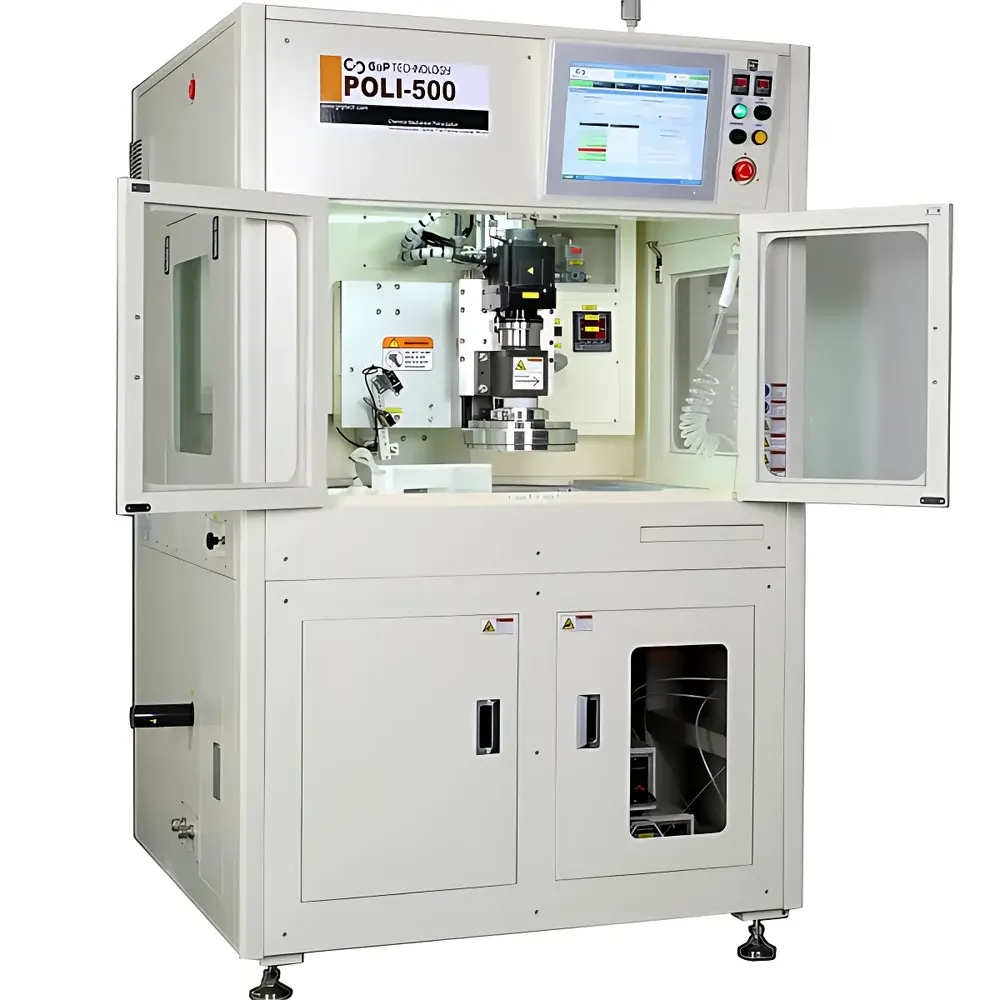
MCF Customized-17 Chemical Mechanical Polishing (CMP) System
| Brand | MCF |
|---|---|
| Origin | Germany |
| Model | customized-17 |
| Platen Diameter | ≥508 mm (20 inch) |
| Platen Speed | 30–200 rpm |
| Wafer Pressure Range | 70–500 g/cm² |
| Retaining Ring Pressure Range | 70–700 g/cm² |
| Carrier Head Speed | 30–200 rpm |
| Oscillation Amplitude | ±10 mm |
| Slurry Delivery | 3-channel peristaltic pump system with adjustable flow and positionable nozzles |
| Endpoint Detection | Integrated friction force & infrared surface temperature monitoring |
| Control System | PC-based industrial controller with touchscreen HMI, 20 programmable recipes, up to 6 process stages per recipe |
| Within-Wafer Non-Uniformity (WIWNU, 1σ, EE=5 mm) | ≤5% |
| Wafer-to-Wafer Non-Uniformity (WTWNU) | ≤5% |
Overview
The MCF Customized-17 Chemical Mechanical Polishing (CMP) System is an engineered platform for precision surface planarization in semiconductor front-end manufacturing. It operates on the fundamental principle of synergistic material removal—combining controlled mechanical abrasion via rotating polishing pads with chemically reactive slurry interactions at the wafer–pad interface. This dual-mechanism process enables deterministic removal of dielectric films (e.g., SiO₂, low-k), conductive layers (e.g., Cu, W, Co), and barrier materials across diverse device architectures including logic, memory (DRAM, NAND), STI (Shallow Trench Isolation), and SOI (Silicon-on-Insulator) wafers. Designed for R&D, pilot-line integration, and low-volume high-mix production, the system supports 4-inch, 6-inch, and 8-inch substrates through interchangeable carrier heads and a modular platen architecture. Its mechanical stability, thermal management, and real-time endpoint sensing are calibrated to meet the stringent uniformity and repeatability requirements of sub-28 nm node process development.
Key Features
- Modular carrier head design enabling rapid changeover between 4”, 6”, and 8” wafers—no tooling requalification required.
- Pneumatic bladder-based wafer pressure actuation with independent back-pressure control, ensuring consistent downforce distribution and minimizing edge shear stress.
- Dual-axis endpoint detection: simultaneous measurement of in-situ friction coefficient (via torque transduction) and pad surface temperature (via non-contact IR pyrometer), correlated via proprietary algorithm for robust stop-point identification.
- Three-channel slurry delivery system with individually calibrated peristaltic pumps, each supporting flow rates from 50–500 mL/min and nozzle positioning within ±2 mm resolution for localized chemical dosing.
- Industrial-grade PC-based control architecture with embedded Windows OS, 15.6” resistive touchscreen HMI, and deterministic real-time scheduling—guaranteeing <10 ms I/O response latency for closed-loop pressure and speed regulation.
- Comprehensive data logging compliant with SEMI E10 (Definition and Measurement of Equipment Reliability and Availability) and traceable to NIST-traceable calibration standards.
Sample Compatibility & Compliance
The Customized-17 accommodates silicon, sapphire, SiC, and compound semiconductor wafers with thicknesses ranging from 200 µm to 1,000 µm. It supports oxide CMP (SiO₂, FSG, USG), metal CMP (Cu, Ta, Ru, Co), and advanced barrier/seed layer processing under ISO Class 5 cleanroom-compatible enclosures (optional). All motion control firmware, recipe execution logs, and sensor data archives comply with FDA 21 CFR Part 11 requirements for electronic records and signatures when configured with audit trail activation and user role-based access control. The system meets CE Machinery Directive 2006/42/EC, EMC Directive 2014/30/EU, and RoHS 2011/65/EU standards. Documentation includes full Declaration of Conformity, risk assessment per ISO 12100, and safety circuit schematics certified by TÜV Rheinland.
Software & Data Management
The integrated MCF-CMP Studio software provides recipe-driven operation with hierarchical parameter locking (operator vs. engineer access levels), multi-stage process sequencing (pre-conditioning, main polish, over-polish, clean-rinse), and automated post-process reporting. Raw sensor streams—including platen torque, carrier head load, slurry flow rate, IR temperature, and oscillation phase—are time-stamped at 100 Hz and stored in HDF5 format for offline analysis. Export modules support ASTM E1395-compliant CSV and SECS/GEM protocol for factory automation integration. Audit trails record all user actions (login/logout, recipe edits, manual overrides) with SHA-256 hashing and immutable timestamps, satisfying GLP and GMP documentation integrity requirements.
Applications
- Gate oxide planarization in advanced FinFET and GAA transistor development.
- Cu interconnect damascene processing with <±2% dishing and erosion control at line widths <15 nm.
- STI topography correction for high-aspect-ratio trench fill uniformity verification.
- SOI handle-wafer thinning and buried oxide (BOX) smoothing prior to bonding.
- MEMS cavity release and optical waveguide facet polishing for photonic ICs.
- Compound semiconductor substrate preparation (GaN-on-Si, GaAs) requiring low-defect-density surface finish (Ra <0.2 nm).
FAQ
What wafer sizes does the Customized-17 support?
The system supports 4-inch, 6-inch, and 8-inch wafers via interchangeable carrier heads and retainer rings. All configurations maintain identical pressure uniformity profiles and endpoint detection sensitivity.
Is the system compatible with abrasive-free or chelating slurries?
Yes—the three-channel slurry delivery system accommodates pH-sensitive, non-aqueous, and particle-free chemistries, with wetted path materials selected for chemical resistance (e.g., PFA-lined tubing, ceramic pump rollers, Hastelloy C-276 valves).
Can the endpoint detection system be validated per SEMI E172?
Yes—MCF provides a documented validation protocol including reference wafer sets, repeatability testing (n≥30 runs), and correlation analysis against ex-situ profilometry (Dektak XT) and ellipsometry (Woollam M-2000), aligned with SEMI E172 guidelines for CMP endpoint metrology.
Does the control system support remote diagnostics and predictive maintenance?
The system includes OPC UA server functionality and optional MQTT gateway for integration into MES/SCADA platforms. Vibration spectral analysis and motor current signature monitoring enable early detection of bearing wear or pad glazing degradation.
What level of process documentation is provided for qualification in regulated environments?
MCF delivers full IQ/OQ documentation packages (per ASTM E2500), including test protocols, raw data worksheets, deviation logs, and summary reports—all structured for direct submission to quality assurance teams in semiconductor fabs operating under ISO 9001 or IATF 16949 frameworks.