

MCL MadPLL® Atomic Force Microscope Controller
| Brand | MCL Think Nano |
|---|---|
| Origin | USA |
| Manufacturer Type | Authorized Distributor |
| Import Status | Imported |
| Model | MadPLL® |
| Price Range | USD $14,000 – $72,000 (based on configuration) |
| Positional Detection Noise | 0.15 nm RMS |
| Sample Diameter Limit | <15 mm |
| XY Scan Range (with compatible stages) | up to 200 µm |
| Z-Range (with Nano-OP30) | 30 µm (closed-loop), 100 µm (open-loop) |
| PLL Frequency Lock Range | 10–100 kHz |
| Phase Shift Resolution | <0.1° |
| Demodulation Bandwidth | 3 kHz |
| PCC Compensation Range | ±50 pF |
| Operating Systems | Windows 7/10/11 (32/64-bit), LabVIEW 2015+ compatible |
Overview
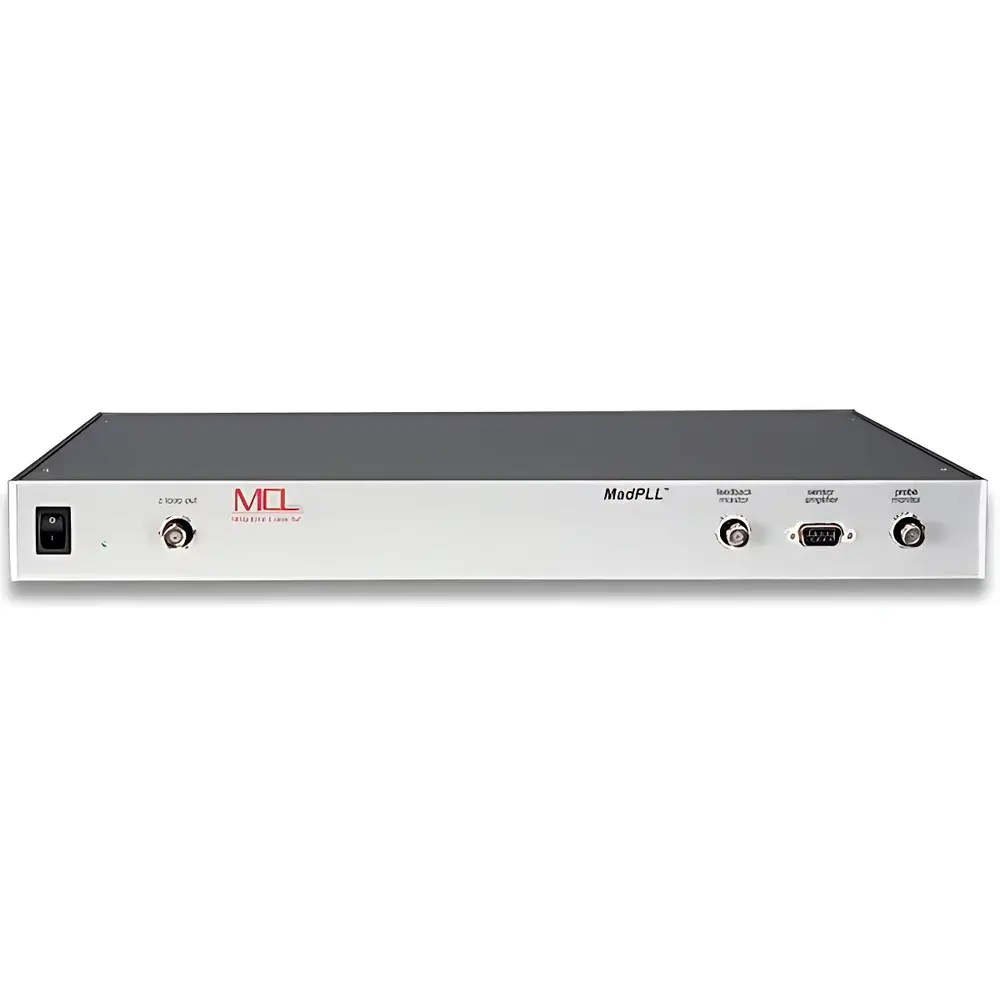
The MCL MadPLL® Atomic Force Microscope Controller is a fully integrated, digital phase-locked loop (PLL)-based control system engineered for high-stability, low-noise scanning probe microscopy (SPM) using resonant probes—including quartz tuning forks and Akiyama-style cantilevers. Unlike conventional AFM controllers relying on analog lock-in detection or open-loop excitation, the MadPLL® implements a real-time, digitally synthesized PLL architecture with adaptive proportional-integral (PI) feedback for Z-axis force regulation. Its core function is to maintain precise resonance tracking of the probe’s mechanical eigenmode while simultaneously extracting frequency shift (Δf), amplitude (A), and phase (φ) as primary feedback signals—enabling quantitative non-contact and tapping-mode AFM, as well as near-field optical microscopy (NSOM) and scanning tunneling microscopy (STM)-compatible configurations. Designed explicitly for integration with Mad City Labs’ PicoQ®-equipped nanopositioning systems, the controller delivers closed-loop positional fidelity down to sub-nanometer resolution in Z (0.15 nm RMS noise floor) and supports multi-axis synchronization for true vector-scan acquisition. The system operates independently of external signal generators or oscilloscopes, making it suitable for compact lab environments, teaching platforms, and custom vacuum-compatible SPM builds.
Key Features
- Digital PLL architecture with auto-ranging frequency lock (10–100 kHz), 50 mHz resolution, and ±500 Hz measurement range
- Integrated sensor amplifier board with programmable gain (2×–40×), 16-bit DAC-controlled excitation, and ±10 V input/output compliance
- Probe board support for tuning forks, Akiyama probes, and Accutune-style resonant sensors—no optical alignment required
- Automated parasitic capacitance compensation (PCC) with real-time adjustment up to ±50 pF
- Three operational modes: self-oscillation, PLL-driven, and DDS (lock-in)-driven—with selectable constant-excitation or constant-signal amplitude control
- Built-in Z-axis PI controller with digitally adjustable integration time constant and error signal inversion capability
- Real-time spectrum analysis (amplitude, phase) via front-panel BNC outputs and software visualization
- Fully USB 2.0–controlled; native compatibility with Windows (32/64-bit), LabVIEW, MATLAB, and C++ APIs
- Modular hardware design: sensor amplifier and probe board mount directly onto Mad City Labs’ Nano-Drive®-controlled positioning stages (e.g., Nano-HS3, Nano-OP30)
Sample Compatibility & Compliance
The MadPLL® controller supports samples with diameters under 15 mm and is routinely deployed with standard optical-grade substrates (Si/SiO₂, mica, sapphire, ITO glass) and device wafers (Si, GaAs, InP). Its low-noise electronics and rigid mechanical interface ensure stable operation on passive or active vibration isolation tables. While the controller itself is not certified to ISO/IEC 17025 or FDA 21 CFR Part 11, its architecture enables full audit-trail-capable data acquisition when used with Mad City Labs’ AFMView™ software—supporting GLP/GMP-aligned workflows through timestamped parameter logging, metadata embedding (probe type, setpoint, gain, PCC value), and raw signal export in HDF5 and ASCII formats. All associated nanopositioning hardware complies with RoHS 2 and CE electromagnetic compatibility directives. Vacuum-compatible variants of supporting stages (e.g., Nano-OP30-VAC) are available for UHV SPM integration (≤10⁻⁸ Torr).
Software & Data Management
The MadPLL® software suite provides unified control of hardware initialization, probe characterization, scan parameter definition, and real-time feedback monitoring. Key capabilities include automated Q-factor calculation, resonance frequency search with sweep-and-hold, and dynamic PCC calibration prior to each scan. Integration with AFMView™ enables synchronized multi-channel imaging (topography, Δf, phase, amplitude), line profile extraction, and offline spectral analysis. All software modules support scripting via Python bindings and direct LabVIEW VI integration. Data files retain embedded experimental metadata—including stage model numbers, sensor gain settings, PLL loop parameters, and environmental timestamps—ensuring traceability for peer-reviewed publication or internal QA documentation. Export formats include .tif (for publication-ready images), .h5 (HDF5 for machine learning pipelines), and .txt (for third-party analysis tools like Gwyddion or WSxM).
Applications
- Nanoscale topographic and mechanical property mapping of semiconductor devices, MEMS structures, and 2D materials (graphene, MoS₂)
- Optical antenna characterization and plasmonic nanostructure metrology in NSOM configurations
- In situ nanofabrication process monitoring (e.g., thermal scanning probe lithography, dip-pen nanolithography)
- High-resolution inspection of magnetic and ferroelectric domains using frequency-modulated (FM) AFM
- Teaching laboratories: rapid assembly of functional AFMs for undergraduate physics and materials science curricula
- Vacuum-based SPM development for surface science studies (adsorption kinetics, atomic manipulation)
- Custom hybrid instruments: coupling with confocal Raman, photoluminescence, or ultrafast pump-probe optical setups
FAQ
What probe types are natively supported by the MadPLL® controller?
Tuning forks (standard 32.768 kHz and custom-frequency crystals), Akiyama probes, and Accutune-style resonant sensors—all mounted without optical alignment via spring-loaded contacts on the included probe boards.
Can the MadPLL® be used outside of Mad City Labs’ positioning systems?
Yes—its analog I/O (±10 V) and TTL synchronization ports allow integration with third-party piezo stages, though closed-loop performance and noise specifications are guaranteed only with PicoQ®-equipped Nano-Drive® controllers.
Is vacuum operation possible?
The controller electronics are bench-top rated (non-vacuum), but all probe boards, sensor amplifiers, and cabling are compatible with feedthrough integration into UHV chambers when paired with Mad City Labs’ vacuum-rated nanopositioners (e.g., Nano-OP30-VAC).
What is the typical Z-resolution achievable in closed-loop AFM mode?
0.15 nm RMS positional noise translates to ≤0.5 nm topographic resolution in ambient air under optimized conditions (vibration isolation, thermal stability, calibrated probe); sub-Å resolution has been demonstrated in cryogenic UHV configurations.
Does the software support automated batch processing of multiple scans?
Yes—AFMView™ includes scriptable batch mode for sequential acquisition, flatness correction, and cross-section generation across user-defined sample grids.




