
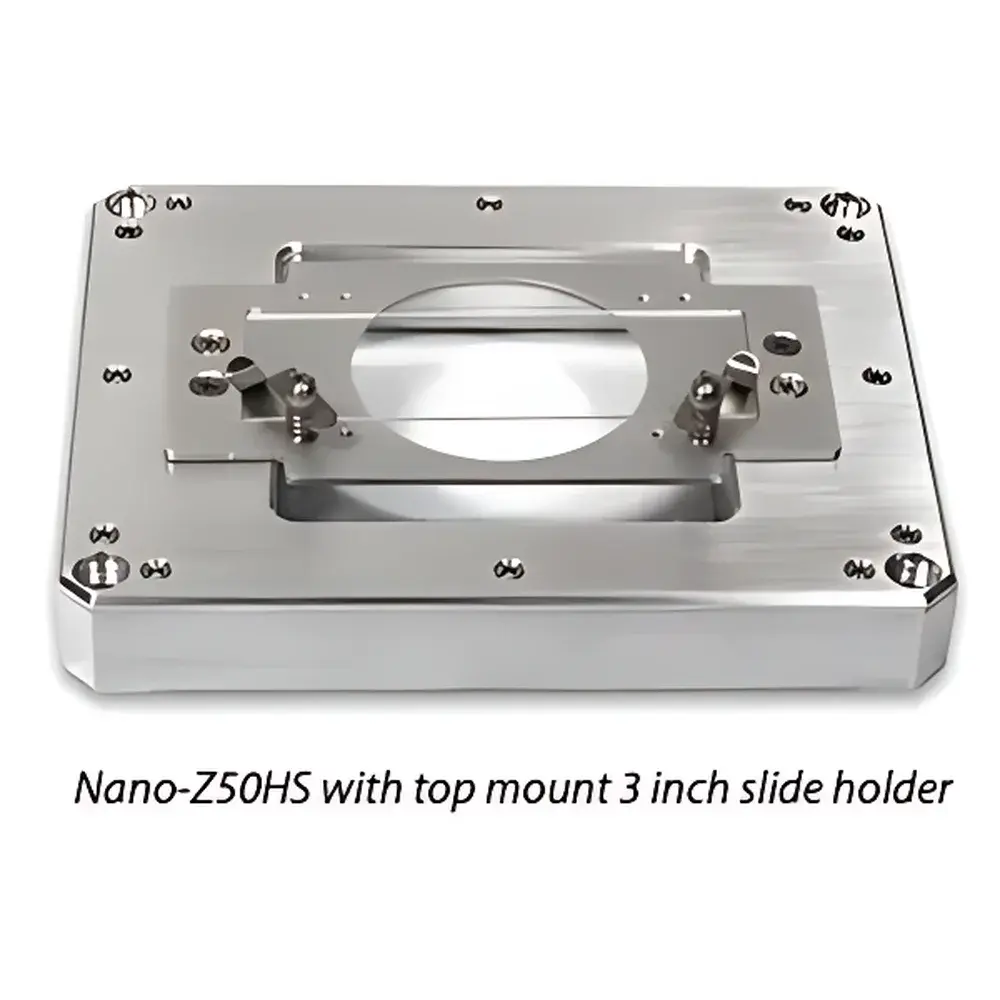
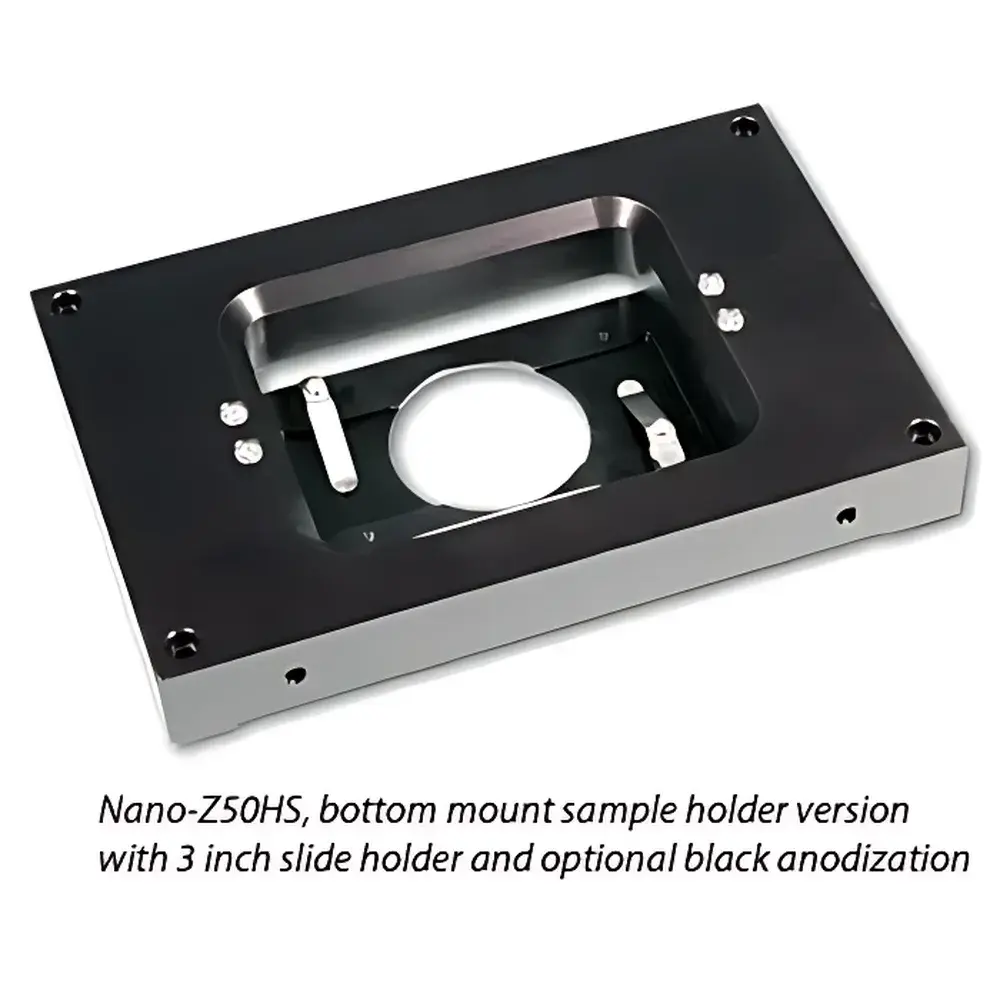
MCL Think Nano Nano-Z50HS High-Speed Closed-Loop Piezoelectric Z-Axis Translation Stage
| Brand | MCL Think Nano |
|---|---|
| Origin | USA |
| Model | Nano-Z50HS |
| Motion Range | 50 µm |
| Resolution | 0.1 nm |
| Resonant Frequency | 1000 Hz ±20% |
| Stiffness | 1.0 N/µm |
| Max. Horizontal Load | 200 g |
| Body Material | Aluminum |
| Controller | Nano-Drive®85 |
| Control Mode | Closed-loop with PicoQ® position sensing |
Overview
The MCL Think Nano Nano-Z50HS is a single-axis, high-speed, closed-loop piezoelectric translation stage engineered exclusively for precision vertical (Z-axis) sample positioning in advanced optical microscopy and high-resolution imaging systems. It operates on the principle of direct piezoelectric actuation—leveraging the inverse piezoelectric effect to convert applied voltage into nanoscale mechanical displacement with exceptional linearity, repeatability, and dynamic response. Unlike stepper-motor or voice-coil-based stages, the Nano-Z50HS eliminates mechanical backlash, hysteresis-induced drift, and thermal expansion artifacts, making it suitable for applications demanding sub-nanometer stability and real-time axial modulation. Its compact low-profile design (height: 0.77″) enables seamless integration onto commercial upright and inverted microscopes—including Nikon Eclipse, Olympus IX, and Zeiss Axio series—without requiring optical path modification or structural reconfiguration.
Key Features
- High-speed Z-axis motion with up to 150 Hz sinusoidal tracking capability, enabling rapid optical sectioning and live-focus correction during time-lapse confocal or multiphoton imaging.
- Closed-loop operation with integrated PicoQ® capacitive position sensors delivering absolute, drift-free position feedback at 0.1 nm resolution—traceable to NIST-calibrated references.
- Minimal moving mass architecture: only the sample holder moves; all piezo actuators and sensing elements are statically mounted within the aluminum chassis, ensuring optimal dynamic fidelity and mechanical Q-factor.
- 50 µm total travel range optimized for biological and material science applications where fine axial control outweighs large displacement needs—e.g., focal plane stabilization, z-stack acquisition, and interferometric surface profiling.
- Aluminum body with precision-machined kinematic mounts ensures thermal stability (coefficient of linear expansion: 23.1 × 10⁻⁶ /°C), dimensional consistency across ambient lab conditions (15–30 °C), and compatibility with vacuum-compatible variants upon request.
Sample Compatibility & Compliance
The Nano-Z50HS accommodates standard optical substrates including 1″ × 3″ glass slides, 24 × 50 mm coverslips, and 35 mm petri dishes via interchangeable, magnetically secured holders. All holders maintain ≤±50 nm parallelism over full travel and are designed to minimize parasitic tilt (<0.5 µrad). The stage complies with ISO 9283:1998 for repeatability testing of industrial manipulators and meets the mechanical stability requirements outlined in ASTM E2587–21 for quantitative microscopy metrology. When operated with the Nano-Drive®85 controller under validated firmware (v3.2+), system-level audit trails, user access logs, and parameter change records satisfy FDA 21 CFR Part 11 data integrity provisions for regulated GLP/GMP environments.
Software & Data Management
Native support includes LabVIEW™ drivers (NI-VISA compliant), MATLAB® Instrument Control Toolbox interfaces, and Python APIs (PySerial + NumPy integration) for custom automation workflows. The Nano-Drive®85 controller provides real-time waveform generation (arbitrary, sine, triangle, sawtooth) with jitter <100 ps RMS and supports synchronized triggering via TTL/USB/RS-422 inputs. All position data streams are timestamped using internal FPGA-based clocks (accuracy ±1 ppm) and exportable in HDF5 or CSV formats with metadata embedding (e.g., controller firmware version, sensor calibration ID, temperature reading). Firmware updates follow IEC 62304 Class B software lifecycle standards.
Applications
- High-speed confocal z-scanning at frame rates exceeding 30 volumes/sec for calcium imaging in neuronal tissue slices.
- Focal drift compensation in single-molecule localization microscopy (SMLM), including PALM and STORM, where axial registration accuracy directly impacts localization precision.
- In situ nanomechanical testing—coupled with AFM or nanoindenter systems—to modulate sample height during force-distance curve acquisition.
- Adaptive optics beam path alignment in ultrafast laser systems, where sub-100 nm Z-correction compensates for thermal lensing in Ti:sapphire amplifiers.
- Automated wafer inspection metrology, particularly for EUV photomask defect review requiring repeatable 50 µm Z-traversal with <1 nm step error.
FAQ
What is the maximum recommended load for vertical (Z-up) orientation?
The Nano-Z50HS is rated for 200 g in horizontal mounting configuration. For vertical use, contact MCL engineering to evaluate static load distribution, creep behavior, and long-term hysteresis—custom preload compensation algorithms may be implemented.
Is vacuum compatibility available?
Yes—vacuum-rated versions (10⁻⁷ Torr) with stainless-steel fasteners, ceramic-insulated cabling, and outgassing-tested adhesives are available under part number Nano-Z50HS-VAC.
Can multiple Nano-Z50HS units be synchronized?
Yes—using the Nano-Drive®85’s master-slave daisy-chain mode with deterministic latency <5 µs between axes, enabling multi-stage coordinated motion for 3D scanning or dual-sample comparison setups.
How often does the PicoQ® sensor require recalibration?
Under normal lab conditions and proper handling, factory calibration remains valid for ≥24 months; annual verification against traceable step-height standards (e.g., NIST SRM 2161) is recommended for ISO/IEC 17025-accredited labs.




