
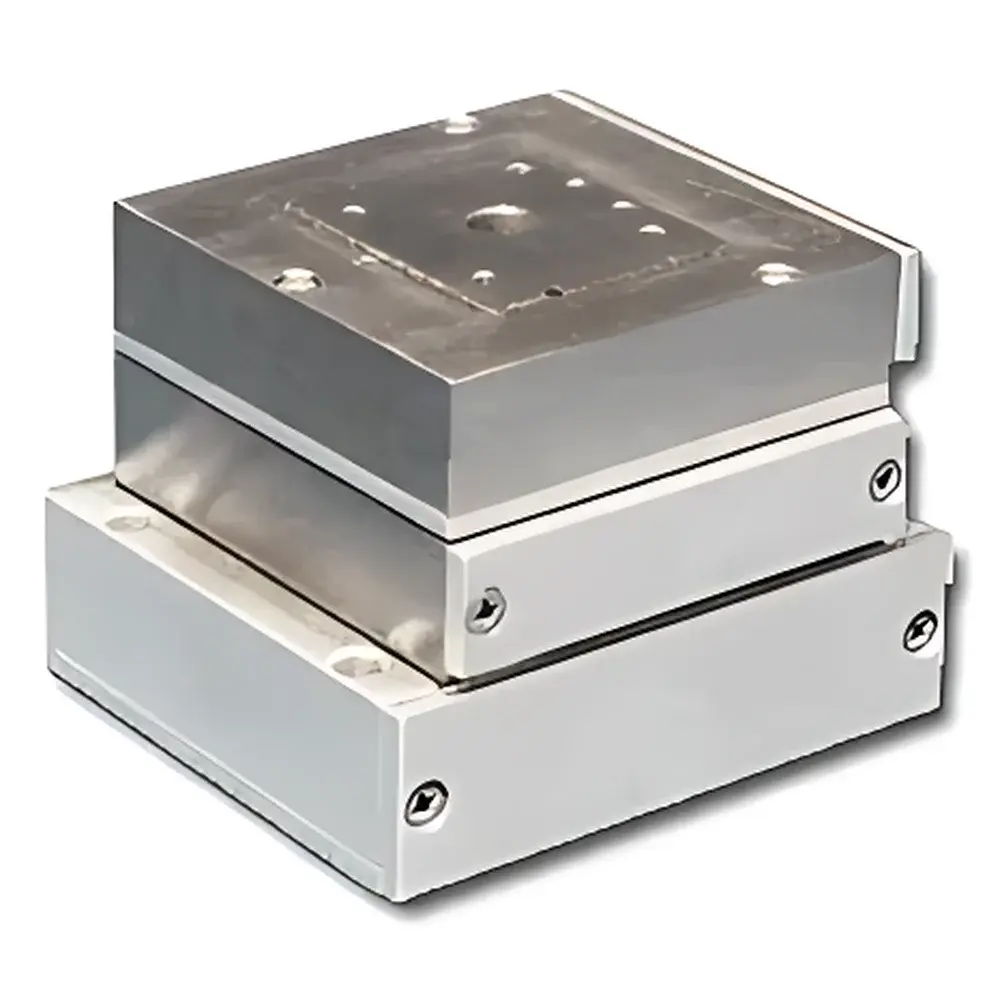
MCL Think Nano Nano-M350 Three-Axis Piezoelectric Nanopositioning Stage
| Brand | MCL Think Nano |
|---|---|
| Origin | USA |
| Model | Nano-M350 |
| Motion Axes | X, Y, Z |
| Travel Range | 50 μm (X), 50 μm (Y), 25 μm (Z) |
| Closed-Loop Resolution | 0.05 nm (25 μm range), 0.1 nm (50 μm range) |
| Resonant Frequency | 1 kHz (X), 700 Hz (Y & Z) |
| Stiffness | 1.0 N/μm |
| Angular Deviation (Roll/Pitch) | ≤1 μrad |
| Angular Deviation (Yaw) | ≤3 μrad |
| Max Horizontal Load | 0.5 kg |
| Max Vertical Load | 0.2 kg |
| Body Material | Aluminum/Titanium or Invar |
| Vacuum Compatibility | High Vacuum (Non-Bakeable) |
| Controller | Nano-Drive® |
Overview
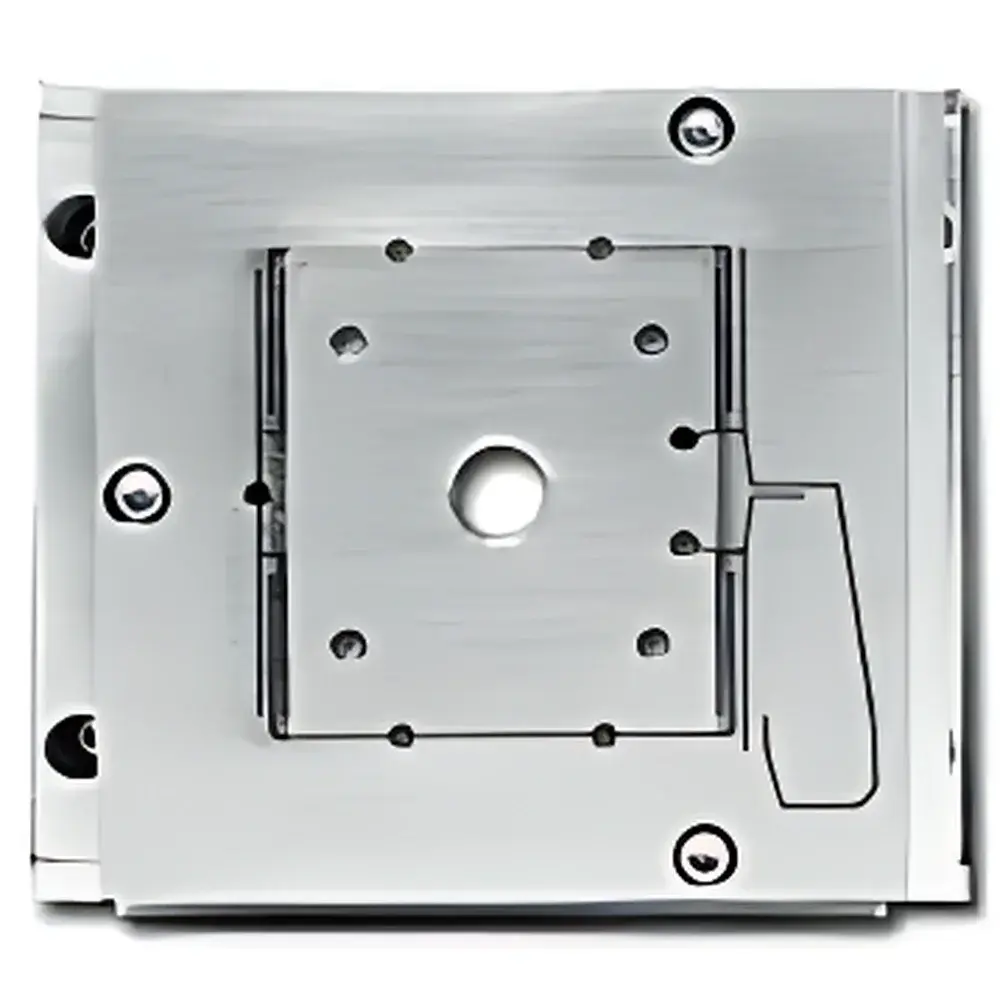
The MCL Think Nano Nano-M350 is a high-precision, compact three-axis piezoelectric nanopositioning stage engineered for sub-nanometer motion control in demanding optical, scanning probe, and electron microscopy applications. Utilizing direct-drive piezoelectric actuation with integrated capacitive or strain-gauge position sensing, the Nano-M350 operates on the principle of electrostrictive displacement—where applied voltage induces controlled lattice deformation in piezoceramic elements—enabling deterministic, hysteresis-compensated motion under closed-loop feedback. Its monolithic aluminum-titanium or low-expansion invar construction ensures exceptional thermal stability (coefficient of thermal expansion < 1.2 × 10⁻⁶ /°C for Invar variant), minimizing drift during extended acquisition sequences typical in nanolithography alignment or SEM-based nanomanipulation. The stage features a central 6.35 mm (0.25") optical aperture, enabling unobstructed beam path integration in confocal, interferometric, or cathodoluminescence setups without mechanical reconfiguration.
Key Features
- True three-axis independent motion (X, Y, Z) with orthogonal decoupling to minimize crosstalk (< 0.02% inter-axis coupling measured per ISO 230-2 Annex B)
- Closed-loop resolution down to 0.05 nm—achieved via proprietary PicoQ® sensor architecture delivering absolute position encoding without homing or reference marks
- High mechanical bandwidth: 1 kHz resonant frequency on X-axis supports dynamic tracking of fast sample drift compensation routines in real-time AFM or nanoindentation feedback loops
- Low angular error: roll/pitch deviation ≤1 μrad and yaw ≤3 μrad over full travel—critical for maintaining collimation in single-mode fiber coupling or objective lens alignment
- Modular vacuum compatibility: non-bakeable high-vacuum variants rated to 1 × 10⁻⁷ Torr meet UHV-adjacent instrumentation requirements in surface science chambers
- Integrated Nano-Drive® controller interface supporting analog ±10 V input, digital USB 2.0, and optional Ethernet TCP/IP for synchronized multi-stage orchestration
Sample Compatibility & Compliance
The Nano-M350 is designed for integration into OEM and laboratory-grade systems where dimensional fidelity and long-term positional repeatability are governed by international metrology standards. Its mechanical design conforms to ISO 10360-5 for coordinate measuring machine (CMM) stage performance verification protocols. When operated with the Nano-Drive® controller, the system supports audit-trail logging compliant with FDA 21 CFR Part 11 requirements for electronic records in regulated QC environments. While not intrinsically certified for GLP/GMP production lines, its traceable calibration documentation—including factory-certified linearity error maps (< ±0.03% F.S.) and thermal drift characterization reports—facilitates user qualification under ISO/IEC 17025 accredited laboratories. The stage’s inert material set (no outgassing elastomers, gold-plated electrical contacts) satisfies ASTM E595 criteria for total mass loss (TML < 0.5%) and collected volatile condensable materials (CVCM < 0.05%) in space-qualified optical payloads.
Software & Data Management
Native support is provided through MCL’s Nano-Control Suite v4.x—a Windows-based application enabling waveform generation (sine, triangle, arbitrary LUT), multi-axis trajectory planning (S-curve acceleration profiles), and real-time data streaming at up to 10 kHz sampling. All position data are timestamped with microsecond precision and exportable in HDF5 format for interoperability with Python (NumPy/H5Py), MATLAB, or LabVIEW-based analysis pipelines. The Nano-Drive® firmware implements non-volatile memory storage for user-defined calibration tables and retains zero-point offsets across power cycles. For enterprise integration, the SDK includes C/C++, .NET, and Python APIs with thread-safe multithreading support—enabling synchronization with external triggers from CCD frame grabs, laser pulse generators, or SEM scan clocks. Optional time-synchronized logging enables correlation of stage position with spectral or temporal detector signals in pump-probe experiments.
Applications
- Precision optical alignment in ultrafast laser cavities and quantum optics testbeds requiring sub-100 pm path-length stabilization
- SEM/TEM in-situ nanomanipulation, including probe-based lithography, nanowire contact formation, and localized electron-beam-induced deposition (EBID)
- Micromirror array positioning in adaptive optics systems for wavefront correction in astronomical interferometry
- Atomic force microscope (AFM) scanner augmentation for large-area mosaic imaging with automated tile stitching and drift correction
- Fiber-to-chip coupling in photonic integrated circuit (PIC) packaging, where axial (Z) repeatability < 0.1 nm ensures optimal evanescent field overlap
- Nanoscale thermal expansion coefficient mapping using lock-in thermography combined with periodic Z-modulation
FAQ
Is the Nano-M350 compatible with ultra-high vacuum (UHV) systems?
The standard Nano-M350 is rated for high vacuum (1 × 10⁻⁷ Torr). UHV-compatible versions (≤1 × 10⁻¹⁰ Torr) are available with modified feedthroughs and ceramic-insulated actuators—contact engineering for custom configuration.
Can multiple Nano-M350 stages be synchronized?
Yes—via Nano-Drive®’s master-slave daisy-chain mode or external TTL trigger distribution; jitter between axes is < 50 ns when using shared clock distribution.
What is the recommended maintenance interval for closed-loop calibration?
Factory calibration remains stable for ≥24 months under continuous operation at 23 ± 1°C; annual verification against NIST-traceable interferometric standards is advised for ISO 17025 compliance.
Does the stage support custom travel ranges or mounting configurations?
MCL offers OEM redesign services—including modified aperture geometry, alternate baseplate threading (M4/M6), and extended Z-range variants—subject to minimum order quantities and lead-time consultation.
How is thermal drift compensated during long-duration experiments?
Invar-body models exhibit < 5 nm/°C Z-drift over 0–40°C; active compensation is implemented via optional temperature sensor input to Nano-Drive®, enabling real-time offset correction using user-defined thermal coefficients.



