
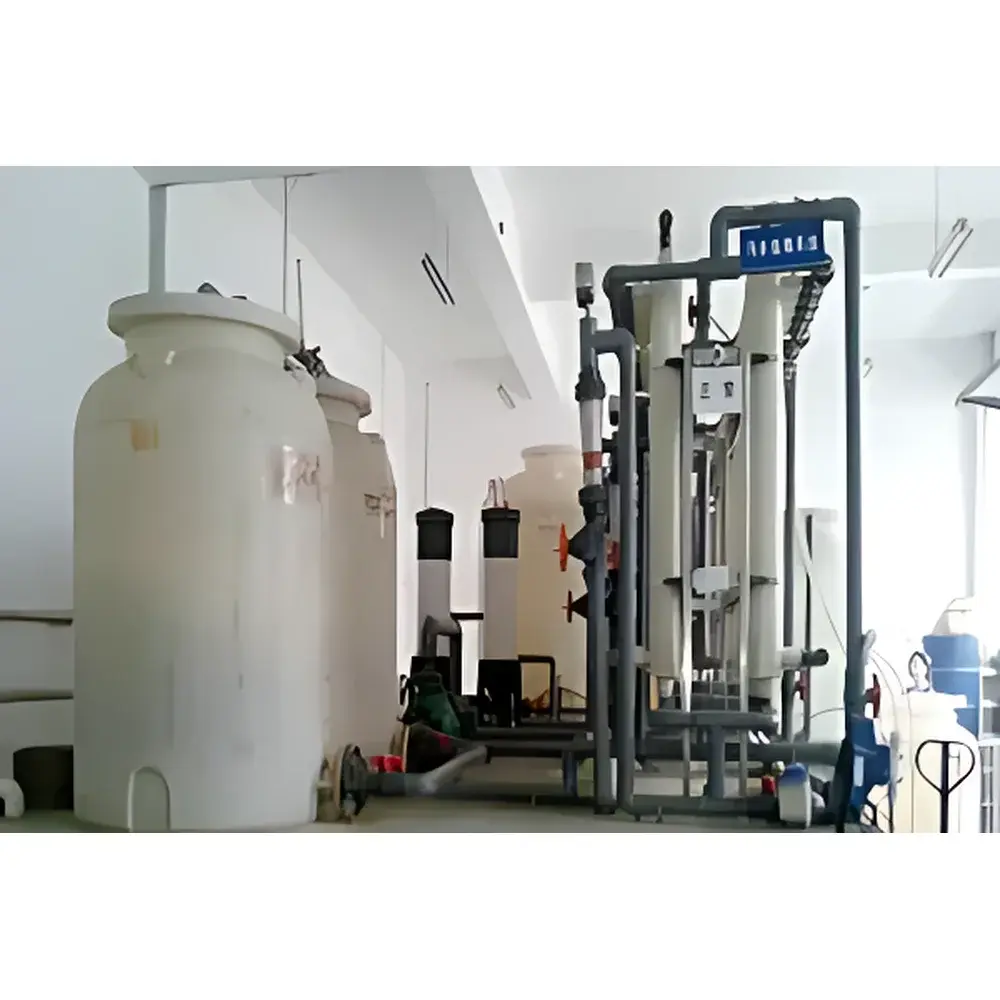
MD Deammonification Technology by New Biolink
| Brand | New Biolink |
|---|---|
| Origin | Beijing, China |
| Manufacturer Type | Authorized Distributor |
| Country of Origin | China |
| Model | MD Deammonification Technology |
| Pricing | Available Upon Request |
| Application | Ammonia-Nitrogen Removal from Wastewater |
Overview
MD Deammonification Technology is a laboratory-scale membrane distillation (MD) system engineered for selective, energy-efficient removal and recovery of ammonia-nitrogen (NH3-N) from industrial and municipal wastewater streams. Unlike conventional thermal or air-stripping processes, this system leverages the fundamental principles of vapor-phase mass transfer across a hydrophobic microporous membrane. Under a controlled temperature gradient—typically with feed side heated to 40–60 °C and permeate side maintained at 15–25 °C—volatile NH3 molecules, generated via pH-driven deprotonation of NH4+, diffuse through membrane pores as vapor without wetting the membrane. The process operates near atmospheric pressure and avoids bulk phase boiling, enabling integration with low-grade heat sources such as solar thermal collectors, waste heat from HVAC systems, or low-pressure steam exhaust.
Key Features
- Hydrophobic polytetrafluoroethylene (PTFE) or polypropylene (PP) flat-sheet or hollow-fiber membrane modules, optimized for high NH3 selectivity and long-term fouling resistance
- pH-modulated feed conditioning unit with integrated NaOH dosing and real-time pH monitoring (range: 0–14, ±0.1 accuracy)
- Acidic absorbent circuit using dilute H2SO4 (0.1–0.5 M) to capture and stabilize NH3 as ammonium sulfate—enabling direct recovery of fertilizer-grade (NH4)2SO4
- Vacuum-assisted configuration option (Vacuum MD mode) for enhanced flux and simultaneous production of concentrated aqueous ammonia (≥10% w/w) suitable for reuse in synthesis or scrubbing applications
- Modular design compatible with benchtop fume hoods; footprint < 0.8 m²; total system weight < 45 kg
- Temperature-controlled recirculation loops with PID-regulated heaters and chillers (±0.3 °C stability)
Sample Compatibility & Compliance
The system is validated for continuous treatment of synthetic and real-world wastewaters containing 50–1500 mg/L NH3-N, including leachate, anaerobic digester supernatant, semiconductor rinse water, and pharmaceutical effluents. Feed streams may contain suspended solids ≤15 mg/L and turbidity ≤5 NTU; pretreatment via cartridge filtration (5 µm) is recommended. The MD module complies with ASTM D8079-22 (Standard Guide for Membrane Distillation Performance Testing) and aligns with ISO 22192:2021 (Water quality — Determination of ammonia nitrogen — Spectrophotometric method after distillation). All wetted components meet USP Class VI biocompatibility requirements, and the control architecture supports audit-ready operation under GLP and GMP environments where traceability of process parameters (temperature, pH, flow rate, vacuum level) is required.
Software & Data Management
An embedded Linux-based controller runs custom SCADA firmware with local HMI touchscreen interface (7″ capacitive display). Real-time data logging records temperature profiles (feed/permeate), transmembrane flux (L/m²·h), pH, conductivity, and acid consumption at 10-second intervals. Export formats include CSV and SQLite; optional OPC UA server enables integration into LIMS or centralized plant SCADA. For regulated laboratories, optional 21 CFR Part 11-compliant software package provides electronic signatures, role-based access control, and immutable audit trails—including user login/logout timestamps, parameter change history, and alarm event logs.
Applications
- Ammonia recovery from anaerobic digestion sidestreams for on-site fertilizer production
- Treatment of high-strength landfill leachate prior to biological polishing
- Regeneration of ion-exchange regeneration brines containing NH4+
- Zero-liquid-discharge (ZLD) pilot studies integrating MD with crystallization or electrodialysis
- Method development and validation per EPA Method 350.1 or ISO 5667-16 for ammonia speciation in complex matrices
- Educational use in chemical engineering and environmental science curricula for teaching membrane separation thermodynamics and sustainability metrics (e.g., specific energy consumption < 0.8 kWh/kg NH3-N removed)
FAQ
What feed pretreatment is required before MD operation?
Feed must be filtered to ≤5 µm to prevent pore blockage; dissolved organics (COD > 200 mg/L) may require activated carbon polishing to mitigate membrane organic fouling.
Can the system handle wastewater with high calcium or magnesium hardness?
Yes—unlike RO, MD is not limited by scaling potential; however, supersaturation-induced precipitation at the membrane surface should be monitored via periodic SEM-EDS analysis of used modules.
Is ammonia recovery yield quantified and traceable?
Yes—recovery efficiency is calculated continuously using inline UV-Vis (220 nm) absorbance of permeate acid loop and verified by titrimetric analysis per ISO 7150-1.
What maintenance intervals are recommended for membrane modules?
Under typical lab-use conditions (8 h/day, 5 days/week), PTFE membranes demonstrate >12 months operational stability; cleaning-in-place (CIP) with 0.1 M citric acid + 0.05 M NaOCl is advised every 200 operating hours.
Does the system support remote monitoring and control?
Standard Ethernet connectivity enables secure remote access via SSH or VNC; optional cellular modem (LTE-M) available for off-grid deployment with cloud-based dashboard (AWS IoT Core compatible).



