
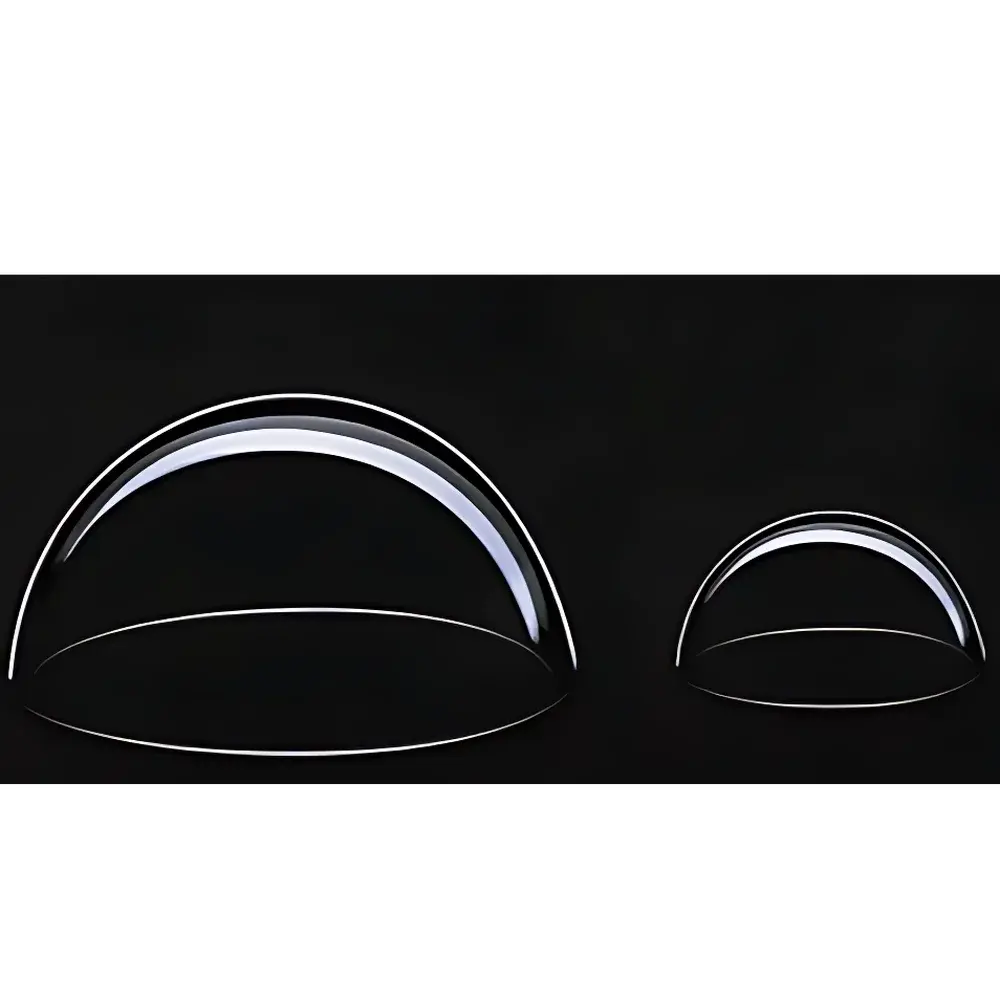
Meg1060 Spherical Dome Optical Window
| Brand | MiXran |
|---|---|
| Model | Meg1060 |
| Type | Spherical Dome Optical Window |
| Material | Fused Silica (Standard) |
| Diameter Range | 25–100 mm |
| Dome Height | 11.5–49 mm |
| Wall Thickness | 1–4 mm |
| Surface Quality | λ/10 @ 633 nm (typ.) |
| Coating Options | AR (250–1100 nm), UV-enhanced, or Custom Broadband |
| Transmission | >99.5% per surface (AR-coated, visible range) |
| Damage Threshold | >5 J/cm² (10 ns, 1064 nm, 10 Hz) |
| Compliance | ISO 10110-7, MIL-O-13830A |
Overview
The Meg1060 Spherical Dome Optical Window is a precision-engineered optical component designed for demanding applications requiring uniform pressure distribution, omnidirectional field-of-view coverage, and minimal wavefront distortion under vacuum or pressurized environments. Unlike flat or plano-convex windows, the Meg1060 employs a true spherical dome geometry—defined by a constant radius of curvature across its entire surface—enabling near-zero off-axis aberration and symmetric mechanical load response. It operates on the principle of isotropic stress redistribution: when subjected to differential pressure (e.g., in underwater housings, aerospace sensor pods, or vacuum chamber viewports), the spherical profile converts radial compressive forces into uniform hoop stress, significantly enhancing structural integrity over equivalent flat windows. This makes the Meg1060 particularly suitable for high-reliability optical interfaces in laser delivery systems, environmental simulation chambers, and imaging systems where angular field uniformity and thermal/mechanical stability are critical.
Key Features
- Precision-ground and polished fused silica substrate with surface figure accuracy ≤ λ/10 @ 633 nm (RMS), verified via interferometric testing per ISO 10110-5.
- Spherical dome geometry with tight tolerance control on radius of curvature (±0.1%); available in four standard diameters (25 mm, 50 mm, 75 mm, 100 mm) with proportional height-to-diameter ratios optimized for mechanical safety factor ≥ 3.5 under 1 atm differential pressure.
- Customizable anti-reflection coatings applied via ion-assisted e-beam deposition; standard broadband AR (BBAR) covers 250–1100 nm with residual reflectance <0.25% per surface; optional V-coats for 532 nm, 1064 nm, or UV-enhanced variants (185–400 nm).
- Edge treatment includes fine ground bevel (0.1–0.2 mm × 45°) to mitigate chipping and improve mounting compatibility with standard O-ring grooves or elastomeric seals.
- Thermal coefficient of expansion matched to common housing materials (e.g., 304 stainless steel, aluminum 6061-T6) to minimize thermo-mechanical stress at operating temperatures from –40 °C to +80 °C.
Sample Compatibility & Compliance
The Meg1060 is compatible with standard optical mounts (e.g., Thorlabs SM1-threaded flanges, Edmund Optics C-mount adapters) and integrates seamlessly into ISO-KF, CF-35, or DN40 vacuum feedthrough configurations. All units undergo 100% visual inspection per MIL-O-13830A scratch-dig standards and are certified to ISO 10110-7 for surface imperfections. Batch traceability includes interferometric wavefront maps, coating spectral transmission curves, and mechanical dimension reports. The component complies with RoHS 2015/863/EU and REACH SVHC regulations. For regulated environments (e.g., medical laser devices or aerospace instrumentation), documentation packages support GLP/GMP audit readiness, including material certificates (CoC), coating process logs, and calibration records aligned with ISO/IEC 17025-accredited test protocols.
Software & Data Management
While the Meg1060 is a passive optical component, its integration into system-level design workflows is supported through downloadable technical data packages (TDPs) in STEP, IGES, and Zemax Binary (.ZBF) formats. These include full geometric models with accurate refractive index dispersion (Sellmeier coefficients for fused silica), coating stack definitions, and polarization-dependent transmission matrices. Users can import these directly into optical design software (e.g., Zemax OpticStudio, CODE V, FRED) for stray light analysis, thermal deformation modeling, or ray-trace-based performance prediction. All TDPs are timestamped, digitally signed, and archived with SHA-256 checksums for version control and regulatory traceability.
Applications
- Vacuum viewport assemblies for synchrotron beamlines and ultra-high-vacuum (UHV) spectroscopy chambers (≤10⁻⁹ mbar).
- Pressure-resistant optical domes for underwater LIDAR housings and subsea camera systems (rated to 100 m depth with appropriate sealing).
- Omnidirectional collimation optics in multi-angle scattering setups (e.g., Mie scattering calibrations, particle sizing instruments).
- Front-end protective windows for high-energy pulsed laser systems (e.g., Ti:sapphire amplifiers, Nd:YAG pump cavities), where damage threshold and group delay dispersion must be minimized.
- Environmental test chamber viewports requiring simultaneous transmission across UV-VIS-NIR bands and resistance to thermal cycling (–40/+80 °C, 500 cycles).
FAQ
Is the Meg1060 available with custom radii or non-standard diameters?
Yes—custom geometries are supported with lead times of 6–8 weeks; minimum order quantity applies for non-standard sizes.
Can the Meg1060 be coated for CO₂ laser transmission (10.6 µm)?
Yes—ZnSe or Ge substrates with diamond-turned spherical domes are offered separately; fused silica is not suitable for 10.6 µm due to strong absorption.
Do you provide mounting hardware or sealing gaskets with the dome?
Standard mounting kits (including stainless steel retaining rings and Viton O-rings) are available as optional accessories; specifications align with ISO 3601-1 and AS568A standards.
What is the maximum allowable pressure differential for the 100 mm Meg1060 dome?
At room temperature and with proper edge support, the 100 mm variant (4 mm wall thickness) is rated for ≥2.5 atm differential pressure per finite element analysis validated against ASTM E1290 fracture mechanics criteria.
Are test reports provided with each shipment?
Yes—each unit ships with a Certificate of Conformance (CoC), interferogram report, and spectral transmission data; full QA documentation is available upon request for regulated procurement.



