
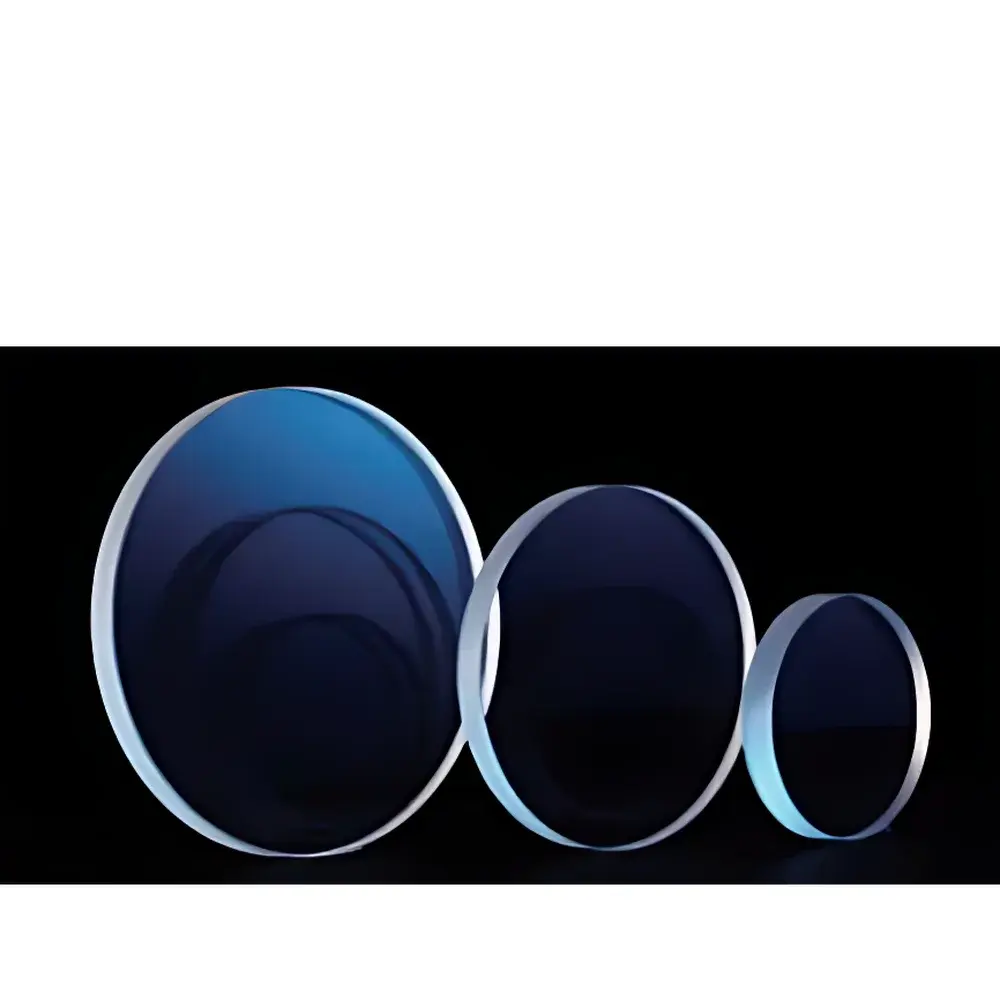
Meg1061 — MiXran UV-Grade Fused Silica Precision Flat Optical Window
| Brand | MiXran |
|---|---|
| Model | Meg1061 |
| Material | UV-grade fused silica (SiO₂) |
| Surface Flatness | λ/10 @ 632.8 nm |
| Surface Quality | 10–5 scratch-dig |
| Parallelism | < 10 arcsec |
| Thickness Tolerance | ±0.05 mm |
| Diameter Options | Φ5.0 to Φ50.8 mm |
| Standard Thickness | 2 mm (Φ5–Φ25.4), 3 mm (Φ30), 4 mm (Φ38.1–Φ50.8) |
| Coating Options | Broadband AR (UV: 250–400 nm, VIS: 350–700 nm, NIR: 600–1100 nm, SWIR: 900–1700 nm) |
| Transmission | >99.0% per surface (coated), >99.5% (uncoated, 250–2000 nm) |
| Laser Damage Threshold | >5 J/cm² @ 355 nm, 10 ns, 20 Hz |
Overview
The Meg1061 is a high-precision flat optical window engineered from synthetic UV-grade fused silica—selected for its exceptional transmission in the deep ultraviolet (DUV) down to 185 nm, ultra-low thermal expansion (α ≈ 0.55 × 10⁻⁶ /°C), and outstanding homogeneity (< 1 × 10⁻⁶ refractive index variation). Designed for demanding optical systems including spectroscopic instrumentation, excimer laser beam delivery, vacuum ultraviolet (VUV) metrology, and space-borne sensor front-ends, the Meg1061 meets stringent requirements for wavefront distortion control and environmental stability. Its λ/10 surface flatness (measured at HeNe wavelength, 632.8 nm) and 10–5 surface quality ensure minimal phase error and scatter—critical for interferometric alignment, cavity optics, and high-numerical-aperture imaging paths. Unlike standard BK7 or borosilicate windows, fused silica’s near-zero hydroxyl (OH⁻) content eliminates absorption bands in the NIR and avoids solarization under prolonged UV exposure.
Key Features
- Optically polished surfaces with λ/10 transmitted wavefront error (TWE) and <10 arcsec parallelism—validated via Zygo GPI interferometry
- Material certified to ASTM F796-22 specifications for UV-transmitting fused silica, including trace metal impurity limits (Fe < 1 ppm, Al < 5 ppm)
- Low birefringence (<5 nm/cm) and negligible fluorescence under 248 nm or 193 nm excitation
- Hermetically sealed packaging with nitrogen purge and desiccant—compliant with MIL-PRF-13830B handling protocols
- Customizable edge treatments: fine-ground (standard), laser-marked part ID, or blackened bevel to suppress stray light
- Thermal shock resistance up to ΔT = 200 °C—suitable for bake-out in UHV environments (≤10⁻⁹ Torr)
Sample Compatibility & Compliance
The Meg1061 window is compatible with cleanroom Class 100 (ISO 5) assembly and qualifies for integration into ISO/IEC 17025-accredited optical test benches. Its surface chemistry and outgassing profile conform to ECSS-Q-ST-70-02C for space applications, with total mass loss (TML) < 0.5% and collected volatile condensable materials (CVCM) < 0.05% after 24 h at 125 °C in vacuum. For regulated life-science instrumentation, the uncoated variant satisfies USP requirements for optical components in photometric calibration systems. All AR coatings are ion-beam sputtered (IBS), providing adhesion rated to MIL-C-48497A and durability tested per ISO 9211-4:2021 (tape peel, abrasion, humidity cycling).
Software & Data Management
Each Meg1061 unit ships with a digital Certificate of Conformance (CoC) containing interferometric map data (Zernike coefficients up to n=12), spectral transmittance curves (200–2000 nm, 1 nm resolution), and batch-specific material certification (including OH⁻ content measured by FTIR at 2.73 µm). CoCs are embedded in PDF/A-2b format with embedded digital signature (RSA-2048), enabling traceability in FDA 21 CFR Part 11-compliant QA workflows. Spectral data files are provided in ASCII-compatible .CSV and native .ZMX (Zemax) formats for direct import into optical design software.
Applications
- Vacuum-compatible viewports for synchrotron beamlines (e.g., soft X-ray/VUV endstations)
- Input/output couplers for Ti:sapphire and frequency-tripled Nd:YAG laser cavities
- Reference windows in NIST-traceable UV radiometers (e.g., calibrated against FEL lamps)
- Front elements in Raman spectrometers operating below 250 cm⁻¹ shift
- Environmental monitoring sensors deployed in stratospheric balloon payloads (e.g., ozone DUV absorption cells)
- Photolithography alignment subassemblies requiring sub-microradian angular stability over thermal cycling
FAQ
Is the Meg1061 suitable for 193 nm ArF excimer laser applications?
Yes—its low metallic impurity content and high-purity synthetic origin ensure minimal solarization; certified lifetime >10⁹ pulses at 10 mJ/cm², 20 Hz.
Can I specify custom thickness or non-standard diameters?
Yes—custom geometries (including rectangular blanks and wedge angles ≤ 3 arcmin) are available under MiXran’s OEM program with lead time of 6–8 weeks.
Do AR coatings affect laser-induced damage threshold (LIDT)?
IBS-deposited coatings maintain >90% of bare fused silica LIDT; full LIDT reports per coating band are supplied with each order.
Is surface figure data provided for every individual window?
Yes—interferometric verification is performed on 100% of production units; raw phase maps and PV/RMS values are included in the CoC.
How is thermal drift compensated in precision interferometric setups?
The coefficient of thermal expansion (CTE) is characterized per batch; CTE deviation from nominal is reported ±0.05 × 10⁻⁶ /°C to support thermal modeling in alignment algorithms.





