
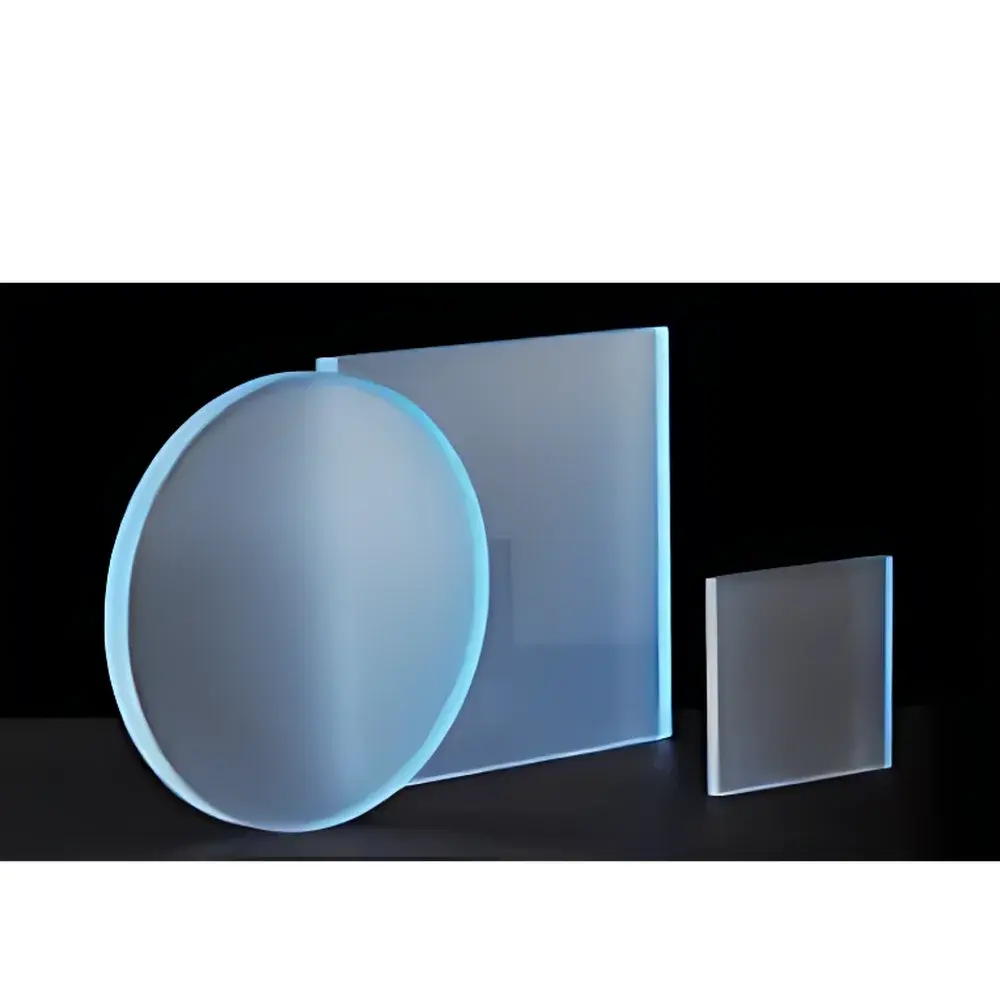
Meg1085 — MiXran Fused Silica High-Reflectivity Laser Mirrors
| Brand | MiXran |
|---|---|
| Substrate Material | Fused Silica (Synthetic Quartz) |
| Model | Meg1085 |
| Diameter Options | 12.5 mm, 25 mm, 50 mm |
| Thickness Options | 6 mm (12.5 mm & 25 mm dia), 10 mm (50 mm dia) |
| Laser Wavelength Ranges | 244–257 nm (Ar⁺), 266 nm (4×Nd:YAG), 300–308 nm (Ar⁺), 351–364 nm (Ar⁺), 355 nm (3×Nd:YAG), 458–528 nm (Ar⁺), 532 nm (2×Nd:YAG), 1064 nm (Nd:YAG) |
| Angle of Incidence | 0° or 45° |
| Avg. Reflectivity (Ravg) | ≥99.0% to ≥99.8% across specified bands |
| Laser Damage Threshold | 2–10 J/cm² (10 ns pulses, 10 Hz, 1064 nm reference) |
| Surface Flatness | λ/10 @ 633 nm |
| Surface Quality | 10–5 scratch-dig per MIL-PRF-13830B |
| Coating Type | Dielectric multilayer, ion-beam sputtered (IBS) or electron-beam evaporated (EBE), optimized for high LIDT and environmental stability |
Overview
The Meg1085 series comprises precision-engineered fused silica high-reflectivity laser mirrors designed for demanding continuous-wave (CW) and pulsed laser systems operating in the deep ultraviolet (DUV) through near-infrared (NIR) spectrum. Manufactured by MiXran using synthetic fused silica substrates—selected for ultra-low thermal expansion (α ≈ 0.55 × 10⁻⁶ /°C), exceptional UV transmission (>90% at 193 nm), and high homogeneity—the Meg1085 mirrors serve as critical optical cavity components, beam steering elements, and harmonic separation optics in industrial, scientific, and medical laser platforms. Each mirror features dielectric interference coatings deposited via ion-beam sputtering (IBS) or high-density electron-beam evaporation (EBE), ensuring minimal absorption (<0.05%), low wavefront distortion, and long-term stability under high-power irradiation. The design adheres to ISO 10110-7 surface quality standards and is validated for use in Class 4 laser environments per IEC 60825-1.
Key Features
- Fused silica substrate with certified OH-content <1 ppm and metallic impurity levels <1 ppb—ensuring negligible solarization and minimal thermal lensing under intense UV exposure
- Dual-angle configuration: 0° (normal incidence) and 45° (Brewster-compatible) variants available for cavity alignment flexibility and polarization-sensitive setups
- High laser-induced damage threshold (LIDT): up to 10 J/cm² (10 ns, 10 Hz, 1064 nm) and 3 kW/cm² (CW, 514.5 nm Ar⁺), verified per ISO 21254-1 test methodology
- Surface flatness maintained at λ/10 @ 633 nm (peak-to-valley), enabling diffraction-limited performance in interferometric and ultrafast applications
- Coating spectral bandwidth engineered for ±1.5 nm tolerance around central wavelength; spectral shift <0.05 nm/°C temperature coefficient
- Robust adhesion tested per MIL-C-48497A; humidity resistance validated per ISO 9211-4 (95% RH, 40°C, 240 h)
Sample Compatibility & Compliance
The Meg1085 mirrors are compatible with standard kinematic mounts (e.g., Thorlabs KM100, Newport UMB12) and vacuum-compatible optical tables (UHV-rated to 10⁻⁹ mbar). Substrate dimensions conform to ANSI/OEOSC OP1.002 mechanical tolerances (±0.05 mm diameter, ±0.1 mm thickness). All units undergo 100% spectral verification using calibrated Ocean Insight QE Pro spectrometers and LIDT screening via Quantel Brilliant B Nd:YAG laser systems. Certificates of Conformance include traceable calibration data against NIST-traceable reference standards. Compliant with RoHS 2015/863/EU and REACH Annex XVII; non-proprietary coating materials avoid Pb, Cd, Cr⁶⁺, and Hg compounds. Suitable for GLP-compliant laser metrology labs requiring audit-ready documentation.
Software & Data Management
While the Meg1085 is a passive optical component, MiXran provides downloadable spectral reflectance datasets (CSV and SDF formats) for integration into Zemax OpticStudio, CODE V, and FRED optical design environments. Each serial-numbered unit ships with a digital Certificate of Performance containing measured R(λ) curves, surface map interferograms (Zygo GPI data), and LIDT test logs. Optional secure cloud access (via MiXran Optical Portal) enables version-controlled revision history, batch-level statistical process control (SPC) reports, and ISO 17025-aligned uncertainty budgets for reflectance and flatness measurements.
Applications
- Resonator end mirrors and folding mirrors in Q-switched Nd:YAG lasers (266 nm, 355 nm, 532 nm, 1064 nm)
- Harmonic separation optics in multi-wavelength Ar⁺ ion laser systems (244–528 nm)
- Beam delivery optics in excimer-based micromachining (193 nm, 248 nm) and semiconductor lithography tool subassemblies
- Ultrafast amplifier cavities (Ti:sapphire, Yb:fiber) requiring low group delay dispersion (GDD) and high pulse fidelity
- Calibration references in national metrology institutes for radiometric reflectance transfer standards
- Vacuum-UV (VUV) beamlines where outgassing rates <1×10⁻¹² Torr·L/s·cm² (per ASTM E595) are mandated
FAQ
What substrate material is used, and why fused silica?
Fused silica (SiO₂) is selected for its near-zero thermal expansion coefficient, high UV transparency down to 185 nm, radiation hardness, and low intrinsic birefringence—critical for maintaining wavefront fidelity in high-repetition-rate and ultrafast laser systems.
Are custom coatings available beyond the listed wavelengths?
Yes. MiXran offers bespoke dielectric stack design and deposition for wavelengths from 157 nm (F₂ excimer) to 2000 nm, including dual-band, broadband HR, and polarizing (p- or s-polarized) configurations—subject to minimum order quantity and lead time validation.
Do these mirrors meet FDA or IEC 60601 requirements for medical laser devices?
While the Meg1085 itself is not a medical device, its material certifications (USP , ISO 10993-5 cytotoxicity screening on coating leachates) and LIDT validation support inclusion in Class II/III laser systems compliant with IEC 60601-2-22 and FDA 21 CFR Part 1040.
Is there batch-to-batch reflectance consistency?
Yes. Process control includes real-time optical monitoring during deposition, post-coating spectral verification, and statistical tolerance stacking per ISO 9001:2015 Clause 8.5.1; typical Ravg variation across production lots is ≤±0.08% within specification band.
Can these mirrors be cleaned using standard ISO 10110 protocols?
Yes. Recommended cleaning follows ISO 10110-7 Annex A: solvent rinse (HPLC-grade acetone → IPA), followed by dry nitrogen purge; no ultrasonic agitation or abrasive wipes permitted to preserve coating integrity.




