
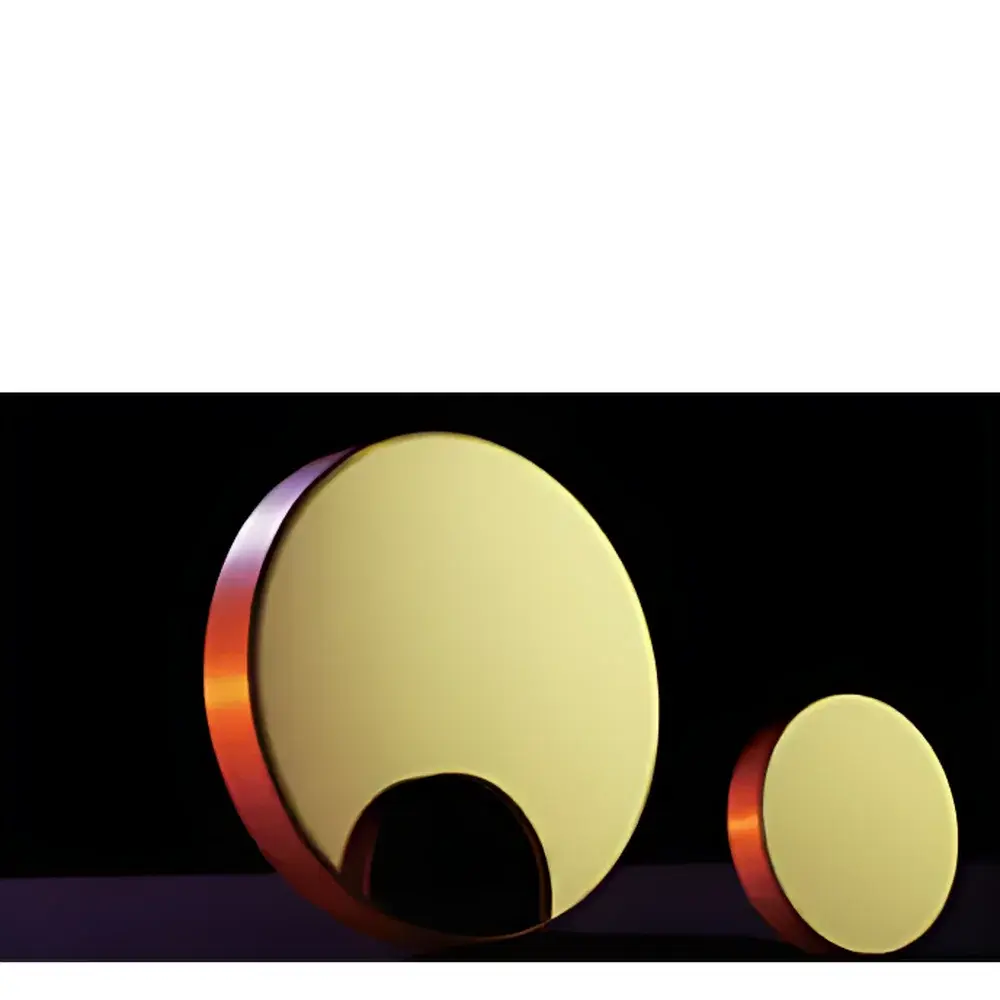
Meg1098 ZnSe Broadband Wedge Beam Splitter for Mid-IR (7–14 µm)
| Brand | MiXran |
|---|---|
| Origin | Beijing, China |
| Model | Meg1098 |
| Component Type | Optical Element |
| Substrate Material | Zinc Selenide (ZnSe) |
| Wedge Angle | 0.5° (standard) |
| S1 Surface | 45° AOI Broadband Partial Reflector (R/T = 50/50 ±10% avg. @ 7–14 µm) |
| S2 Surface | Broadband Anti-Reflection Coating (Rₐᵥg < 2.5% @ 7–14 µm) |
| Dimensions | 12.7 × 12.7 × 3 mm / 25.4 × 25.4 × 5 mm / 50.8 × 50.8 × 8 mm |
| Clear Aperture | ≥90% of diameter |
| Surface Quality | 60-40 scratch-dig |
| Damage Threshold | >500 MW/cm² (10 ns, 1064 nm, pulsed) |
Overview
The Meg1098 ZnSe Broadband Wedge Beam Splitter is a precision optical component engineered for stable, low-loss beam division in mid-infrared (mid-IR) systems operating across the 7–14 µm spectral range. Fabricated from high-purity, CVD-grown zinc selenide (ZnSe), this wedge-type splitter eliminates ghost reflections and interference fringes inherent to parallel-plate designs—critical for FTIR spectrometers, quantum cascade laser (QCL) setups, thermal imaging calibration benches, and CO₂ laser beam combiners. Its asymmetric wedge geometry (standard 0.5°) ensures angular separation of reflected and transmitted beams without requiring precise rotational alignment of the optic, significantly simplifying optical train integration. The S1 surface features a dielectric partial reflector optimized for 45° angle of incidence (AOI), delivering a nominal 50R/50T splitting ratio with ≤±10% deviation across the entire 7–14 µm band. The S2 surface is coated with a multi-layer broadband anti-reflection (BBAR) stack, achieving Rₐᵥg < 2.5% over the same range—minimizing secondary reflections that degrade signal-to-noise ratio in interferometric or multi-pass configurations.
Key Features
- ZnSe substrate with transmission >70% across 7–14 µm (uncoated baseline), enabling high-throughput mid-IR operation
- Wedge architecture eliminates etalon effects and standing-wave artifacts common in zero-wedge beam splitters
- Dielectric S1 coating designed specifically for 45° AOI, ensuring consistent R/T balance independent of polarization state (non-polarizing behavior verified via Mueller matrix modeling)
- S2 BBAR coating deposited via ion-assisted e-beam evaporation, qualified per MIL-C-48497A for environmental stability (humidity, thermal cycling)
- λ/10 surface flatness (measured at 633 nm HeNe reference, extrapolated for IR performance) supports wavefront preservation in coherent mid-IR applications
- High laser damage threshold validated for both nanosecond pulsed (CO₂, QCL) and continuous-wave sources—certified per ISO 21254-1
Sample Compatibility & Compliance
The Meg1098 is compatible with standard kinematic mounts (e.g., Thorlabs KM100, Newport UMB1) and vacuum-compatible optical tables. It meets RoHS 2015/863/EU directive requirements for hazardous substance restriction. While not an end-user instrument, its material composition and coating durability support integration into systems compliant with ISO/IEC 17025-accredited laboratories. ZnSe substrate purity (>99.999%) and coating adhesion (qualified per ASTM D3359 Tape Test, Class 5A) ensure long-term reliability under repeated thermal cycling (−40 °C to +80 °C). No proprietary firmware or embedded electronics are present; therefore, no FCC or CE marking applies—only optical component-level declarations apply.
Software & Data Management
As a passive optical component, the Meg1098 requires no software, drivers, or data interfaces. Its performance specifications—including spectral R/T curves, phase shift on reflection, and polarization-dependent loss (PDL < 0.3% across band)—are provided in NIST-traceable calibration reports (available upon request). Spectral data files (.csv, .sdf) conform to the Photonics Standards Consortium (PSC) metadata schema v2.1 and are compatible with OpticStudio (Zemax), CODE V, and FRED optical design platforms. Batch-specific test reports include interferometric surface maps (Zygo Verifire™) and FTIR transmission/reflection scans (Bruker VERTEX 80v, 4 cm⁻¹ resolution).
Applications
- Michelson and Mach-Zehnder interferometers for gas-phase molecular spectroscopy (e.g., CH₄, CO₂, NOₓ detection)
- Beam combining/splitting in dual-wavelength QCL systems (e.g., 7.7 µm + 10.6 µm) for differential absorption lidar (DIAL)
- Reference-path conditioning optics in Fourier-transform infrared (FTIR) spectrometers compliant with ASTM E1421 and ISO 13717
- Thermal background suppression in uncooled microbolometer calibration sources
- Mid-IR optical coherence tomography (OCT) probe arms requiring minimal dispersion and group-delay mismatch
FAQ
Is the Meg1098 suitable for use with CO₂ lasers (10.6 µm)?
Yes. The ZnSe substrate and dielectric coatings are specifically optimized for 10.6 µm operation, with measured transmission >68% and reflectance stability confirmed at average powers up to 150 W CW.
Does the wedge angle induce beam displacement?
Yes—transmitted beam offset is approximately 0.44 mm per mm of thickness at 10.6 µm. Displacement values are tabulated in the mechanical drawing package and accounted for in included Zemax prescription files.
Can I specify custom R/T ratios or coating bands?
Yes. MiXran offers OEM customization including 70R/30T, 30R/70T, or extended bands (3–12 µm or 8–16 µm) with lead times of 6–8 weeks and MOQ of 5 units.
Is there a certificate of conformance available?
Each unit ships with a CoC listing substrate lot ID, coating run number, surface flatness verification, and spectral performance summary. Full metrology reports (including raw FTIR data) are available as optional add-ons.
How should the Meg1098 be cleaned?
Use spectroscopic-grade acetone followed by methanol on lint-free wipes (e.g., Texwipe TX609); avoid ultrasonic cleaning or abrasive solvents. Refer to ISO 10110-7:2017 for recommended handling protocols.





