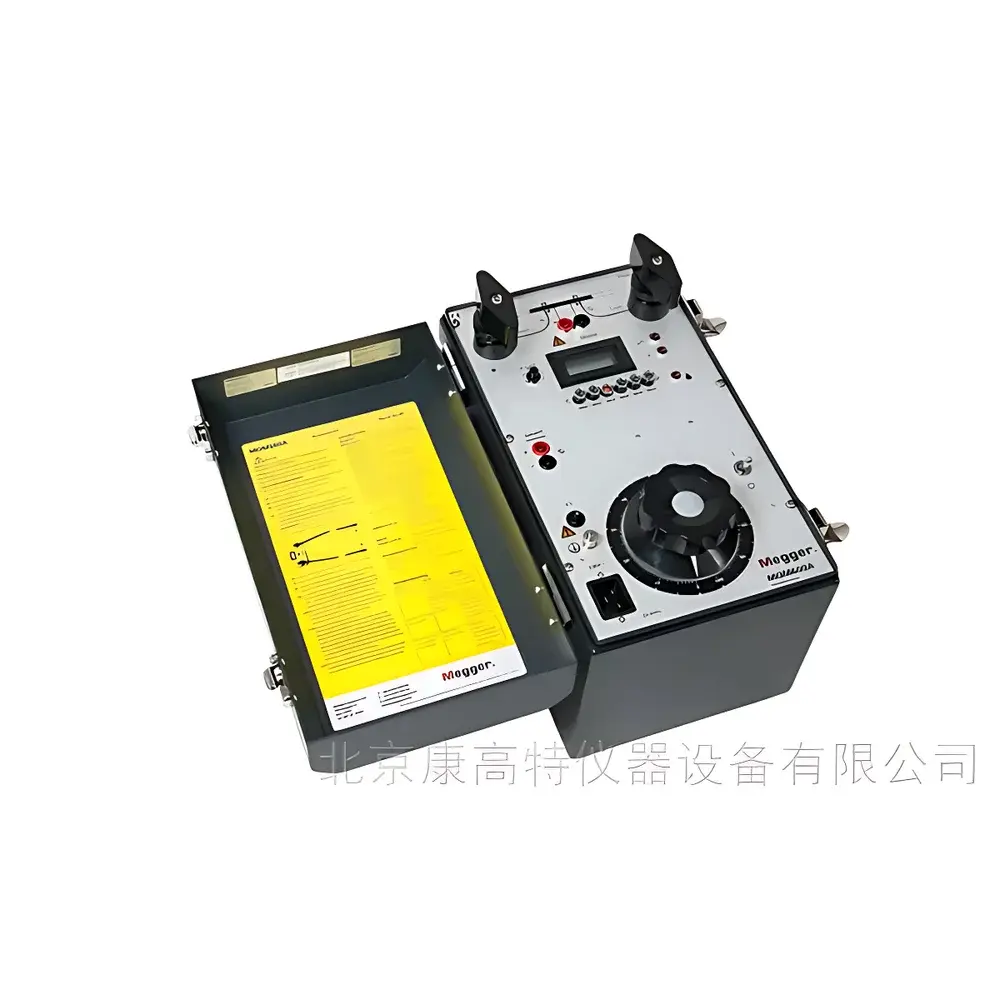

Megger MOM600A Micro-Ohmmeter
| Brand | Megger |
|---|---|
| Origin | USA |
| Model | MOM600A |
| Voltage Options | 115 V AC / 230 V AC |
| Output Current Range | 0–600 A DC |
| Resistance Measurement Range | 0–1999 µΩ |
| Resolution | 1 µΩ |
| Accuracy | ±1% of reading + 1 digit (at 100–600 A) |
| Operating Temperature (115 V) | 0°C to +50°C |
| Operating Temperature (230 V) | 0°C to +40°C |
| Storage Temperature | −40°C to +70°C |
| Humidity | 5–95% RH, non-condensing |
| Dimensions (Instrument) | 356 × 203 × 241 mm |
| Weight (115 V unit) | 25 kg |
| Weight (230 V unit) | 24.7 kg |
Overview
The Megger MOM600A Micro-Ohmmeter is a high-current, four-wire (Kelvin) low-resistance measurement instrument engineered for precision assessment of contact resistance in high-voltage power system components. It operates on the principle of constant-current DC injection (up to 600 A) combined with synchronous voltage sensing to eliminate lead and contact resistance errors—ensuring traceable, repeatable measurements down to 1 µΩ. Designed explicitly for field use in substations, switchyards, and industrial facilities, the MOM600A meets the demanding requirements of preventive maintenance programs mandated under IEEE C37.09, IEC 62271-1, and ANSI/NETA ATS standards. Its robust thermal management architecture enables stable output under variable ambient loads, while its dual-voltage design (115 V / 230 V AC) ensures operational flexibility across global utility grids without external transformers.
Key Features
- High-current DC source: Continuously adjustable 0–600 A output with programmable current hold timing (10 s to 15 min), optimized for thermal stability during contact resistance evaluation.
- Kelvin four-terminal measurement: Independent current injection and voltage sensing paths eliminate parasitic resistance from test leads—critical for sub-milliohm accuracy on busbar welds and circuit breaker contacts.
- Wide environmental tolerance: Certified operation from 0°C to +50°C (115 V model) and 0°C to +40°C (230 V model); storage range extends to −40°C to +70°C—validated for deployment in arctic substations and tropical coastal installations.
- Integrated safety architecture: Dual-stage overcurrent protection via miniature circuit breakers and thermal cutouts; automatic current ramp-down upon open-circuit detection prevents arc flash hazards during probe disconnection.
- Field-rugged mechanical design: IP54-rated enclosure; impact-resistant transport case (GD-00010) with custom foam inserts; reinforced 5 m, 50 mm² current cables (GA-05053) and shielded 2.5 mm² sense cables for noise immunity in EMI-heavy HV environments.
- Compliance-ready calibration infrastructure: Supplied with NIST-traceable calibration shunt (BB-90020, 600 A / 60 mV) and documentation supporting ISO/IEC 17025 audit trails and GLP/GMP data integrity requirements.
Sample Compatibility & Compliance
The MOM600A is validated for testing metallic interfaces where low-resistance continuity is mission-critical: circuit breaker main contacts (including vacuum and SF₆ types), isolator blade-to-stem joints, busbar weld seams, grounding grid connections, and cable lug terminations. It conforms to international standards including IEC 61000-4-30 (EMC immunity), EN 61010-1 (safety for electrical equipment), and UL 61010-1. Its measurement methodology aligns with ASTM D257 (surface resistivity) and IEEE Std 380-2017 (contact resistance test procedures). All firmware and hardware revisions are documented per FDA 21 CFR Part 11 requirements for electronic records and signatures when used in regulated utility asset management systems.
Software & Data Management
While the MOM600A operates as a standalone bench-and-field instrument, its analog voltage output (10 mV per 100 A, ±0.5%) and RS-232 interface (optional adapter) support integration into SCADA-linked condition monitoring platforms. Raw resistance values, test current, duration, and timestamp are retained in non-volatile memory for post-test review. Exported CSV logs include metadata required for NETA-certified reporting (e.g., “ATS Table 7.2 – Contact Resistance Limits”) and can be imported into Megger’s PowerDB™ analytics suite for trend analysis across fleet-wide assets. Audit trails record operator ID, calibration date, and configuration changes—fully compliant with ISO 9001:2015 clause 7.1.5.2 (Measurement traceability).
Applications
- Circuit breaker contact resistance verification: Quantifies degradation due to pitting, oxidation, or mechanical wear prior to thermal runaway—per IEEE C37.09 Clause 6.4.2.1.
- Busbar joint integrity assessment: Detects voids or incomplete fusion in exothermic welds by measuring resistance gradients along conductor length using sequential voltage probe placement.
- Substation grounding system validation: Measures inter-electrode resistance in multi-point grounding grids to verify compliance with IEEE Std 80-2013 step-and-touch potential limits.
- Generator and transformer terminal inspection: Verifies bolt-torque consistency and plating integrity at high-current feed-through points where micro-gaps induce localized heating.
- Pre-commissioning acceptance testing: Documents baseline contact resistance values for contractual handover under EN 50160 and IEC 60076-3 protocols.
FAQ
What is the maximum continuous test current the MOM600A can deliver at 230 V input?
At 230 V AC supply, the MOM600A delivers up to 600 A DC for 15 seconds at full load; sustained 300 A operation is rated for 2.5 minutes with ≥15-minute cooldown between cycles.
Does the MOM600A support automated pass/fail threshold reporting?
No—threshold evaluation is performed externally via recorded data; however, the instrument’s digital display includes user-configurable alarm indicators for pre-set resistance limits.
Can the MOM600A measure resistance on energized equipment?
No—operation requires de-energized, isolated, and grounded circuits per OSHA 1910.269 and NFPA 70E Article 130.5.
Is the 115 V version compatible with standard North American 120 V outlets?
Yes—the 115 V variant accepts 110–127 V AC, 50/60 Hz input with built-in voltage regulation; nominal 4370 VA draw requires dedicated 30 A circuit.
How is measurement uncertainty quantified for ISO/IEC 17025 accreditation?
Uncertainty budget includes contributions from current source stability (±0.25%), voltage measurement linearity (±0.15%), thermal EMF drift (<±0.5 µV), and calibration shunt tolerance (±0.05%)—total expanded uncertainty (k=2) is ≤±1.3% at 100 µΩ.
Related Products