
Mel-Build Dual-Tilt Probe TEM Sample Holder
| Brand | Mel-Build |
|---|---|
| Origin | Japan |
| Manufacturer Type | Authorized Distributor |
| Origin Category | Imported |
| Model | Dual-Tilt Probe TEM Sample Holder |
| Pricing | Available Upon Request |
Overview
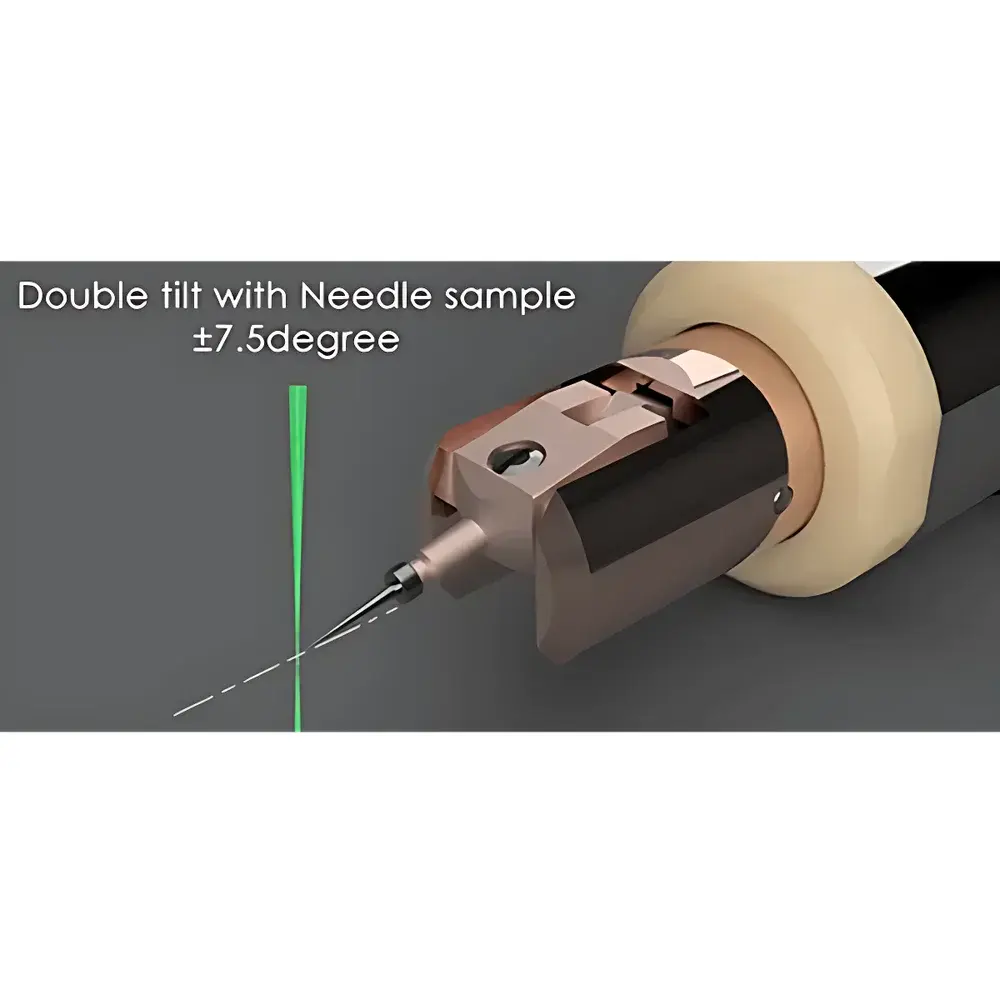
The Mel-Build Dual-Tilt Probe TEM Sample Holder is a precision-engineered mechanical specimen holder designed for high-resolution and analytical transmission electron microscopy (TEM) applications requiring controlled, independent angular manipulation of needle-type specimens. Unlike conventional single-tilt or goniometer-based holders, this dual-tilt configuration enables simultaneous and decoupled rotation about two orthogonal axes—typically designated as α (tilt) and β (precession or azimuthal tilt)—while maintaining the probe tip precisely at the optical axis intersection point throughout the full angular range. This geometric constraint ensures minimal image shift and optimal beam-specimen interaction stability during acquisition sequences such as electron tomography, in situ heating/cooling experiments, or nanomechanical probing. The holder is fully compatible with standard JEOL and Thermo Fisher (formerly FEI) TEM column interfaces, including 3.5 mm and 4.0 mm aperture-compatible stubs, and adheres to ISO 16812:2020 dimensional specifications for TEM sample holders.
Key Features
- True dual-axis mechanical tilt mechanism with independent α and β rotation controls, enabling full 3D orientation control of needle-shaped specimens
- Optimized kinematic design ensuring sub-micron tip centering retention (< ±0.3 µm deviation from optical axis) across the entire tilt range (±30° α, ±30° β typical)
- High-stiffness stainless steel and titanium alloy construction for thermal and mechanical stability under high-vacuum conditions (≤1×10⁻⁷ Pa)
- Integrated electrical feedthroughs (optional) supporting in situ electrical biasing or signal readout during TEM observation
- Compatible with focused ion beam (FIB)-prepared needle specimens mounted on Omniprobe-style or custom micro-manipulator pins
- Designed for use in ultra-high-resolution (UHR) TEM modes, including Cs-corrected imaging and exit-wave reconstruction techniques
Sample Compatibility & Compliance
This holder accommodates needle-type specimens with diameters ranging from 5–20 µm and lengths up to 15 µm, commonly prepared via lift-out and in situ FIB thinning workflows. It supports both conductive (e.g., Pt-coated Si, Au/Pd tips) and insulating (e.g., SiO₂ nanowires, ceramic nanofibers) samples without charging artifacts when used with low-dose acquisition protocols. The mechanical interface conforms to JEOL JSM/ARM series and Thermo Fisher Titan/Themis TEM column mounting standards. All materials meet ASTM F899-22 requirements for vacuum-compatible alloys, and surface finish complies with ISO 14644-1 Class 5 cleanroom handling specifications. Documentation includes traceable calibration certificates for angular repeatability (±0.1° over 100 cycles) and vacuum outgassing test reports per ASTM E595-23.
Software & Data Management
While the holder itself is mechanically actuated, its operation integrates seamlessly with TEM platform software suites—including JEOL’s EMIP, Thermo Fisher’s Velox, and DigitalMicrograph (Gatan)—to enable synchronized tilt-series acquisition, automated alignment routines, and metadata tagging of angular position and stage coordinates. When used with tomography packages (e.g., IMOD, TomoJ, or SerialEM), the dual-tilt geometry allows for accurate projection angle assignment and missing-wedge compensation. Full audit trails—including operator ID, timestamp, tilt sequence log, and vacuum status—are preserved in accordance with GLP and FDA 21 CFR Part 11-compliant data management workflows where enabled by host system configuration.
Applications
- Electron tomography of nanostructured catalysts, battery electrode particles, and biological macromolecular complexes
- In situ nanomechanical testing using integrated piezoresistive or capacitive probes
- Atomic-scale characterization of grain boundaries and dislocation dynamics under controlled tilt
- FIB-TEM correlative workflow execution: site-specific lamella extraction, transfer, re-orientation, and final thinning
- Crystallographic phase mapping via precession electron diffraction (PED) across multiple zone axes
- Quantitative strain analysis using geometric phase analysis (GPA) on tilted crystalline domains
FAQ
Is this holder compatible with aberration-corrected TEM systems?
Yes—it maintains mechanical stability and optical centering performance under the stringent vibration and drift requirements of Cs- and Cc-corrected TEM columns.
Can it be used for cryo-TEM applications?
No—this is a room-temperature mechanical holder; cryo-capable variants with liquid nitrogen cooling circuits are available separately.
What is the maximum working distance from the pole piece gap?
Standard configuration provides 1.2 mm clearance; extended-length versions (up to 2.5 mm) are offered for high-tilt configurations in double-tilt stages.
Does it support electrical measurements during imaging?
Electrical feedthrough options (4-wire configuration, bandwidth up to 1 MHz) are available upon request and require custom pinout integration with the TEM stage controller.
How is angular calibration verified?
Each unit undergoes factory calibration using laser interferometric angular measurement and is supplied with a NIST-traceable certificate specifying hysteresis, repeatability, and zero-offset values for both tilt axes.





