
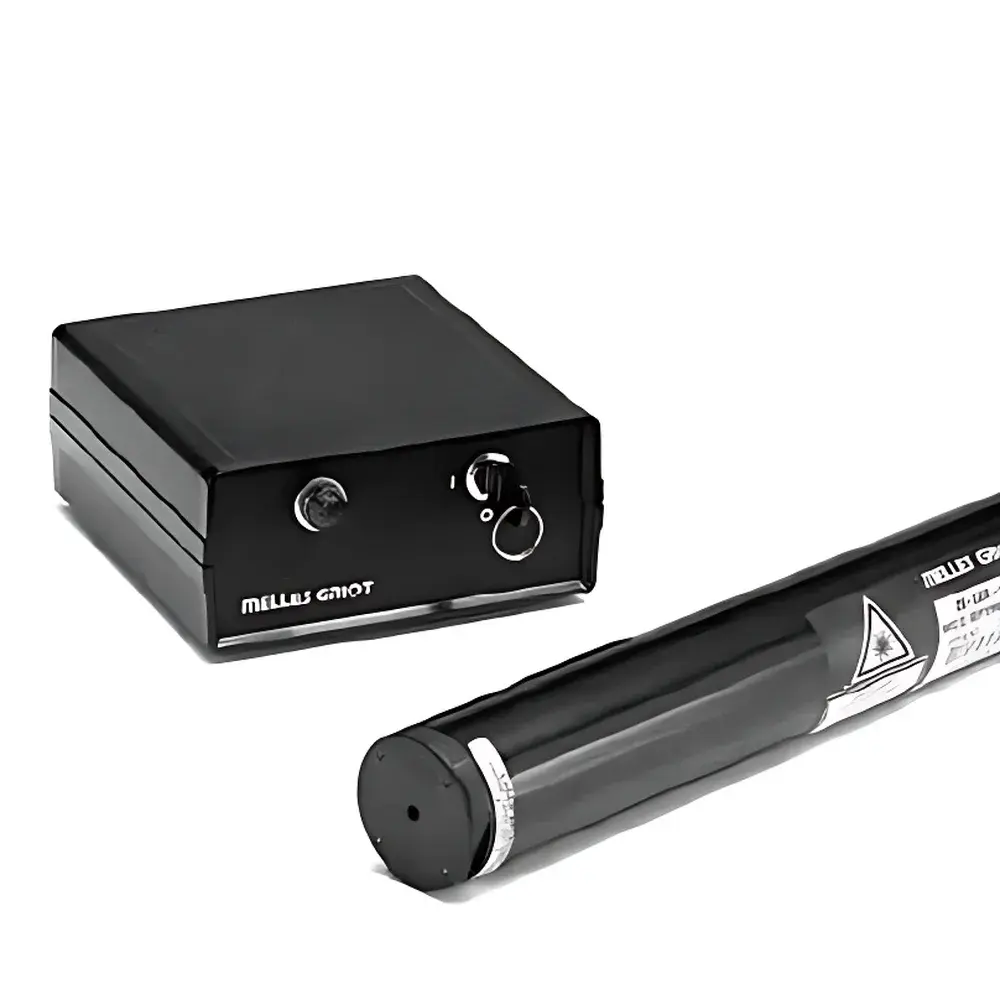
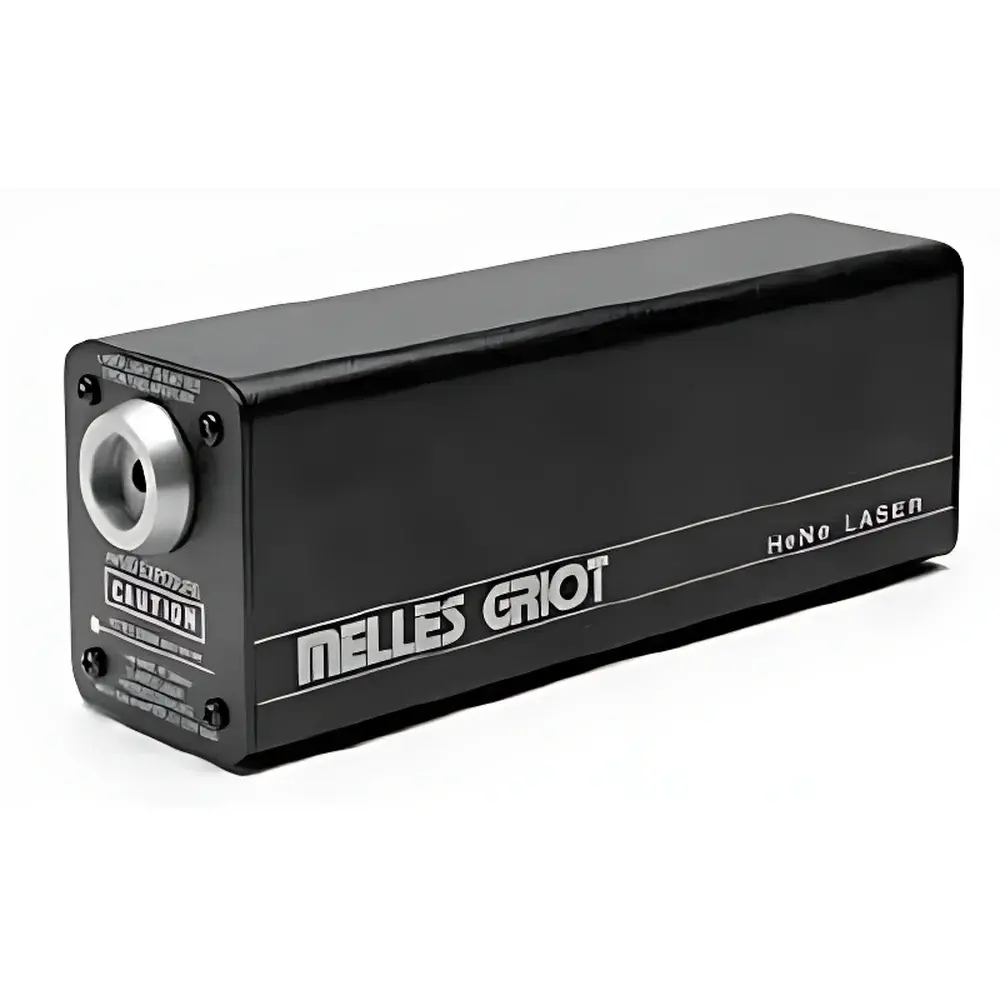
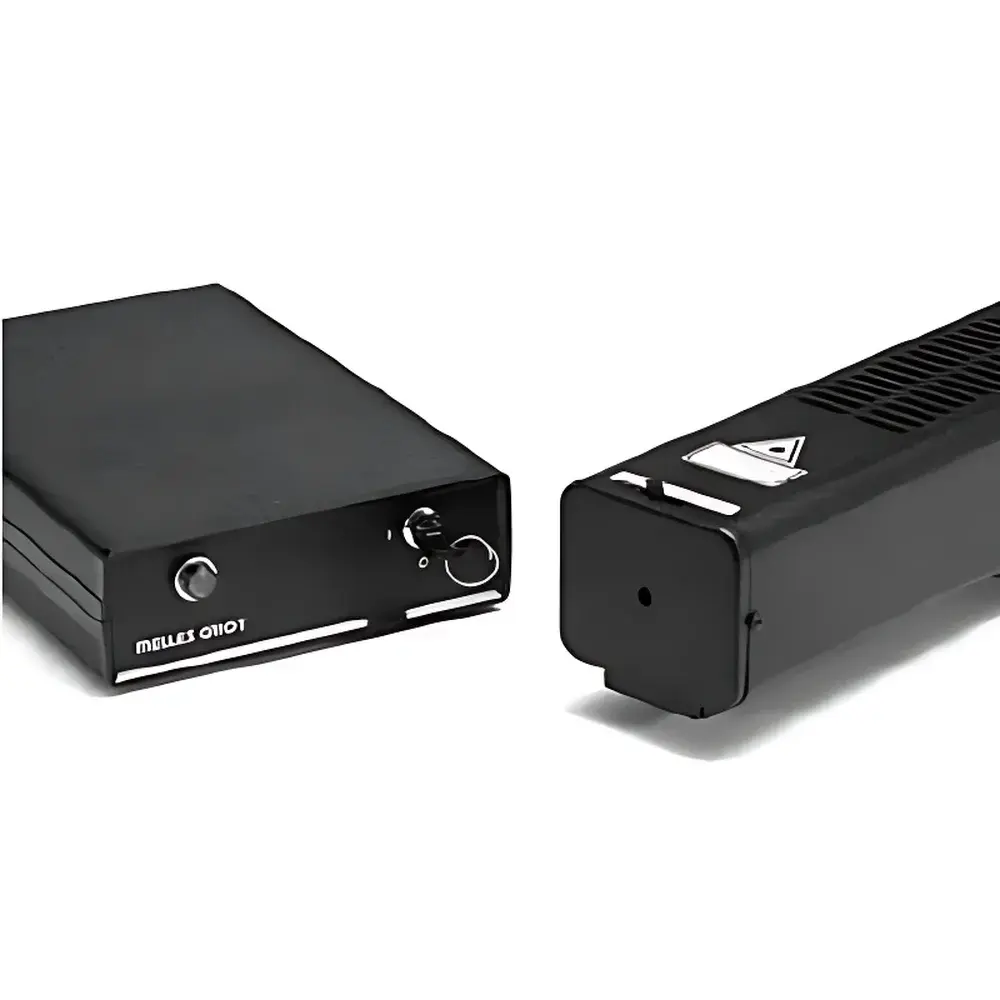
Melles Griot 25 LHR 213 Helium-Neon (HeNe) Laser
| Brand | Melles Griot |
|---|---|
| Origin | USA |
| Model | 25 LHR 213 |
| Wavelength | 632.8 nm |
| Output Power | 0.5 mW |
| Beam Diameter | 0.46 mm |
| Beam Divergence | 1.77 mrad |
| Polarization | Unpolarized |
| Transverse Mode | TEM₀₀ |
| Lifetime | >20,000 hours |
| Warm-up Time | <10 min to frequency lock |
| Frequency Stability | ±1.0 MHz (1 min), ±2.0 MHz (1 hr), ±3.0 MHz (8 hrs) |
| Power Stability | ±0.2% |
| Linewidth | <1.5 GHz |
| Coherence Length | >20 cm |
Overview
The Melles Griot 25 LHR 213 is a high-reliability, continuous-wave (CW) helium-neon (HeNe) gas laser engineered for precision optical alignment, interferometry, holography, and spectroscopic excitation. Operating at the fundamental helium-neon transition wavelength of 632.8 nm, this laser delivers stable, diffraction-limited TEM00 output with exceptional long-term power and frequency stability. Its sealed-plasma tube design ensures maintenance-free operation and a rated lifetime exceeding 20,000 hours—consistent with Melles Griot’s legacy in industrial and research-grade gas lasers. Unlike diode-based alternatives, the 25 LHR 213 leverages the inherent coherence, low noise, and narrow linewidth (<1.5 GHz) of stimulated emission in a low-gain HeNe plasma medium, making it suitable for applications demanding high spatial coherence and minimal mode-hopping.
Key Features
- Stable 632.8 nm red output with nominal power of 0.5 mW, optimized for low-noise alignment and reference beam generation
- TEM00 transverse mode profile ensuring Gaussian intensity distribution and predictable M² ≈ 1.0
- Beam diameter of 0.46 mm (1/e²) and full-angle divergence of 1.77 mrad, enabling precise collimation and efficient coupling into single-mode fibers or optical cavities
- Unpolarized output; optional linear polarization (>500:1 extinction ratio) available via integrated Brewster-angle windows or external polarizers
- Rapid thermal stabilization: achieves frequency lock within 10 minutes of cold start, minimizing downtime in production or lab environments
- Frequency stability of ±1.0 MHz over 1 minute, ±2.0 MHz over 1 hour, and ±3.0 MHz over 8 hours—critical for heterodyne interferometry and cavity ring-down spectroscopy
- Power stability better than ±0.2% RMS over 8 hours, verified under constant ambient temperature (23 ± 1°C) and line voltage regulation
- Robust mechanical architecture with rigid aluminum housing, threaded mounting base (¼”-20 UNC), and industry-standard electrical interface (15-pin D-sub)
Sample Compatibility & Compliance
The 25 LHR 213 is compatible with standard optical benches, kinematic mounts, and modular optomechanics—including Melles Griot’s own line of laser tube holders, beam expanders, and polarization rotators. Its low-power CW output meets Class 3R laser safety requirements per IEC 60825-1:2014 and ANSI Z136.1-2022, requiring only basic administrative controls (e.g., designated laser area signage, trained personnel). The device complies with FCC Part 15 Subpart B for unintentional radiators and carries CE marking for electromagnetic compatibility (EMC) and low-voltage directive (LVD) conformity. While not certified for medical or aerospace use out-of-the-box, its design adheres to ISO 10110-7 surface quality standards for internal optics and supports integration into systems requiring GLP/GMP traceability when paired with calibrated photodetectors and frequency monitors.
Software & Data Management
The 25 LHR 213 operates as a standalone analog source and does not include embedded firmware or digital control interfaces. However, its analog monitor photodiode output (BNC connector) provides real-time feedback for external power stabilization loops or data acquisition systems (e.g., National Instruments DAQ, Thorlabs Kinesis). For frequency-sensitive applications, users may integrate the laser with commercial wavemeters (e.g., HighFinesse WS7) or Pound–Drever–Hall locking electronics. All operational parameters—including warm-up behavior, power drift, and frequency tuning response—are documented in Melles Griot’s Technical Reference TR-25-LHR, which supports audit-ready recordkeeping in regulated environments. No proprietary software is required; configuration and diagnostics rely on standard oscilloscopes, multimeters, and spectrometers compliant with IEEE 1226-1998 (IEEE Standard for Software Life Cycle Processes).
Applications
- Optical alignment and straightness verification in coordinate measuring machines (CMMs) and semiconductor lithography tools
- Reference source for Michelson, Twyman–Green, and Mach–Zehnder interferometers used in surface metrology and thin-film thickness measurement
- Illumination source for holographic recording media (e.g., silver halide emulsions, photopolymer plates) requiring high spatial coherence
- Excitation source in Raman spectroscopy setups where narrow linewidth minimizes spectral broadening artifacts
- Calibration target for CCD/CMOS sensor linearity, pixel uniformity, and quantum efficiency mapping
- Teaching laboratories for demonstrating laser physics principles: population inversion, cavity resonance, transverse mode structure, and Doppler-broadened gain profiles
FAQ
What is the typical warm-up time to achieve frequency lock?
The 25 LHR 213 reaches stable frequency operation within 10 minutes of power-on under nominal laboratory conditions (23°C, 50% RH, stable AC line).
Does this laser require an external power supply?
Yes—it requires a dedicated Melles Griot 05-LPM series power supply (e.g., 05-LPM-825), delivering regulated DC current and thermistor-based tube temperature control.
Can the output be fiber-coupled?
Yes, using standard 633 nm-optimized single-mode fibers (e.g., Thorlabs 780HP) and adjustable kinematic fiber launchers; coupling efficiency typically exceeds 65% with proper mode-matching optics.
Is the beam astigmatically corrected?
No—the 25 LHR 213 emits a naturally symmetric TEM00 beam; no internal astigmatism correction is applied, consistent with ISO 11146-1 beam propagation specifications.
What is the expected lifetime under continuous operation?
Rated minimum lifetime is 20,000 hours at 25°C ambient temperature and nominal drive current; actual service life often exceeds 30,000 hours in vibration-isolated, dust-controlled environments.




