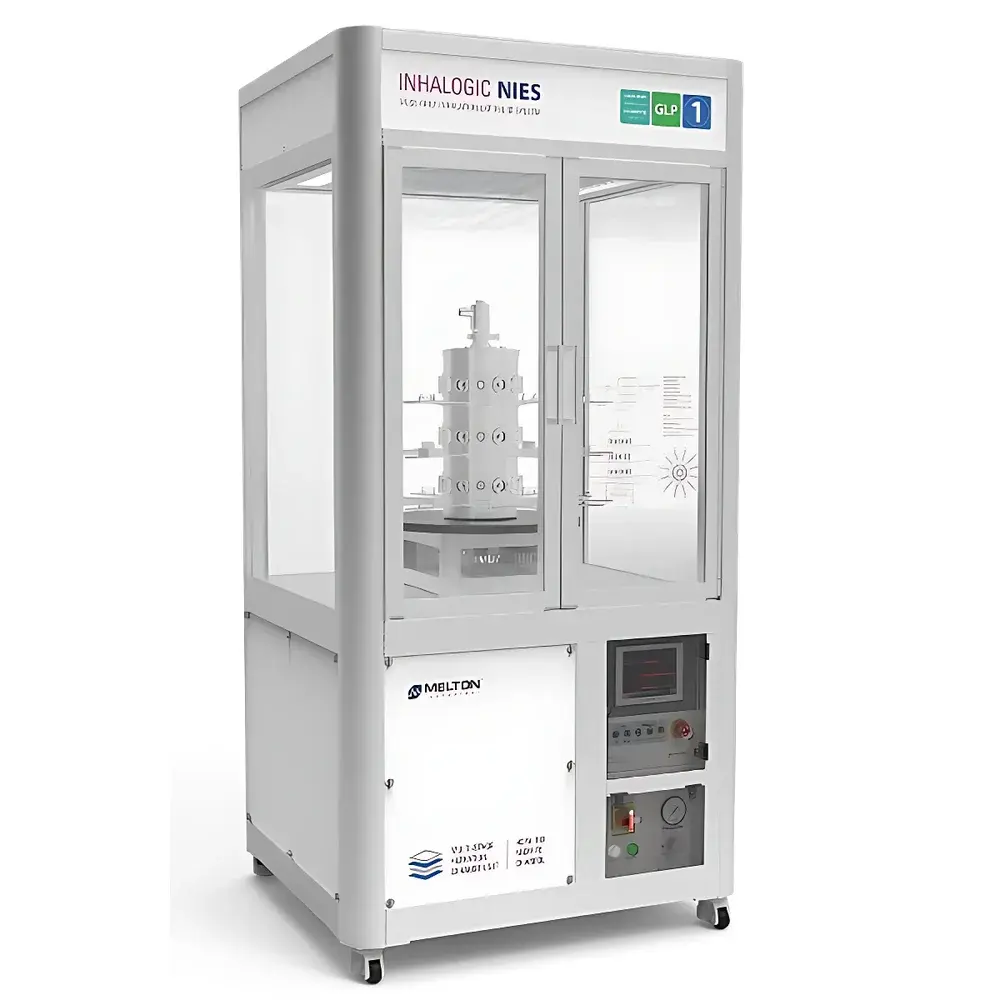
Melton Lab INHALOGIC NIES-GLP Nose-Only Inhalation Exposure System
| Brand | Melton Lab |
|---|---|
| Origin | Shanghai, China |
| Manufacturer Type | Direct Manufacturer |
| Country of Origin | China |
| Model | INHALOGIC NIES-GLP |
| Pricing | Upon Request |
Overview
The Melton Lab INHALOGIC NIES-GLP is a nose-only inhalation exposure system engineered for regulatory-compliant toxicological and pharmacological studies in rodents. It operates on the principle of controlled aerosol generation and precise spatial distribution of test atmospheres within a calibrated exposure chamber array. Unlike whole-body exposure systems, this design ensures that animals inhale only via the nasal orifice—mimicking human respiratory deposition patterns while eliminating dermal or oral contamination pathways. The system integrates an aerosol generator (capable of nebulizing liquids or dispersing dry powders), a conditioned dilution and mixing manifold, a laminar-flow distribution plenum, and individually sealed animal ports with real-time airflow monitoring. All critical process parameters—including aerosol concentration, particle size distribution (via optional cascade impactor integration), temperature, relative humidity, and oxygen saturation—are continuously logged and traceable to support GLP audit readiness.
Key Features
- Compact footprint: ≤1 m² floor space—optimized for high-density laboratory environments without compromising operational integrity.
- Dual-mode control architecture: Local touchscreen HMI with embedded logic controller + Ethernet-enabled remote operation via secure TCP/IP interface for centralized lab management.
- Scalable capacity: Configurable for up to 60 simultaneous nose-only exposures across modular rodent restraint tubes (standardized for mice or rats).
- Networked scalability: Supports synchronization and coordinated dosing across up to 200 units via centralized exposure management software—enabling multi-site or large-cohort studies.
- Reliability engineering: Designed for >10,000 hours mean time between failures (MTBF), validated through accelerated life-cycle testing per IEC 60601-1 and ISO 13485-aligned manufacturing protocols.
- GLP-ready validation package: Includes IQ/OQ/PQ documentation templates, electronic audit trail (21 CFR Part 11 compliant), calibration certificates traceable to NIST standards, and full system qualification reports.
Sample Compatibility & Compliance
The INHALOGIC NIES-GLP accommodates a broad spectrum of test materials: aqueous and organic solvent-based liquids (e.g., pharmaceutical suspensions, pesticide formulations), dry powder aerosols (e.g., nanomaterials, respirable APIs), and volatile organic compounds (VOCs) when paired with vaporization modules. Particle size output is tunable from <1 µm to >10 µm MMAD (mass median aerodynamic diameter), enabling targeted deposition in upper airways or alveolar regions. The system meets ASTM E1772–22 (Standard Guide for Inhalation Toxicology Studies), OECD Test Guideline 412 (Subacute Inhalation Toxicity), and ISO 10993-12 (Biological Evaluation of Medical Devices—Sample Preparation and Reference Materials). All stainless-steel wetted surfaces comply with USP Class VI biocompatibility requirements; airflow paths are certified leak-tight per ISO 13845.
Software & Data Management
The integrated ExposureControl™ v3.2 software provides real-time visualization of chamber dynamics—including mass concentration (µg/L), flow rate (L/min), temperature (±0.3°C), RH (±2% RH), and O₂ (±0.1%). Raw sensor data is stored in HDF5 format with SHA-256 checksum integrity verification. Audit trails record all user actions, parameter changes, and alarm events with immutable timestamps. Export modules support CSV, XML, and SDTM-compliant datasets for direct ingestion into toxicology databases (e.g., ToxIQ, Provantis). Optional integration with LIMS platforms is available via HL7 v2.5 or RESTful API endpoints. Electronic signatures adhere to FDA 21 CFR Part 11 requirements, including role-based access control and dual-authorization workflows for critical operations.
Applications
- Regulatory safety assessment of inhaled therapeutics (e.g., dry powder inhalers, nebulized biologics) per ICH S5(R3) and FDA guidance.
- Environmental health research on airborne pollutants (PM₂.₅, diesel exhaust particles, wildfire smoke condensates).
- Respiratory disease modeling—including COPD, asthma, and pulmonary fibrosis—using pathogen-free or genetically modified rodent strains.
- Tobacco and nicotine product evaluation under WHO Framework Convention on Tobacco Control (FCTC) Annex II reporting standards.
- Occupational exposure limit (OEL) derivation for industrial nanomaterials and specialty chemicals.
FAQ
Does the system support both liquid and dry powder aerosol generation?
Yes—via interchangeable aerosol modules: a vibrating mesh nebulizer for liquids and a fluidized bed disperser for dry powders, both validated per USP & Ph. Eur. aerosol performance criteria.
Is particle size distribution characterization included?
The base configuration includes real-time optical particle sizer (OPS) integration; cascade impactor compatibility (e.g., Andersen or Next Generation Impactor) is available as an optional add-on with gravimetric and chemical analysis support.
Can exposure parameters be adjusted dynamically during a study?
Yes—concentration ramping, pulse-dosing, and intermittent exposure profiles can be programmed with sub-minute temporal resolution and synchronized across multiple chambers.
What validation documentation is provided for GLP studies?
Full IQ/OQ/PQ protocols and reports, instrument calibration records, software validation summary (including 21 CFR Part 11 compliance evidence), and system suitability test data are delivered pre-installation.
Is custom engineering support available for non-standard species or exposure durations?
Yes—Melton Lab’s R&D team offers bespoke modifications, including primate-compatible restraint interfaces, chronic 90-day exposure configurations, and specialized gas-phase co-exposure modules (e.g., O₃ + PM₂.₅).
Related Products