
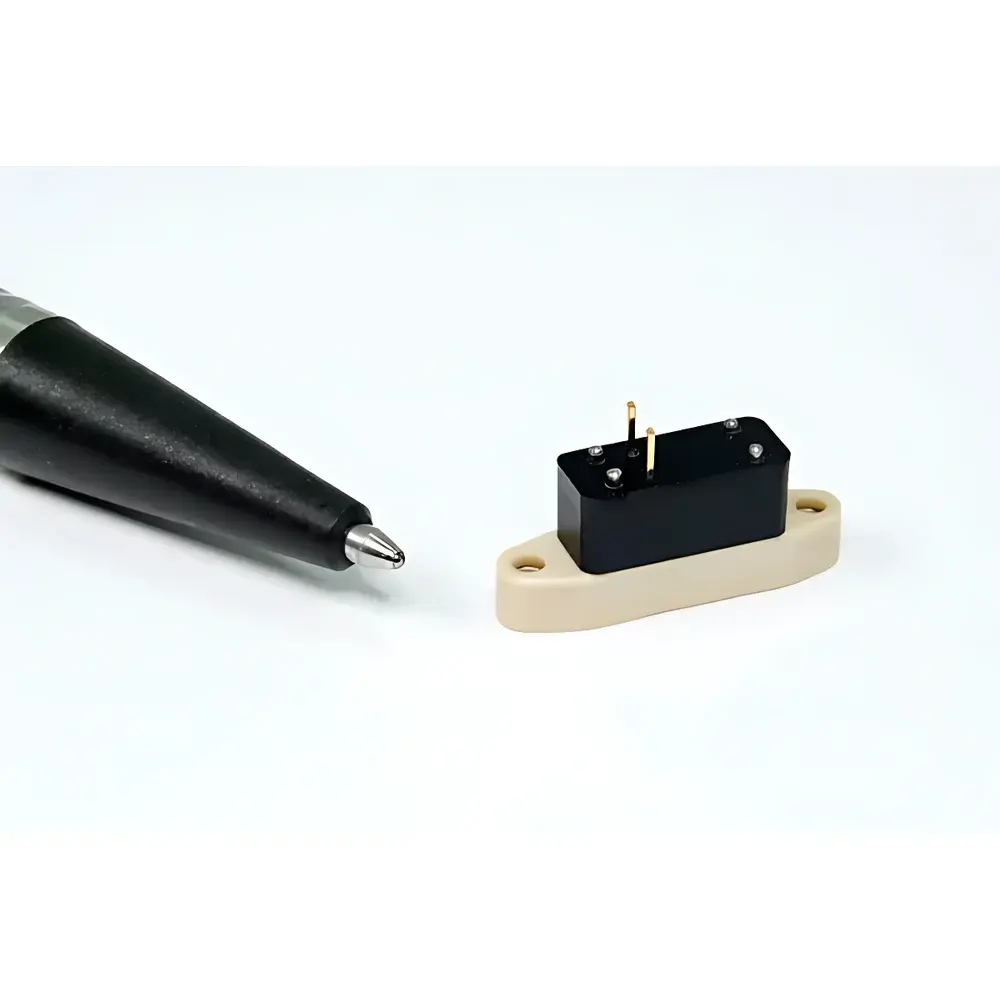
Memetis OC Series Microfluidic Normally-Open/Normally-Closed Switching Valve
| Brand | Memetis |
|---|---|
| Origin | Germany |
| Model | OC |
| Valve Type | Thermally Actuated SMA-Based Micro-Switching Valve |
| Housing Material | PEEK (Biocompatible) |
| Actuation Principle | Shape Memory Alloy (NiTi) |
| Operating Temperature Range | 25–80 °C (typ.) |
| Fluid Compatibility | Aqueous solutions, buffers, cell media, low-viscosity organic solvents |
| Max. Operating Pressure | 3 bar (43.5 psi) |
| Response Time | < 300 ms (ON/OFF) |
| Lifetime | > 10⁶ cycles |
| Electrical Interface | 2-pin flexible PCB or solder pads |
| Dimensions | Ø 2.4 mm × 3.2 mm (tip-sized footprint) |
Overview
The Memetis OC Series is a thermally actuated, solid-state microfluidic switching valve engineered for high-integration microsystems requiring reliable, low-power, and biocompatible fluid routing. Unlike solenoid- or piezoelectric-based valves, the OC valve employs a precisely patterned Nickel-Titanium (NiTi) shape memory alloy (SMA) actuator embedded within a monolithic PEEK housing. Upon resistive heating (typically 80–120 mW), the SMA element undergoes a reversible martensite-to-austenite phase transition, inducing mechanical deflection that opens or closes the microchannel—depending on its normally-open (NO) or normally-closed (NC) configuration. This principle enables fail-safe operation without continuous power draw, zero electromagnetic interference, and silent, wear-free actuation. Designed specifically for lab-on-chip (LoC), organ-on-chip, and point-of-care diagnostic platforms, the OC valve delivers deterministic flow control in sub-milliliter-scale fluidic networks where space, power budget, and biological compatibility are critical constraints.
Key Features
- Ultra-compact form factor: 2.4 mm diameter × 3.2 mm height—compatible with standard microfluidic cartridge footprints and printed circuit board (PCB) mounting.
- Biocompatible PEEK housing certified per ISO 10993-5 (cytotoxicity) and USP Class VI, suitable for direct contact with primary cells, stem cells, and therapeutic reagents.
- No moving seals or elastomers: Eliminates particle shedding, swelling, or degradation in aggressive aqueous or buffered environments.
- Low-power actuation: Typical hold current < 15 mA at 5 V; compatible with battery-powered and portable instrumentation.
- High cycle endurance: Validated for > 1 million switching cycles under 2 bar hydraulic load and physiological temperature conditions.
- Integrated thermal management: Optimized heat dissipation path minimizes cross-talk in multi-valve arrays and ensures stable duty-cycle performance.
Sample Compatibility & Compliance
The OC valve is validated for use with deionized water, PBS, DMEM/F12, HEPES-buffered saline, and common cell culture media (e.g., RPMI-1640). It exhibits no measurable leachables per ASTM D4292-22 (extraction testing) and maintains integrity after autoclaving at 121 °C for 20 minutes (single-cycle validation). While not intended for sterile filtration, the valve complies with ISO 8536-4 (infusion equipment) dimensional and functional benchmarks. For regulated applications—including IVD development and GLP-compliant assay automation—the device supports traceable batch documentation and can be integrated into systems designed to meet FDA 21 CFR Part 11 requirements when paired with compliant control firmware and audit-log-enabled drivers.
Software & Data Management
The OC valve operates as a digital peripheral: binary TTL or CMOS-level signals (3.3/5 V logic) trigger state transitions via external driver circuits (e.g., dedicated SMA controllers or custom FPGA modules). Memetis provides reference schematics and timing diagrams for seamless integration into LabVIEW, Python (PySerial/PyVISA), or MATLAB-based control stacks. When deployed in multi-valve configurations, synchronization is achieved via hardware-triggered pulse trains with jitter < 10 µs. Full system-level data logging—including valve state timestamps, drive voltage/current waveforms, and ambient temperature—is supported through standardized SPI/I²C telemetry interfaces. All firmware and driver libraries adhere to MISRA C guidelines and include built-in error-checking for open-circuit, short-circuit, and thermal runaway detection.
Applications
- Automated sample preparation workflows: Precise reagent metering, buffer exchange, and wash-step sequencing in nucleic acid extraction and immunoassay cartridges.
- Dynamic perfusion control in 3D cell culture platforms: Real-time modulation of shear stress and nutrient delivery across endothelialized microvessels or tumor spheroid arrays.
- Fluorescence-activated cell sorting (FACS)-adjacent microfluidics: High-speed gating of labeled cell populations prior to detection or collection.
- High-throughput drug screening: Parallelized dosing of compound libraries into multi-well microplates via integrated microvalve manifolds.
- OEM instrument integration: Embedded fluidic routing in portable diagnostics, wearable biosensors, and closed-loop therapeutic delivery devices.
FAQ
What is the maximum recommended operating pressure for the OC valve?
The OC valve is rated for continuous operation up to 3 bar (43.5 psi) at 25 °C. Pressure rating decreases linearly to 2 bar at 80 °C due to PEEK’s thermal modulus reduction.
Can the OC valve be sterilized using ethylene oxide (EtO)?
Yes—EtO sterilization (250–500 mg/L, 2–6 h exposure) has been verified without affecting SMA actuation performance or PEEK structural integrity.
Is custom port geometry or tubing interface available?
Standard configurations feature 100 µm internal channel diameter with integrated 1/32″ OD microbore ferrule ports. Custom inlet/outlet geometries (e.g., flat-seal, chip-bonding pads) are available under NDA for OEM volume orders.
Does the valve require active cooling between actuation cycles?
No. The PEEK housing provides sufficient passive thermal decay (< 2 s to baseline) for typical duty cycles ≤ 10 Hz. Forced-air cooling is unnecessary in most benchtop or cartridge-based implementations.
How is lifetime defined and validated?
Lifetime is measured as the number of full ON/OFF cycles until actuation force drops by >15% relative to initial specification, tested per ISO 11784-2 under constant 2 bar backpressure and 37 °C ambient.



