
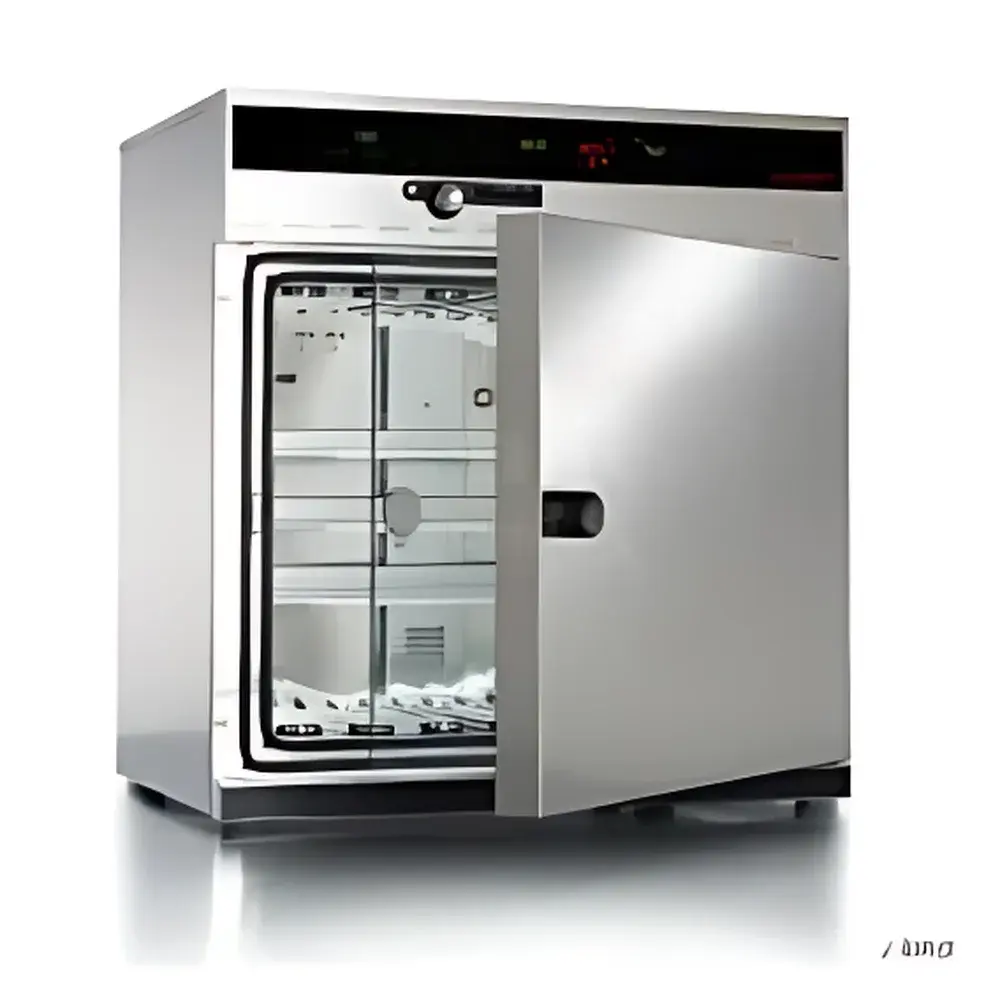
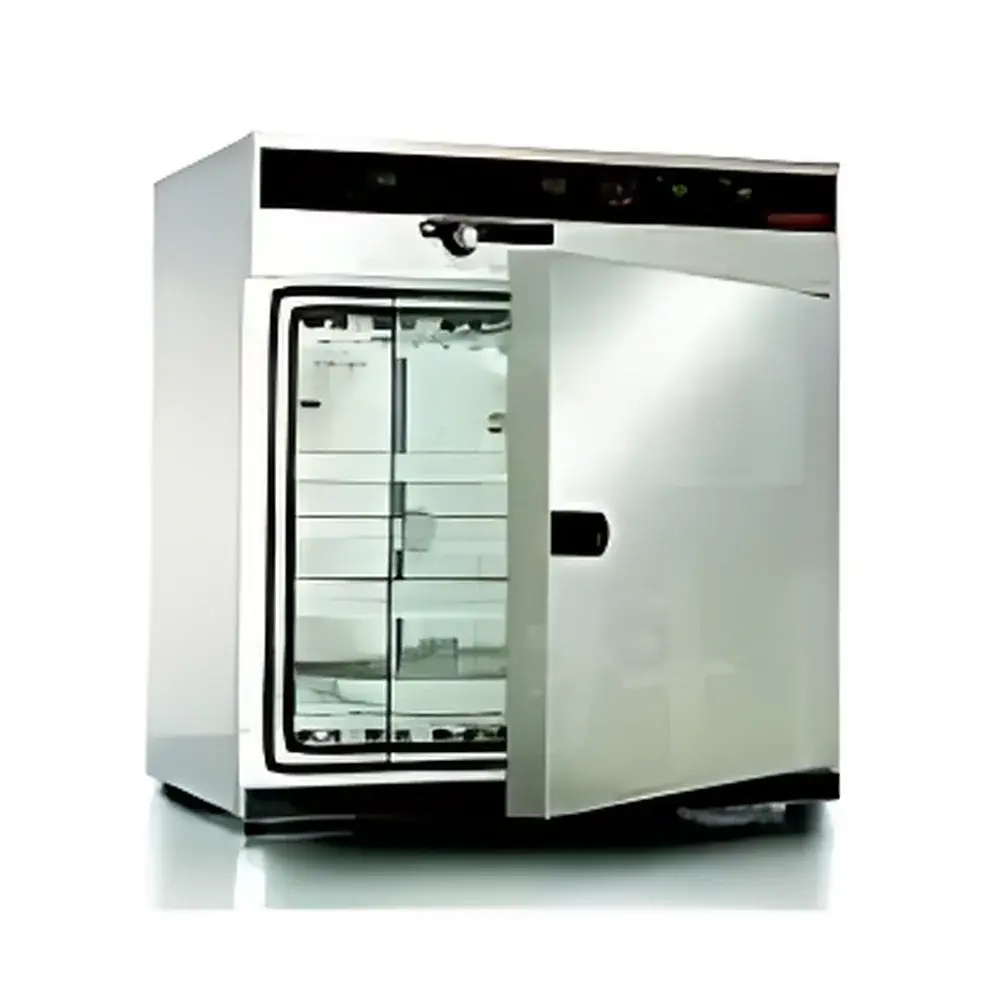
MEMMERT HCP108 Temperature and Humidity Controlled Chamber
| Brand | MEMMERT |
|---|---|
| Origin | Germany |
| Model | HCP108 |
| Instrument Type | Upright Environmental Test Chamber |
| Internal Volume | ~108 L |
| Interior Dimensions (W×H×D) | 560 × 480 × 400 mm |
| Exterior Dimensions (W×H×D) | 710 × 778 × 550 mm |
| Interior Material | Electropolished Stainless Steel (Deep-Drawn) |
| Exterior Material | Stainless Steel Body with Galvanized Steel Rear Panel |
| Temperature Range (without humidity control) | 20–160 °C |
| Temperature Range (with humidity control) | 20–90 °C |
| Temperature Uniformity (per DIN 12880 at 50 °C) | ≤ ±0.3 °C |
| Temperature Stability (per DIN 12880 at 50 °C) | ≤ ±0.15 °C |
| Humidity Range | 20–95 % RH (capacitive sensor, sterilizable) |
| Humidity Control | Microprocessor-driven steam generation + desiccant-based dehumidification |
| Power Supply | 230 V / 50–60 Hz |
| Max. Power Consumption | ~1000 W |
| Net Weight | ~70 kg |
| Gross Weight | ~78 kg |
| Standard Accessories | 2 stainless steel sliding shelves (556 × 361 mm), factory calibration certificate (60 °C center point), Celsius 2005 software (standard), internal memory card (1024 KB ring buffer, ~3 months @ 1-min interval) |
Overview
The MEMMERT HCP108 is a precision-engineered upright temperature and humidity controlled chamber designed for applications demanding strict environmental reproducibility under GLP, GMP, and ISO 17025-compliant laboratory conditions. It operates on a dual-control principle: temperature regulation via Peltier-assisted heating and high-accuracy Pt100 A-class 4-wire resistance thermometry, and humidity control via integrated steam generation (using distilled water supplied externally) coupled with active desiccant-based dehumidification. The chamber’s laminar, non-turbulent air circulation system—fully validated per DIN 12880—ensures uniform thermal distribution and minimal stratification across the entire working volume (~108 L). Its electropolished stainless-steel interior (deep-drawn, seamless construction) supports routine sterilization cycles up to 160 °C, while its hermetically sealed door assembly with optional inner glass panel minimizes moisture loss and condensation risk during dynamic RH transitions.
Key Features
- Triple-layer thermal safety architecture: mechanical temperature limiter (TB), electronically adjustable temperature watchdog (TWW), and MEMMERT’s proprietary ASF (Automatic Safety Function) — a redundant dual-Pt100 fault-detection system enabling continuous operation even during single-sensor failure.
- Microprocessor-based fuzzy logic control for simultaneous, independent regulation of temperature and relative humidity — achieving setpoint convergence within minutes and recovery times <15 min after door opening (per DIN 12880 test protocol).
- Integrated diagnostics and alarm management: audible and visual alerts for over/under-temperature, over/under-humidity, prolonged door opening, empty water reservoir, and sensor faults — all logged with timestamps in the internal ring buffer.
- Calibration traceability: onboard 3-point temperature and 2-point humidity (20 % RH / 90 % RH) calibration capability without external PC; optional factory-issued calibration certificates (e.g., at 50 °C / 80 % RH) available per DIN 12900-1.
- Expandable sensor architecture: up to three additional user-positionable Pt100 probes (optional) for localized monitoring of sample or load temperature — data synchronized with main chamber readings and stored in the same memory structure.
Sample Compatibility & Compliance
The HCP108 accommodates a wide range of sample formats—including Petri dishes, vials, stability trays, and custom fixtures—within its 560 × 480 × 400 mm workspace. Its electropolished stainless-steel chamber and autoclavable humidity sensor meet stringent requirements for pharmaceutical stability testing (ICH Q1A–Q5C), accelerated aging studies (ASTM D3574, ISO 188), and material conditioning prior to mechanical testing (ISO 291, ASTM D618). All critical control and logging functions comply with FDA 21 CFR Part 11 when used with the optional Celsius FDA Edition software (Q2/Q3), providing full audit trail, electronic signature support, and secure user access control via MEMMERTCard XL or RFID ID cards (V9). The chamber’s design conforms to DIN 12880 (laboratory incubators), DIN EN 60529 (IP20 ingress protection), and IEC 61000-6-3 (EMC emissions).
Software & Data Management
Standard inclusion of the Celsius 2005 software enables remote programming, real-time monitoring, and export of time-stamped temperature/humidity logs in CSV or PDF format. For regulated environments, the optional Celsius FDA Edition (Q2) delivers full 21 CFR Part 11 compliance: role-based user authentication, immutable electronic records, biometric or PKI-supported digital signatures, and automatic generation of IQ/OQ documentation packages (Z5, Q1, Q2). Data integrity is reinforced by an internal 1024 KB circular memory buffer—capable of storing >120,000 timestamped entries (temperature, humidity, alarms, setpoints) at 1-minute intervals for approximately 3 months. Connectivity options include RS232 (standard), RS485 (V1), Ethernet (W6), and USB (W2/W4), with printer support via parallel interface (PCL3-compatible) or USB-converted HP Deskjet integration (W1).
Applications
The HCP108 serves as a foundational platform for method development and validation in pharmaceutical quality control labs (e.g., stability-indicating assay conditioning, excipient compatibility studies), polymer and composite material preconditioning (ISO 291, ASTM D618), seed germination and plant physiology research, electronics component reliability testing (JEDEC JESD22-A119), and long-term storage simulation of diagnostic reagents. Its precise 20–90 °C / 20–95 % RH operating envelope supports ICH Zone IVb climatic condition modeling, while its 160 °C dry-heat sterilization cycle (STERICard-enabled, 4-hour duration) ensures microbiological decontamination of chamber internals without compromising sensor integrity.
FAQ
What standards does the HCP108 comply with for temperature uniformity and stability?
It meets DIN 12880 requirements: temperature uniformity ≤ ±0.3 °C and stability ≤ ±0.15 °C at 50 °C, verified at the chamber center.
Can the HCP108 be integrated into a multi-chamber network?
Yes — via optional RS485 (V1) or Ethernet (W6) interfaces, supporting centralized control and synchronized logging across up to 16 units using Celsius FDA Edition.
Is humidity sensor calibration traceable to national standards?
Factory calibration certificates (e.g., at 50 °C / 80 % RH) are available per DIN 12900-1; field recalibration uses NIST-traceable reference hygrometers and saturated salt solutions.
How is data integrity ensured during power interruption?
The internal memory retains all logged data in non-volatile flash storage; power-loss events are timestamped and flagged in the event log.
Does the HCP108 support automated validation protocols?
Yes — IQ/OQ documentation templates (Z5, Q1, Q2) and optional 27-point temperature/humidity mapping services (Q1) are provided to support GxP validation workflows.



