
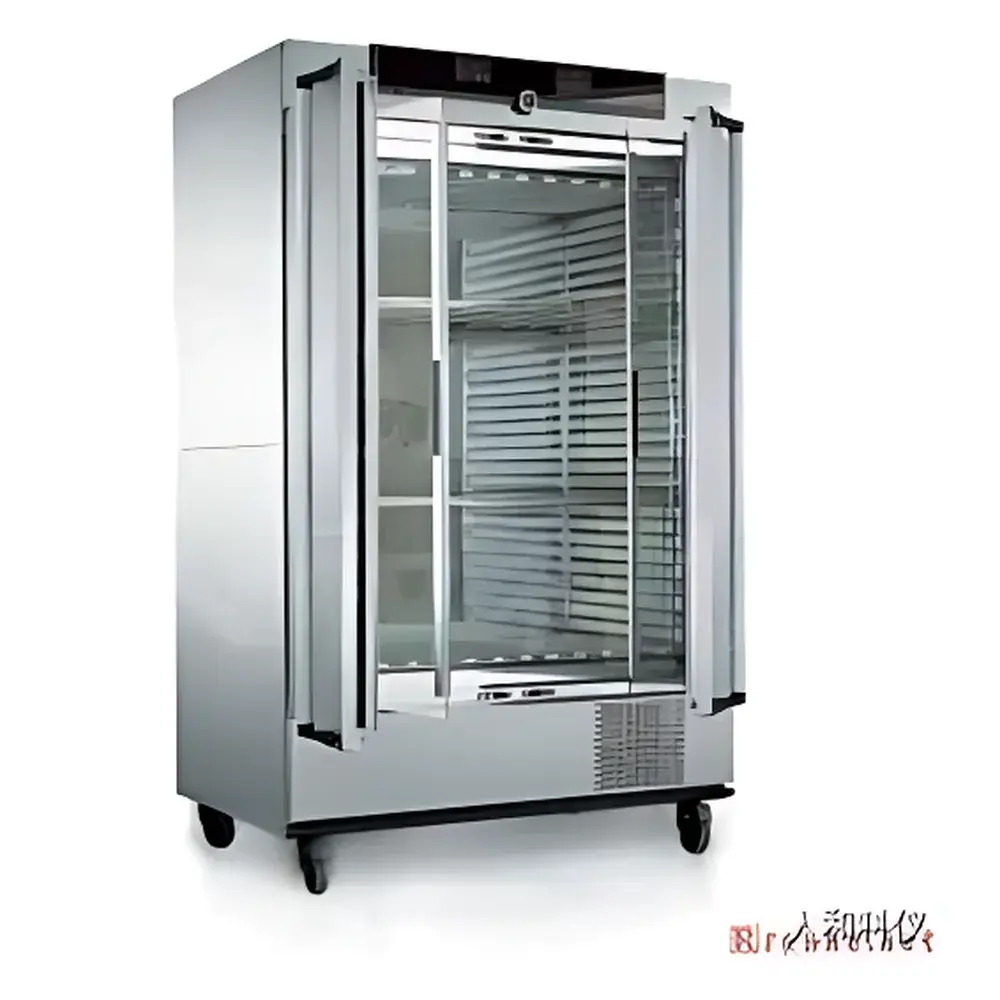
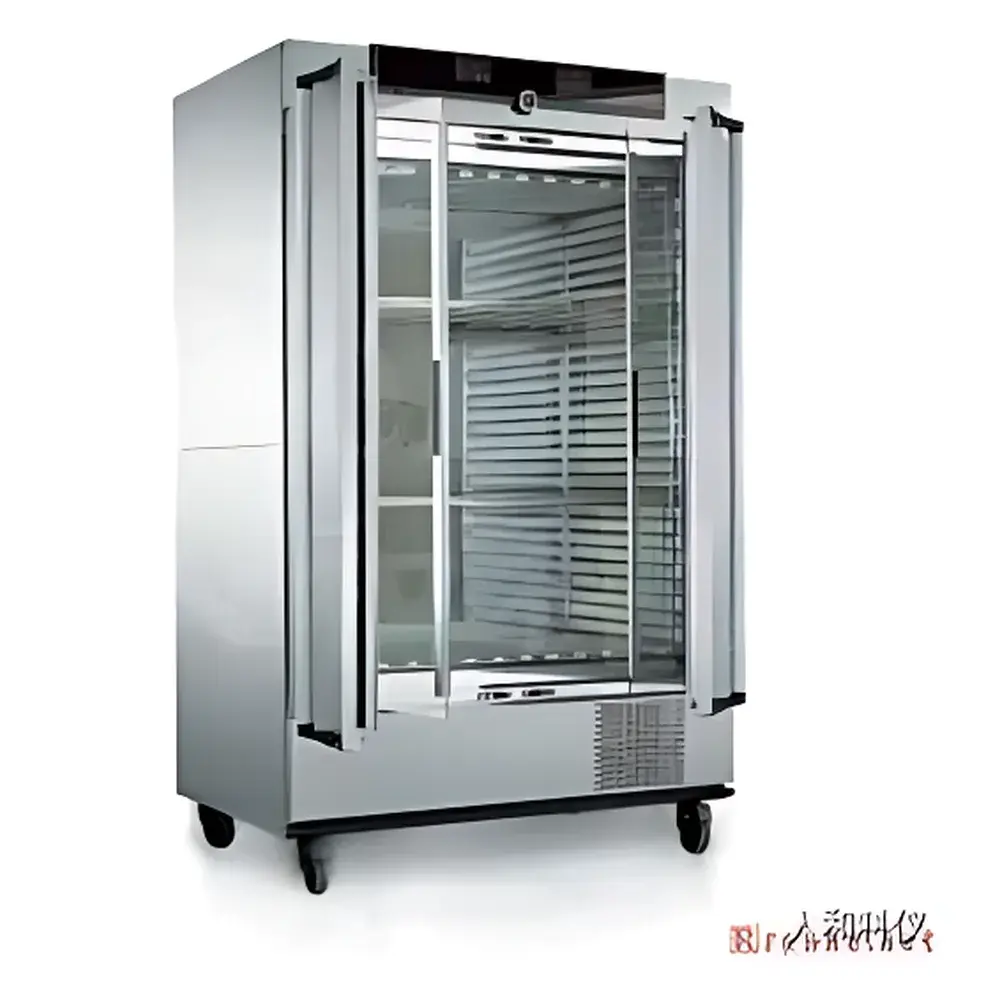
MEMMERT ICP700 Precision Cooled Biochemical Incubator
| Brand | MEMMERT |
|---|---|
| Origin | Germany |
| Model | ICP700 |
| Temperature Range | 0–60 °C |
| Internal Volume | 416 L |
| Chamber Dimensions (W×H×D) | 1040 × 800 × 500 mm |
| External Dimensions (W×H×D) | 1198 × 1495 × 656 mm |
| Cooling Agent | R134a (CFC-/HCFC-free) |
| Control System | Microprocessor-based Fuzzy Logic Controller |
| Programmability | Up to 9-segment temperature/time profiles |
| Interface | RS232 (standard), optional RS485 |
| Software Support | Celsius 2000 (free) |
| Memory Card | MEMoryCard XL compatible |
| Safety | Dual independent overtemperature protection (TWW Class 3.1 + TB Class 1) |
| Heating/Cooling Architecture | Separated top-mounted heating unit and bottom-mounted refrigeration unit |
| Humidity Preservation | Fully enclosed air-jacket heating system |
Overview
The MEMMERT ICP700 is a high-precision, actively cooled biochemical incubator engineered for demanding life science applications requiring stable, programmable thermal environments across a wide operational range of 0 °C to +60 °C. Unlike conventional incubators relying on combined heating/cooling circuits or forced-air convection with inherent humidity loss, the ICP700 employs a fully enclosed air-jacket heating system paired with a dedicated bottom-mounted refrigeration module using environmentally compliant R134a refrigerant. This segregated thermal architecture enables true independent control of heating and cooling functions—eliminating thermal overshoot (“overshoot” or “temperature冲温”) through integral curve-based ramping logic. The result is exceptional temperature uniformity (±0.3 °C at 37 °C, typical), minimal spatial gradient (<0.5 °C across chamber volume), and zero evaporative moisture loss from samples—critical for long-term microbial, cell, or enzymatic assays where hydration integrity directly impacts viability and reproducibility.
Key Features
- Fully enclosed air-jacket heating system ensures homogeneous temperature distribution without desiccation of cultures or media
- Independent top-mounted heating and bottom-mounted refrigeration units enable precise, non-simultaneous thermal actuation—reducing energy consumption and mechanical wear
- Dual redundant overtemperature protection: TWW (Class 3.1) provides active fuzzy-logic correction upon deviation; TB (Class 1) delivers fail-safe power cutoff if chamber exceeds structural thermal limits
- Automatic defrost cycle operates without interrupting incubation—enabling unattended operation over extended periods (e.g., weekends, holidays)
- Up to nine programmable temperature/time segments per profile, supporting complex diurnal cycles, ramp-and-soak protocols, and delayed start/hold functions
- Optional internal fluorescent lighting supports photoperiod-controlled experiments—transforming the ICP700 into a configurable light incubator
- Stainless steel interior and exterior construction (AISI 304) ensures corrosion resistance, cleanability, and compliance with GLP laboratory hygiene standards
Sample Compatibility & Compliance
The ICP700 accommodates standard microbiological and cell culture formats—including Petri dishes, multiwell plates, flasks (up to T225), and roller bottles—within its 416 L stainless steel chamber. Its humidity-preserving design eliminates the need for supplemental water pans or humidification modules, reducing contamination risk and maintenance overhead. The unit complies with IEC 61010-1 (safety requirements for laboratory equipment), EN 60335-1 (household and similar electrical appliances), and carries CE marking for the European Economic Area. While not inherently classified as medical device or GMP-grade hardware, its dual overtemperature safeguards, audit-ready parameter logging (via Celsius 2000), and MEMoryCard XL traceability support alignment with ISO 17025-accredited testing laboratories and FDA-regulated QC workflows under 21 CFR Part 11 when configured with electronic signature and audit trail enabled.
Software & Data Management
Control and monitoring are facilitated via the free Celsius 2000 software suite, enabling remote configuration, real-time data visualization, and export of time-stamped temperature logs in CSV format. Up to six ICP-series incubators can be daisy-chained via RS485 (standard RS232 port upgradeable at no cost) for centralized fleet management. Critical process parameters—including setpoint, actual temperature, fan speed, defrost status, and alarm history—are stored internally and retrievable via serial interface. Optional MEMoryCard XL cards allow offline program storage and transfer—ensuring protocol fidelity across shifts, operators, or experimental repetitions without manual re-entry. All card-based profiles retain timestamped version history and support field-editable parameters, facilitating method validation and change control documentation.
Applications
The ICP700 serves as a core platform for temperature-sensitive biological workflows including aerobic/anaerobic bacterial cultivation (e.g., E. coli, Bacillus spp.), fungal growth studies, enzyme activity assays, seed germination trials, shelf-life stability testing of biologics, and low-temperature fermentation optimization. Its 0 °C lower limit supports cold-adapted organism research and chilling-phase synchronization in cell cycle studies. The programmable light option extends utility to circadian rhythm investigations, photomorphogenesis in plant tissue culture, and algal biomass production. Academic, pharmaceutical, and contract research organizations rely on the ICP700 for reproducible, auditable incubation conditions aligned with ASTM E1709 (Standard Practice for Laboratory Incubators) and ISO 20387 (Biobanking requirements).
FAQ
What refrigerant does the ICP700 use, and why is it environmentally significant?
The ICP700 uses R134a—a zero-ozone-depletion-potential (ODP = 0), low-global-warming-potential (GWP = 1430) hydrofluorocarbon refrigerant—fully compliant with EU F-Gas Regulation (No. 517/2014) and aligned with MEMMERT’s commitment to sustainable instrumentation design.
Can the ICP700 maintain humidity without external water sources?
Yes. Its sealed air-jacket heating system prevents convective drying; internal relative humidity remains stable at ambient levels (typically 40–60% RH at 37 °C) without auxiliary humidifiers or water reservoirs.
How does the dual overtemperature protection (TWW + TB) function during power recovery?
Upon restart after outage, the TWW controller resumes active regulation immediately; TB remains dormant until physical temperature exceeds its fixed hardware threshold—ensuring layered safety even during firmware initialization.
Is Celsius 2000 validated for 21 CFR Part 11 compliance?
Celsius 2000 itself is not formally validated, but when deployed with institutional SOPs covering user access control, electronic signatures, and audit trail review, it supports Part 11–aligned data integrity practices in regulated environments.
What is the maximum ramp rate achievable in programmable profiles?
Ramp rates are dynamically optimized by the fuzzy logic controller to minimize overshoot; typical linear ramps range from 0.1 °C/min to 3.0 °C/min depending on setpoint delta and ambient conditions—configurable per segment within the 9-step profile framework.
Related Products




